


What would art look like if it were to please the greatest number of people?
That was the question posed in 1994 when two artists, in a project sponsored by the Dia Center for the Arts, hired a polling company to survey popular artistic tastes in various countries. The artists used the results to render paintings with a glorious, literal deadpan. The American "most wanted" painting, for example, was a serene landscape, predominantly blue with large swaths of lake and sky, featuring people relaxing, some deer and George Washington.

"Very silly," is how the artists seemed to characterize the byproducts of culture-by-consensus.

Two weeks ago, a similarly reductive process appeared to creep into the music industry. A Barcelona-based artificial intelligence company, PolyphonicHMI, claimed that its Hit Song Science software, designed to identify the "optimal mathematical patterns" of hit songs, had helped produce one: the dance-pop diva Anastacia's Left Outside Alone. The song is currently climbing the charts in Germany and the Netherlands. It will be released in the US in April.
Executives at PolyphonicHMI and Anastacia's representatives are now at odds over whether the software was actually used to produce the single. A producer who worked with the song acknowledges that he uses Hit Song Science, but declined to say whether he had used it for this single. Anastacia's publicists say the software was not used, and in an e-mail message stated that the singer "does not use, support, rely or believe that this is a technology that should figure into any type of creative process now or in the future."

Whether the technology was used for this particular single or not, sources at several labels, both major and indie, confirmed that the product was being used. But their requested anonymity and the vehemence of protest from Anastacia's camp are telling. Since Hit Song Science was announced publicly a little more than a year ago, it has been decried as everything from snake oil to the death of innovation in music -- largely because, like the Dia art project, it seems to reduce both the creative process and popular tastes to mere equations.
PolyphonicHMI says the software uses a proprietary algorithm to weigh and analyze more than 20 components of a recording (tempo, rhythm, cadence, etc.) and assign each song a value. The company used that algorithm to analyze 50 years of music released in the US -- album tracks and singles, pop, jazz and classical, totaling 3.5 million tracks -- and graphed each song in multiple dimensions to create "the music universe." Plotted, it resembles a picture of a far-away galaxy, millions of song-specks floating in cosmic precision, presenting the illusion of randomness.
The company then zeroed in on songs that had charted in the top 30 of Billboard Magazine's "Hot 100" chart during the past five years. What emerged was roughly 55 groupings of songs, or "hit song clusters," as PolyphonicHMI calls them. The promise of the technology is that the hit potential of any new song can be determined by breaking it down against this algorithmic array. The closer it lands to the center of a hit cluster, the more likely it is to be a successful song.
Sacrilege, some would say. But pop music is a commodity. For decades it has been focus-grouped and carefully marketed. Performers are guided through the song-writing process by Grammy-winning producers, and industry gurus have long relied on formulas of one sort or another in an attempt to anticipate -- even guarantee -- the success of a new song or a new artist. The digital age has simply opened up a new area for analysis: the bits and bytes that make up a song's digital DNA.
The idea is similar to one pursued by French author Georges Polti, whose 1921 work, The Thirty-six Dramatic Situations, sought to identify the basic patterns into which any successful literary situation fits -- from No.1, "Supplication," to No.36, "Loss of Loved Ones." (Hit Song Science, not surprisingly, refers to Polti on its Web site.)
"But I hear myself accused, with much violence," Polti wrote, "of an intent to `kill imagination!'"
And yet 80 years later, Terry Rossio, who won an Academy Award as co-author of the animated film Shrek, reports on his Web site, wordplayer.com, that he used Polti when stuck on a project: "It was enormously helpful for us to consult this list and recognize we were doing No. 6B1, `A Monarch Overthrown,' combined with No. 23, `Necessity of Sacrificing Loved Ones.' It helped crystallize our thinking, and led to the plot we are now writing."
But few would attribute the success of any Hollywood film to Polti's formulas, and according to McCready, the same is true of Hit Song Science. For a song to be a hit, it has to sound like a hit and it has to be marketed like a hit -- but it also needs those magic patterns. The first two require costly guesswork. The third, if they could be discovered, might simply minimize the costs.
The British neurologist Dr. Semir Zeki is at the forefront of a field he calls neuroaesthetics and others call blasphemy. In the soon-to-be-released anthology Neurology of the Arts: Painting, Music, Literature (Imperial College Press), he contributes a chapter in which he argues that art is a human activity with a biological basis, ultimately dependent upon -- and obedient to -- the laws of the brain.
He was unfamiliar with Hit Song Science, but supported, in theory, the idea that an algorithm could define popular art. "The brain's capacities are not infinite," he said on the phone from London. "There is a finite number of ways in which music can appeal. You get rid of discordant sounds at the beginning. You keep getting rid of the obvious and soon you're down to a reasonable number."
Zeki, too, has heard people get quite upset at his work's implication. "People say, `You cannot reduce beauty to a formula!'" he says. "But the fact that I know what happens in my brain when I see something as beautiful will not stop me from seeing it as so."
Or as McCready puts it, "We didn't invent these patterns. We just point them out."

In late October of 1873 the government of Japan decided against sending a military expedition to Korea to force that nation to open trade relations. Across the government supporters of the expedition resigned immediately. The spectacle of revolt by disaffected samurai began to loom over Japanese politics. In January of 1874 disaffected samurai attacked a senior minister in Tokyo. A month later, a group of pro-Korea expedition and anti-foreign elements from Saga prefecture in Kyushu revolted, driven in part by high food prices stemming from poor harvests. Their leader, according to Edward Drea’s classic Japan’s Imperial Army, was a samurai

Approaching her mid-30s, Xiong Yidan reckons that most of her friends are on to their second or even third babies. But Xiong has more than a dozen. There is Lucky, the street dog from Bangkok who jumped into a taxi with her and never left. There is Sophie and Ben, sibling geese, who honk from morning to night. Boop and Pan, both goats, are romantically involved. Dumpling the hedgehog enjoys a belly rub from time to time. The list goes on. Xiong nurtures her brood from her 8,000 square meter farm in Chiang Dao, a mountainous district in northern Thailand’s

Located down a sideroad in old Wanhua District (萬華區), Waley Art (水谷藝術) has an established reputation for curating some of the more provocative indie art exhibitions in Taipei. And this month is no exception. Beyond the innocuous facade of a shophouse, the full three stories of the gallery space (including the basement) have been taken over by photographs, installation videos and abstract images courtesy of two creatives who hail from the opposite ends of the earth, Taiwan’s Hsu Yi-ting (許懿婷) and Germany’s Benjamin Janzen. “In 2019, I had an art residency in Europe,” Hsu says. “I met Benjamin in the lobby
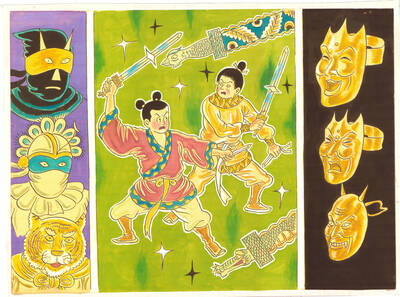
April 22 to April 28 The true identity of the mastermind behind the Demon Gang (魔鬼黨) was undoubtedly on the minds of countless schoolchildren in late 1958. In the days leading up to the big reveal, more than 10,000 guesses were sent to Ta Hwa Publishing Co (大華文化社) for a chance to win prizes. The smash success of the comic series Great Battle Against the Demon Gang (大戰魔鬼黨) came as a surprise to author Yeh Hung-chia (葉宏甲), who had long given up on his dream after being jailed for 10 months in 1947 over political cartoons. Protagonist


 RSS
RSS