


The Vietnamese lawsuit against over 30 US makers of the defoliants used in the Vietnam war is not necessarily the best approach to get compensation, according to the president of a US veterans' organization.
Bobby Muller was in Vietnam to sign an unprecedented Memorandum of Understanding between the Vietnam Veterans of America Foundation (VVAF) and Vietnam's Ministry of Defense.
The long-negotiated MOU marks the first phase of a project to map and assess the impact of unexploded ordnance and landmines that still litter large parts of Vietnam.
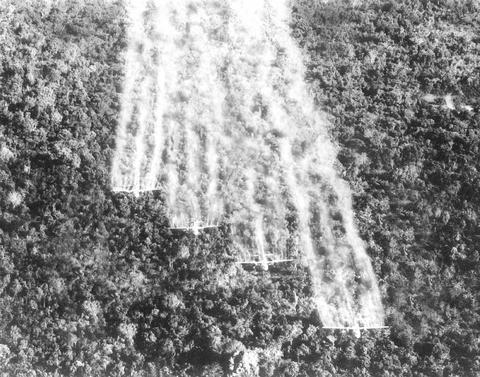
PHOTO: DPA
Muller says a better option would be to avoid legal battles over responsibility, and lobby for increased aid.
"There are extraordinary human needs here and let's expand the programs of assistance to address those needs [to see] whether or not in fact at the end of the day they are directly connected to the exposure to dioxin," Muller said.
In late January, the Vietnam Association for Victims of Agent Orange, on behalf of six plaintiffs, filed a lawsuit in a federal court in New York against 38 US companies involved in the manufacture and supply of herbicides used during the Vietnam war.
The vice-president of the Vietnamese organization, Professor Nguyen Trong Nhan, says that as many as 4.8 million people lived in areas where defoliants were sprayed, and that today, there are over 3 million sufferers from afflictions related to dioxin exposure.
The herbicide was used to destroy food crops, clear areas around military bases and predominantly to deprive northern Vietnamese forces of jungle cover.
Dioxin from Agent Orange has been linked by researchers to a range of diseases and afflictions including cancer and birth defects.
On behalf of American war veterans seeking compensation from Agent Orange manufacturers, Bobby Muller was involved in a lawsuit against the chemical companies in the 1980s, but the lengthy and expensive legal battle meant the US veterans ended up settling out of court.
"Basically for the convenience of both sides, because it was a very costly and time consuming effort, and the chemical companies kept getting beat up in the press, we just came to terms on an out of court settlement for relatively small amounts of money," Muller told journalists in Hanoi.
The settlement involved government compensation for people suffering from various ailments, but no official acceptance that Agent Orange was the cause.
"While we received medical care and compensation, the government still will not say these various problems were because of dioxin exposure. What we have is the vagueness of `We are not saying yes, and we are not going to say no, but we are going to give you the benefit of the doubt,'" Muller said.
The Vietnamese organization is optimistic about their chances of winning compensation, and says that should any of the cases be successful, then thousands more will follow, the vice president of the Vietnamese victim's association recently said.
"According to our US lawyers, if any of the victims win, other victims with the same afflictions will win. We don't have to wait for victory there are many preparations for other law suits in the US," said Professor Nguyen Trong Nhan, vice-president of the recently formed Vietnam Association for Victims of Agent Orange.
The lawsuit may not be the best option Muller said.
"What I have said here in Vietnam over the last week, is that I don't think the legal strategy, which really did not serve us 20-something years ago, will serve today any better," Muller said.
When taking on the companies which made the herbicides, trying to provide irrefutable scientific proof that the dioxins caused illnesses and birth defects is not an easy task.
"I think we have all seen over time, you can argue the science of both sides of anything that gets put on the table," Muller said.
Professor Nhan says that the lawsuit has been taken as a last resort, and that because some US veterans already get compensation, providing irrefutable proof of dioxin-linked illness should not fall on Vietnam.
"In the US among veterans there are victims of Agent Orange so why do we have to carry out scientific research to say that there are Vietnamese victims of Agent Orange," the former health minister said.
The US can easily afford to compensate Vietnamese people who have been affected by dioxin exposure, the professor believes.
"Americans have no lack of money. They send soldiers to many parts of the world, they spend a lot of money on that," he said.
In late October of 1873 the government of Japan decided against sending a military expedition to Korea to force that nation to open trade relations. Across the government supporters of the expedition resigned immediately. The spectacle of revolt by disaffected samurai began to loom over Japanese politics. In January of 1874 disaffected samurai attacked a senior minister in Tokyo. A month later, a group of pro-Korea expedition and anti-foreign elements from Saga prefecture in Kyushu revolted, driven in part by high food prices stemming from poor harvests. Their leader, according to Edward Drea’s classic Japan’s Imperial Army, was a samurai

Approaching her mid-30s, Xiong Yidan reckons that most of her friends are on to their second or even third babies. But Xiong has more than a dozen. There is Lucky, the street dog from Bangkok who jumped into a taxi with her and never left. There is Sophie and Ben, sibling geese, who honk from morning to night. Boop and Pan, both goats, are romantically involved. Dumpling the hedgehog enjoys a belly rub from time to time. The list goes on. Xiong nurtures her brood from her 8,000 square meter farm in Chiang Dao, a mountainous district in northern Thailand’s

Located down a sideroad in old Wanhua District (萬華區), Waley Art (水谷藝術) has an established reputation for curating some of the more provocative indie art exhibitions in Taipei. And this month is no exception. Beyond the innocuous facade of a shophouse, the full three stories of the gallery space (including the basement) have been taken over by photographs, installation videos and abstract images courtesy of two creatives who hail from the opposite ends of the earth, Taiwan’s Hsu Yi-ting (許懿婷) and Germany’s Benjamin Janzen. “In 2019, I had an art residency in Europe,” Hsu says. “I met Benjamin in the lobby

April 22 to April 28 The true identity of the mastermind behind the Demon Gang (魔鬼黨) was undoubtedly on the minds of countless schoolchildren in late 1958. In the days leading up to the big reveal, more than 10,000 guesses were sent to Ta Hwa Publishing Co (大華文化社) for a chance to win prizes. The smash success of the comic series Great Battle Against the Demon Gang (大戰魔鬼黨) came as a surprise to author Yeh Hung-chia (葉宏甲), who had long given up on his dream after being jailed for 10 months in 1947 over political cartoons. Protagonist


 RSS
RSS