


There was really nothing new in the Princess Diana audiotapes aired for the first time Thursday night on American television.
Most of it is familiar from Andrew Morton's 1992 best-selling book, Diana, Her True Story, which is based on the five hours of audiotapes.
But nearly seven years after Diana's violent death in a Parisian highway tunnel car crash, the prospect of actually hearing her voice tell of her depression and bulimia, royal family indifference and search for inner strength was a magnet that far out-trumped any of the modern-day propensity for stars and ordinary people to divulge their innermost feelings over the public airwaves.
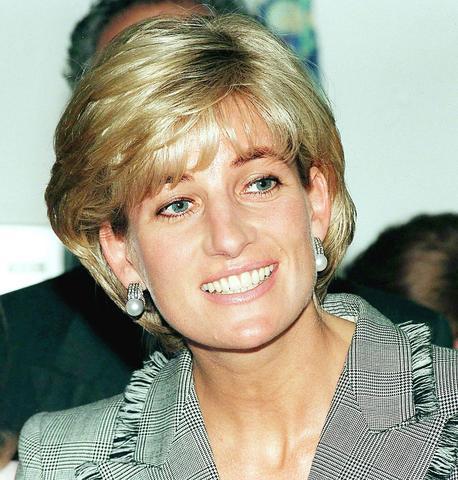
PHOTO: AFP
It was in fact a voice from the grave of an icon, a secret autobiography recorded under cloak-and-dagger conditions by a close friend, with her knowledge and approval but out of sight of the palace minders. NBC television, which acquired the tapes for an undisclosed amount, must be making a financial killing from the two-part broadcast.
And yes, the tapes revealed things about Diana that did not come across on the printed page.
Diana's sighs and giggles and matter-of-fact description of emotionally traumatic events, for example, don't appear in the book.
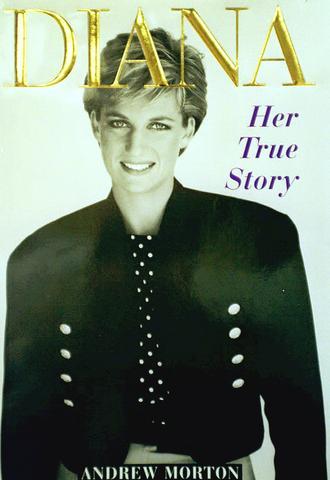
PHOTO: AP
She pours out her sadness as she talks about her pain and anguish at age 18, on the eve of her fairy-tale wedding to Prince Charles in 1981. She is desperately in love with the 30-year-old heir to the British throne, yet already aware there was another woman in his life.
She talks about gorging on food and throwing up before the event, already overwhelmed by the voracious public appetite for every detail of her existence. Photographers have been peeping into her apartment window, where she lived when she worked as a kindergarten teacher.
"My wedding day, I think that was the worst day of my life," Diana said.
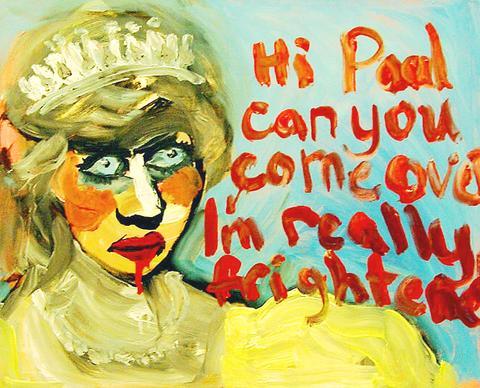
PHOTO: AP
"I said, I can't marry him, I can't do this. [But her family said] bad luck, doll, your face is already on the tea towel," Diana recalled in soft tones. "I knew I couldn't do anything about it."
In the book, Charles emerged as a callous cad who plucked Diana to satisfy the royal family's demands that he finally marry and produce some offspring, while continuing his dalliance with the married Camilla Parker Bowles.
Diana later was granted a divorce, in 1996, and she became strong enough to make her fight against bulimia public and to tackle social issues such as land mine clearance in Africa and AIDS.
But Diana actually giggles when asked about the days after the all-out royal wedding in Westminster Cathedral.
"The wedding night was strange. I just had tremendous hope in me, which was slashed by day two," she says. She takes a breath, pauses to giggle, then continues to describe how Charles lugged along eight novels by his philosopher-hero, Laurens van der Post, to read during their honeymoon.
Diana was "exhausted" by her honeymoon turmoil, but for all the "wrong reasons," she said, laughing again. Her husband preferred the books to the marriage bed.
On the trip, which took them to Egypt, she recalls how Charles wore cufflinks with two entwined Cs engraved on them for Charles and Camilla as the royal couple prepared to meet with president Anwar Sadat. She challenged him, and asked him if they were a present from Camilla. He said yes.
"And boy, did we have a row," she says, with a kick of pride in her voice.
When the book appeared, the royal family could not figure out how Morton had managed to interview Diana, whose every step was controlled by the palace. In fact, Diana had approached Morton through a mutual friend, James Colthurst.
After seeing her suffer for 10 years in the marriage, Colthurst knew that Diana was bursting with unhappiness at Charles, and suggested the book idea.
"She was going to say something anyway," Colthurst said. "She had the choice of doing it as a loose cannon, or controlling the outcome, which she was able to do with the book."
Diana, Colthurst, Morton and the publisher conspired from the beginning to keep things secret, and the three men often met clandestinely in out of the way places to cloak their project.
Colthurst, who carried questions written out by Morton and a tape recorder on his visits to her home at Kensington Palace, said Diana needed little encouragement to talk. He sometimes rode a bike on the visits, and had easy access to the quarters as an old friend.
"She just started at the beginning of her childhood and kept going," Colthurst said in the NBC interview. "And it was obviously something she wanted to do."
Morton said Diana had been "conned" and "lured" into the marriage and the palace.
In Thursday's program, Diana also talks about the birth of William and Harry in 1981 and 1984, and her desperate unhappiness and postnatal depression passed off by Charles as "crying wolf." She tried to commit suicide during one of the pregnancies, throwing herself down the stairs. Another time she tried to slit her wrists.
"My husband made me feel so, ummm, inadequate in every possible way so that each time I came up for air, he'd push me down again," she says.
The final blow, she said, was his reaction to the birth of Harry, whose red hair "horrified" him and who disappointed Charles because he was a boy.
"Charles had been hoping for a girl. Suddenly as Harry was born, it just went bang down the drain," she says.
"`Oh god, he's even got red hair,'" Diana quotes Charles as saying.
Last week Joseph Nye, the well-known China scholar, wrote on the Australian Strategic Policy Institute’s website about how war over Taiwan might be averted. He noted that years ago he was on a team that met with then-president Chen Shui-bian (陳水扁), “whose previous ‘unofficial’ visit to the US had caused a crisis in which China fired missiles into the sea and the US deployed carriers off the coast of Taiwan.” Yes, that’s right, mighty Chen caused that crisis all by himself. Neither the US nor the People’s Republic of China (PRC) exercised any agency. Nye then nostalgically invoked the comical specter
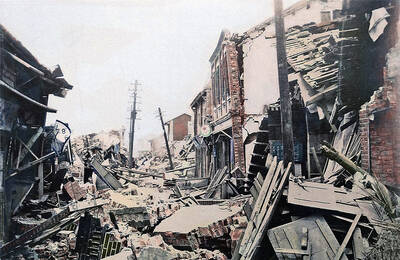
April 15 to April 21 Yang Kui (楊逵) was horrified as he drove past trucks, oxcarts and trolleys loaded with coffins on his way to Tuntzechiao (屯子腳), which he heard had been completely destroyed. The friend he came to check on was safe, but most residents were suffering in the town hit the hardest by the 7.1-magnitude Hsinchu-Taichung Earthquake on April 21, 1935. It remains the deadliest in Taiwan’s recorded history, claiming around 3,300 lives and injuring nearly 12,000. The disaster completely flattened roughly 18,000 houses and damaged countless more. The social activist and

Over the course of former President Ma Ying-jeou’s (馬英九) 11-day trip to China that included a meeting with Chinese Communist Party (CCP) leader Xi Jinping (習近平) a surprising number of people commented that the former president was now “irrelevant.” Upon reflection, it became apparent that these comments were coming from pro-Taiwan, pan-green supporters and they were expressing what they hoped was the case, rather than the reality. Ma’s ideology is so pro-China (read: deep blue) and controversial that many in his own Chinese Nationalist Party (KMT) hope he retires quickly, or at least refrains from speaking on some subjects. Regardless

Approaching her mid-30s, Xiong Yidan reckons that most of her friends are on to their second or even third babies. But Xiong has more than a dozen. There is Lucky, the street dog from Bangkok who jumped into a taxi with her and never left. There is Sophie and Ben, sibling geese, who honk from morning to night. Boop and Pan, both goats, are romantically involved. Dumpling the hedgehog enjoys a belly rub from time to time. The list goes on. Xiong nurtures her brood from her 8,000 square meter farm in Chiang Dao, a mountainous district in northern Thailand’s


 RSS
RSS