


Forget for a moment the Taiwan you know of derelict houses and vacant city lots strewn with trash. There is a place where this island's history has not been paved over with identical poured concrete buildings and covered with corrugated metal, where the present has settled comfortably among the past and swept away the cobwebs. Changhua County's Lukang owes much of its charm to a strict set of ordinances that have preserved parts of the town, but more still can be attributed to a sense of pride among its residents.
Lukang's boom time was in the 17th century, when Dutch settlers used it as a seaport for exports. It later became the sister port of Hanchiang harbor on the east coast of China and a gateway to central Taiwan. During this time, Lukang was Taiwan's second largest city, but two events altered that status forever.

PHOTO: DAVID MOMPHARD, TAIPEI TIMES
First, the harbor silted up and separated the town from the sea with an expanse of uninhabitable marshland. The Lukang of today is a port in name only; the coastline is several kilometers away. Later, in the early 1900s, the town residents refused to allow passage of the north-south train line. These events effectively removed Lukang from the modern map, but they also protected it from the rapid modernization that the rest of Taiwan would undergo after World War II.

PHOTO: DAVID MOMPHARD, TAIPEI TIMES
In cities like Taipei and Taichung, old buildings were razed and replaced with cement structures several stories high in order to house an influx of nearly 2 million Nationalist soldiers from China. These eyesore buildings are now the legacy of a regime that believed it would retake the motherland in five years, then 10 years, and so on. Lukang's legacy -- rows of traditional houses -- is noticeably different.
This is not to say that Lukang doesn't have derelict houses and vacant lots strewn with trash; it does. It also has its fair share of ugly concrete buildings, but ordinances put in place long ago prevent residents of the old buildings from dramatically altering the area's aesthetic.
"The people that live in the preservation districts aren't allowed to build high structures, or cover their roofs or walls with metal," said Chen Shi-hsian (陳仕賢), a Lukang historian and owner of a local bookstore. The preservation districts he's referring to lie to the west of the town's main street of Chungshan Road and include Chuanchou Street (泉州街), Putou Street (埔頭街), Youlin Street (瑤林街) and continue south to Nine Turns Alley (九曲 巷), Chinsheng Alley (金盛巷) and Lungshan Temple (龍山寺). Such historic landmarks as Half-side Well (半邊井), and Remembrance Hall (意樓) have long been off-limits to modern development.
But Lukang's respect for the past extends well beyond these preserved areas into the neighboring community and suggests that ordinances may have had a kind of domino effect.
"The old buildings look nicer and were made better," said a resident named Gao, whose own centuries-old abode borders a preservation district. "Many of the old houses belonged to our ancestors, so no one wants to simply get rid of them."
Goa's conservative values were echoed in talks with several of his neighbors and even the mayor. "Conservatism has allowed the preservation of the traditional face of Lukang," said Mayor Huang Chen-long (
But preservation and reverence for the past can sometimes be a nuisance to Lukang's present residents.
"When it rains, water comes through the roofs," said the historian Chen. "When it rains hard, it comes under the door." The entire township, he explains, sits on a five-year flood plain.
The idea of fixing instead of replacing is best exemplified by Lungshan Temple, whose main hall was knocked down in the earthquake of September 1999. With a huge infusion of capital from Tsai Chi-jui (
"The original plan had it scheduled to be finished later this year," said Chen, who has co-authored a book on the temple. "Obviously it will take several more years to complete." Had the community decided to simply build a new temple to the same specifications, he explained, it would have been finished long ago.
But despite the pains of maintenance, most of Lukang's residents seem content to keep things the way they are ? for the most part.
Asked what he might like to change about his house, Gao's answer had nothing to do with the place itself. "There are too many tourists," he said. "It's very annoying to have people always looking in your house."

Last week Joseph Nye, the well-known China scholar, wrote on the Australian Strategic Policy Institute’s website about how war over Taiwan might be averted. He noted that years ago he was on a team that met with then-president Chen Shui-bian (陳水扁), “whose previous ‘unofficial’ visit to the US had caused a crisis in which China fired missiles into the sea and the US deployed carriers off the coast of Taiwan.” Yes, that’s right, mighty Chen caused that crisis all by himself. Neither the US nor the People’s Republic of China (PRC) exercised any agency. Nye then nostalgically invoked the comical specter
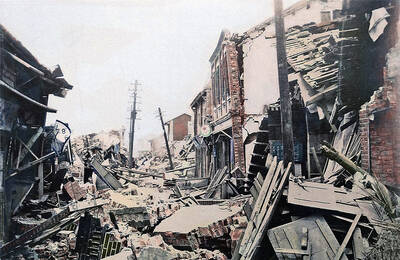
April 15 to April 21 Yang Kui (楊逵) was horrified as he drove past trucks, oxcarts and trolleys loaded with coffins on his way to Tuntzechiao (屯子腳), which he heard had been completely destroyed. The friend he came to check on was safe, but most residents were suffering in the town hit the hardest by the 7.1-magnitude Hsinchu-Taichung Earthquake on April 21, 1935. It remains the deadliest in Taiwan’s recorded history, claiming around 3,300 lives and injuring nearly 12,000. The disaster completely flattened roughly 18,000 houses and damaged countless more. The social activist and

Over the course of former President Ma Ying-jeou’s (馬英九) 11-day trip to China that included a meeting with Chinese Communist Party (CCP) leader Xi Jinping (習近平) a surprising number of people commented that the former president was now “irrelevant.” Upon reflection, it became apparent that these comments were coming from pro-Taiwan, pan-green supporters and they were expressing what they hoped was the case, rather than the reality. Ma’s ideology is so pro-China (read: deep blue) and controversial that many in his own Chinese Nationalist Party (KMT) hope he retires quickly, or at least refrains from speaking on some subjects. Regardless

Approaching her mid-30s, Xiong Yidan reckons that most of her friends are on to their second or even third babies. But Xiong has more than a dozen. There is Lucky, the street dog from Bangkok who jumped into a taxi with her and never left. There is Sophie and Ben, sibling geese, who honk from morning to night. Boop and Pan, both goats, are romantically involved. Dumpling the hedgehog enjoys a belly rub from time to time. The list goes on. Xiong nurtures her brood from her 8,000 square meter farm in Chiang Dao, a mountainous district in northern Thailand’s


 RSS
RSS