


Taipei is reaching for the skies, first with the world's tallest office building and now with one of the largest purpose-built dance clubs in the world, certainly the biggest in Asia.
The US$10 million Ministry of Sound (MoS) in Neihu has an entrance big enough for a car to drive through, eight bars, two dance floors, three DJ booths, a VIP Macallan sky bar, a sunken lounge, 10 private rooms and enough room in the main arena to swing a trapeze artist.
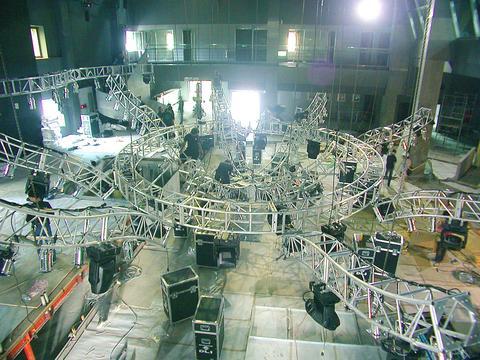
PHOTO: JULES QUARTLY, TAIPEI TIMES
There will be luminous floors, an earth-shattering sound system and en-suite bathrooms in the private booths. The club will be to dance music what the Taipei 101 is to skyscrapers and if all goes as planned it should take clubbing out of the shadows and into the mainstream -- just another musical diversion for the young masses to dance in sanitized splendor and not an insidious attempt to corrupt youth with drugs through electronic sounds.
PHOTO: JULES QUARTLY, TAIPEI TIMES
This conversion from dance music as an illegal activity to merely being cool and the acceptable face of a night out on the town has happened elsewhere before and the owners of MoS in Taiwan are betting the time is right here, right now. The club is slated to open next month.
The MoS story starts with James Palumbo -- the son of a hereditary peer and property developer in the UK -- who managed the trick of turning underground sounds into a profitable business model in London in 1991, when he converted a failing club in the relatively unfashionable south of the city into a global leader of the dance-music industry.

PHOTO: JULES QUARTLY, TAIPEI TIMES
At the time, electronic music was becoming the new beat after the demise of rock 'n' roll and hundreds of thousands of youngsters were spending their weekends going to outdoor parties or raves (that were often free) to dance until the early morning. Newspapers at the time were scandalized and said the nation's youth was at risk.

PHOTO: JULES QUARTLY, TAIPEI TIMES
The entry of the son of a lord and the application of professional management skills to the dance music market gave the whole scene a veneer of respectability. There was even more respect when it turned out that 3,000 people a night would pay US$40 and more just to get in. Laws to prevent outdoor parties without a license and MoS helped turn the youth movement of rave into a section of the entertainment business and part of the establishment.
Today MoS has an annual turnover approaching US$188 million and has expanded its business interests to become the biggest independent record label in the world, as well as having interests in merchandizing, promoting, licensing, radio stations and the Internet (ministryofsound.com is said to be the biggest dance music portal in the world).

PHOTO: JULES QUARTLY, TAIPEI TIMES
Taipei's MoS on Lequn Third Road (樂群三路) measures itself by superlatives. At 1,200 pings (nearly 4,000㎡) it's the largest purpose-built dance club in Asia, dwarfing Velfarre in Tokyo and Zouk in Singapore. An army of nearly 100 staff will service it on a weekend and there are plans to hold conventions, new-car unveilings (hence the car-sized entrance), and live performances from rock, pop and hip-hop artists.
With a capacity of 2,500 people it could fill a hole for a variety of mid-sized events held in the city. It can also function as a smaller bar in the week by shutting off the main arena. On the ground floor there are shops and a fusion restaurant.
The exterior of the building has an upmarket warehouse look, in muted gray, while the interior was modeled by Neil Morton, of GMP, who has come up with a lavishly appointed and shiny image, heavily featuring glass: There are levitating window/walls to the main arena, a smoked-glass chill room, glass private booths and a glass VIP room that overlooks both the main arena and second disco area, "The stars? They wanna be seen," said MoS Project Director Peter Bowden.
"On the weekend we will showcase the best DJ talent and intend to attract the top 20 DJs in the world, plus well-known dance bands like Hybrid," said Bowden, who was formerly the operations director for Luminar, the biggest nightclub business in the world.
"The club will operate on at least two weekdays, one of which will be a retro night. Also, the venue is designed to double as a concert venue and we want to put on anything from international rock bands to Japanese pop stars."
"We've put all the best ideas in the world into this club. It's not like anything seen in Taiwan. It will be a sound, light and visual experience. And yes we will be making the most of our 75-foot (23m) ceiling to provide aerial entertainment."
An octopus-type lighting system is suspended above the main dance arena with 16 video projectors costing US$26,000 each (controlled by eight US$10,000 Apple computers). This is in addition to the strobes, spotlights and lasers. As for the sound, "It will eclipse everything in Taiwan at the moment," Bowden said.
One of the principal directors behind MoS in Taipei is Einjay Lu (呂榮吉) of Shin Mao International (
In an e-mail interview, he said his motivation to build MoS was the realization that for Taipei to be a world-class city it needed a world-class venue, and rezoning regulations had provided the opportunity. "I want to help bring dance music to everyone. I want the people of Taiwan to experience a world-class nightclub here in Taipei. Expect the unexpected."
Lu said he had been nursing the dream for a few years and realized partly by chance that MoS would be the ideal partner for him to achieve it. "I went to London to a trade show called Plaza. It was from there I was invited to a party at MoS in London where I saw what a fantastic club it was. I met Peter [Bowden] there and he invited me to the club he had built in Bangkok. The rest is history."
But not an untroubled one. MoS was supposed to have been completed over a year ago. Referring to the time that it has taken to build the club, Lu said forced changes to plans, building regulations and language problems had held the scheme back, but that these hurdles had been overcome. "If we provide a safe, exciting and professionally managed environment I see no reason why we shouldn't continue to receive the support from the authorities who have been very supportive to us so far."
As for the entertainment program, expect an MoS-style mix of modern Taiwanese and Asian styles. DJs @llen, Victor and Eric Huang are rumored to be among the local DJs who have been approached to support resident DJs Damian Saint from the UK, and Buff Wise from Ibiza, Spain. The opportunity for local DJs to work with resident and star DJs is expected to raise the profile of domestic talent.
It is also hoped that MoS will usher in a new era for the professional management and licensing of clubs. Alan Hsia of Luxy -- the only fully licensed nightclub in the city -- said MoS could widen the market and bring legitimacy to dance music in the city. "Their brand name can help make dancing blossom, so it's not such a taboo. The phenomenon of such a huge venue and the name should make the market bigger and less threatening [to the authorities]."
Other nightclub owners were more skeptical and said it could drain business from the city center if it succeeded. Others said it might fail because people might not want to stray far from the main entertainment nodes of Zhongxiao East Road, Warner Village, Ximending and Anho Road. "There's nothing there," they say of Neihu, which is wedged between Shihlin/Tienmu in the northwest and Nangang to the southeast. It's a recently reclaimed swampland and a hot development zone that is half empty.
"I would like to see this as the bridge between the Shihlin/Tienmu area and the center of town. Of course, there's already a lot of people living here, loads of development and businesses. ... We weighed up where we are. People will come," Bowden said.
"It's not just light and sound, not just loud music, it's a show. If you go to a nightclub why should it be horrible? Why shouldn't it be a nice experience? With comfortable seating and polite people, basically a beautiful place. I want trapeze artists flying around and if people come here and spend their money I want them to leave and think `What a night, I'm coming back here.' This is gonna be amazing, it's going to take your breath away."

In late October of 1873 the government of Japan decided against sending a military expedition to Korea to force that nation to open trade relations. Across the government supporters of the expedition resigned immediately. The spectacle of revolt by disaffected samurai began to loom over Japanese politics. In January of 1874 disaffected samurai attacked a senior minister in Tokyo. A month later, a group of pro-Korea expedition and anti-foreign elements from Saga prefecture in Kyushu revolted, driven in part by high food prices stemming from poor harvests. Their leader, according to Edward Drea’s classic Japan’s Imperial Army, was a samurai

The following three paragraphs are just some of what the local Chinese-language press is reporting on breathlessly and following every twist and turn with the eagerness of a soap opera fan. For many English-language readers, it probably comes across as incomprehensibly opaque, so bear with me briefly dear reader: To the surprise of many, former pop singer and Democratic Progressive Party (DPP) ex-lawmaker Yu Tien (余天) of the Taiwan Normal Country Promotion Association (TNCPA) at the last minute dropped out of the running for committee chair of the DPP’s New Taipei City chapter, paving the way for DPP legislator Su

Located down a sideroad in old Wanhua District (萬華區), Waley Art (水谷藝術) has an established reputation for curating some of the more provocative indie art exhibitions in Taipei. And this month is no exception. Beyond the innocuous facade of a shophouse, the full three stories of the gallery space (including the basement) have been taken over by photographs, installation videos and abstract images courtesy of two creatives who hail from the opposite ends of the earth, Taiwan’s Hsu Yi-ting (許懿婷) and Germany’s Benjamin Janzen. “In 2019, I had an art residency in Europe,” Hsu says. “I met Benjamin in the lobby

It’s hard to know where to begin with Mark Tovell’s Taiwan: Roads Above the Clouds. Having published a travelogue myself, as well as having contributed to several guidebooks, at first glance Tovell’s book appears to inhabit a middle ground — the kind of hard-to-sell nowheresville publishers detest. Leaf through the pages and you’ll find them suffuse with the purple prose best associated with travel literature: “When the sun is low on a warm, clear morning, and with the heat already rising, we stand at the riverside bike path leading south from Sanxia’s old cobble streets.” Hardly the stuff of your


 RSS
RSS