


When Taipei's Texound night club recently closed its doors, a thoughtful observer, meditating on the politics of pleasure, might have concluded that a jubilant night-time culture centered on the body had, once again, been successfully challenged by a day-time ethic devoted to the principles of hard work, financial probity and early nights. If there is any truth in such an analysis, it won't have been the first time such systems of thought and feeling collided, as this new book on disco culture in 1970s America eloquently shows.
Tim Lawrence, a 37 year old British academic specializing in music and dance culture, argues that rock-and-roll led to disco, which then led to techno and house music.
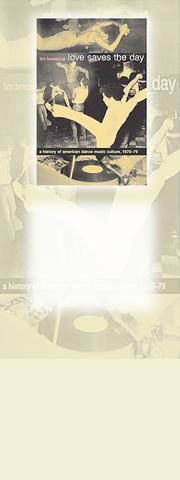
But whereas enthusiasts for these musical styles see them as strongly contrasting and even antagonistic, Lawrence perceives them as merely stages in an on-going continuum. All of them, he writes, were part of one over-
arching movement, which began in earnest in the 1950s (though it was in reality much older), that aimed to assert the claims of pleasure over duty, peace over war, and liberation over absolutely anything that stood in its way.
The young, of course, have always had to have something new, whether it's music or clothes, essentially to proclaim that they are newly emerging into the sexual arena, are the most desirable commodity around, and are not to be confused with previous, now aging, generations.
But 1970s disco is a rather special case. It's been almost universally despised by music intellectuals, the kind of commentators who grace the pages of Rolling Stone. Disco to them was trivial, frivolous, banal, an embarrassment best forgotten. Tim Lawrence points out that in the 900 pages of Richard Crawford's otherwise excellent 2001 book America's Musical Life, 1970s dance music doesn't merit a single reference.
Lawrence is clearly out to change all that. This massively researched tome has unearthed journalism from the era -- newspaper reports, music press interviews, record reviews -- and added interviews of his own with the surviving DJs and club managers. The story he comes up with makes fabulous reading, and this book looks destined to become a classic, opening up a whole lost world of night-time dance culture to generations for whom previously it was merely a rather imprecise legend.
But disco's connections with today's dance culture are strong, Lawrence insists. First, the era saw the emergence of the DJ as someone more than the guy who put on the records. Secondly, the 1970s was the era when drugs came to characterize the clubbing scene on a mass scale. And thirdly, it was the era where urban gay dance venues first hit the American scene in a major way.
This last aspect makes for the book's most memorable pages. It's astonishing to read, for instance, that in the late 1960s it was illegal in New York state for two men to dance together. The law was applied by requiring clubs to demonstrate at least one woman admitted for every three men. Luckily for the male gays, there were usually enough women who enjoyed their night-life style to make this statistical requirement no great problem, and the local lesbians helped. The whole gay side of New York's disco years was mythologized by Andrew Holleran in his fine 1978 novel Dancer from the Dance (though he was later to go on to bemoan the music's dreary predictability).
Even New York gay bathhouses make Lawrence's book. The owner of one remembers that the cops "asked if we would like to buy forty tickets for the Policeman's Ball. It turned out that the tickets cost a hundred dollars, and that there was a Policeman's Ball every week." But he agreed and the raids became token, with the baths notified every time in advance.
Among the names from that era prominent in Love Saves the Day are Village People, The Bee Gees, and Donna Summer (back in the news last week following a court conviction). But Lawrence opts to give most space to the New York DJs and venues of the time, cult leaders such as David Mancuso who opened The Loft in 1970, and is described as a former 1960s mystic who became to many a living god, and in addition just happened to look like Jesus.
There were certainly some sensational incidents. An anti-disco movement got under way at the end of the decade, not unrelated to the disenchantment of the recording companies with 12-inch singles that everyone loved to dance to but few actually went out and bought. An event was stage-managed in 1979 at Chicago's Comisky Park at which 40,000 disco records, donated by baseball fans, were blown up by dynamite between games while the outraged Middle American crowd chanted "Disco sucks!" Lawrence compares it to the Nazis' book burnings.
The sexual implications of the disco years remain their most interesting aspect. Rock-and-roll has been judged an ultra-macho style, with a few token chicks allowed in on the act for appearance's sake. Disco, by contrast, was essentially androgynous, and strongly gay-oriented, despite everything John Trovolta and the movie Saturday Night Fever, made in 1977, could do to modify the image. The extent that rap later re-asserted a masculine ethos, and that techno continued disco's aura of drugged androgyny, are issues that Lawrence examines at the book's close.
There were never many female DJs (the occasional "dyke on the mike" excepted). Mostly the music was for gay men, many of whom seemed to do nothing else than party on a nightly basis.
It would be interesting, in view of Taiwan's current lively night-club world, to know what the scene was like here in the disco era. There's sure to be plenty of material available in Chinese, but it would be good to have it summarized in English, with photos, perhaps for publication in the pages of Taipei Times.
Taiwan in the 1970s was still under the sway of martial law, and things must have been less free-wheeling then they have subsequently, despite occasional glitches, become. Even so, it would be fascinating to know more.

“Taiwan’s Opposition Leader Comes to US With a Message Straight Out of Beijing” read a May 31 headline in the Wall Street Journal. Top US administration officials and members of Congress almost certainly read the WSJ, and if there was a bullet point takeaway that people in Washington should absorb ahead of Chinese Nationalist Party (KMT) Chair Cheng Li-wun’s (鄭麗文) arrival in DC on June 9, that headline is it. The last few columns have discussed this very topic, and the timing is not coincidental. While those top officials likely do not read the Taipei Times, judging by the number

With weighty, anxiety-inducing geopolitical topics dominating the headlines, checking in on the wild and weird state of local politics can take some of the edge off. This November’s elections will determine who will be in charge of fixing potholes in your neighborhood, not the potholes in Taiwan’s complicated geopolitical space. Recently, after an online interview with a Taipei-based journalist, I commented that Taipei journalists never go further than the MRT can take them. He laughed and agreed. Naturally, the Taipei mayoral race is eating up much of the press attention. TAIPEI CITY Democratic Progressive Party (DPP) candidate Puma Shen (沈伯洋) has

In December of 2008 Lee E-tin (李乙廷), a Miaoli county legislative hopeful, was convicted of vote-buying. Rather than buy votes retail, voter by voter, in the usual manner, Lee had done it wholesale, in a commendably efficient manner: he had visited local temples and made donations to gain their support. Because he did not normally make donations to temples, the court ruled he was attempting to improperly influence voter behavior. The case indicates how important temples are in influencing political life. Both judge and politician appeared to see them in the same way. Beijing sees them that way as well. Democratic Progressive

Audiences in Leicester, Cardiff, London and Sheffield will this month gather to watch a series of black-and-white Taiwanese-language films made more than 70 years ago. On the surface, these screenings commemorate the seventieth anniversary of taiyupian (台語片) — Taiwanese-language cinema. Yet the significance of these events extends far beyond nostalgia or film history. They represent a remarkable chapter in Taiwan’s ongoing effort to recover, preserve and reinterpret a cultural heritage that was once thought to have largely disappeared. The centerpiece of the program is the Ho Chi-ming (何基明) directed Xue Pinggui and Wang Baochuan (薛平貴與王寶釧), a film produced in 1955 and


 RSS
RSS