


When Taipei's Texound night club recently closed its doors, a thoughtful observer, meditating on the politics of pleasure, might have concluded that a jubilant night-time culture centered on the body had, once again, been successfully challenged by a day-time ethic devoted to the principles of hard work, financial probity and early nights. If there is any truth in such an analysis, it won't have been the first time such systems of thought and feeling collided, as this new book on disco culture in 1970s America eloquently shows.
Tim Lawrence, a 37 year old British academic specializing in music and dance culture, argues that rock-and-roll led to disco, which then led to techno and house music.
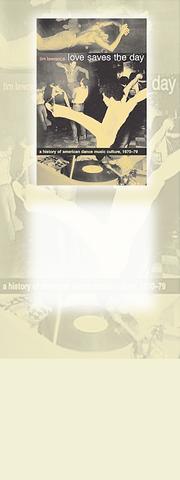
But whereas enthusiasts for these musical styles see them as strongly contrasting and even antagonistic, Lawrence perceives them as merely stages in an on-going continuum. All of them, he writes, were part of one over-
arching movement, which began in earnest in the 1950s (though it was in reality much older), that aimed to assert the claims of pleasure over duty, peace over war, and liberation over absolutely anything that stood in its way.
The young, of course, have always had to have something new, whether it's music or clothes, essentially to proclaim that they are newly emerging into the sexual arena, are the most desirable commodity around, and are not to be confused with previous, now aging, generations.
But 1970s disco is a rather special case. It's been almost universally despised by music intellectuals, the kind of commentators who grace the pages of Rolling Stone. Disco to them was trivial, frivolous, banal, an embarrassment best forgotten. Tim Lawrence points out that in the 900 pages of Richard Crawford's otherwise excellent 2001 book America's Musical Life, 1970s dance music doesn't merit a single reference.
Lawrence is clearly out to change all that. This massively researched tome has unearthed journalism from the era -- newspaper reports, music press interviews, record reviews -- and added interviews of his own with the surviving DJs and club managers. The story he comes up with makes fabulous reading, and this book looks destined to become a classic, opening up a whole lost world of night-time dance culture to generations for whom previously it was merely a rather imprecise legend.
But disco's connections with today's dance culture are strong, Lawrence insists. First, the era saw the emergence of the DJ as someone more than the guy who put on the records. Secondly, the 1970s was the era when drugs came to characterize the clubbing scene on a mass scale. And thirdly, it was the era where urban gay dance venues first hit the American scene in a major way.
This last aspect makes for the book's most memorable pages. It's astonishing to read, for instance, that in the late 1960s it was illegal in New York state for two men to dance together. The law was applied by requiring clubs to demonstrate at least one woman admitted for every three men. Luckily for the male gays, there were usually enough women who enjoyed their night-life style to make this statistical requirement no great problem, and the local lesbians helped. The whole gay side of New York's disco years was mythologized by Andrew Holleran in his fine 1978 novel Dancer from the Dance (though he was later to go on to bemoan the music's dreary predictability).
Even New York gay bathhouses make Lawrence's book. The owner of one remembers that the cops "asked if we would like to buy forty tickets for the Policeman's Ball. It turned out that the tickets cost a hundred dollars, and that there was a Policeman's Ball every week." But he agreed and the raids became token, with the baths notified every time in advance.
Among the names from that era prominent in Love Saves the Day are Village People, The Bee Gees, and Donna Summer (back in the news last week following a court conviction). But Lawrence opts to give most space to the New York DJs and venues of the time, cult leaders such as David Mancuso who opened The Loft in 1970, and is described as a former 1960s mystic who became to many a living god, and in addition just happened to look like Jesus.
There were certainly some sensational incidents. An anti-disco movement got under way at the end of the decade, not unrelated to the disenchantment of the recording companies with 12-inch singles that everyone loved to dance to but few actually went out and bought. An event was stage-managed in 1979 at Chicago's Comisky Park at which 40,000 disco records, donated by baseball fans, were blown up by dynamite between games while the outraged Middle American crowd chanted "Disco sucks!" Lawrence compares it to the Nazis' book burnings.
The sexual implications of the disco years remain their most interesting aspect. Rock-and-roll has been judged an ultra-macho style, with a few token chicks allowed in on the act for appearance's sake. Disco, by contrast, was essentially androgynous, and strongly gay-oriented, despite everything John Trovolta and the movie Saturday Night Fever, made in 1977, could do to modify the image. The extent that rap later re-asserted a masculine ethos, and that techno continued disco's aura of drugged androgyny, are issues that Lawrence examines at the book's close.
There were never many female DJs (the occasional "dyke on the mike" excepted). Mostly the music was for gay men, many of whom seemed to do nothing else than party on a nightly basis.
It would be interesting, in view of Taiwan's current lively night-club world, to know what the scene was like here in the disco era. There's sure to be plenty of material available in Chinese, but it would be good to have it summarized in English, with photos, perhaps for publication in the pages of Taipei Times.
Taiwan in the 1970s was still under the sway of martial law, and things must have been less free-wheeling then they have subsequently, despite occasional glitches, become. Even so, it would be fascinating to know more.

In late October of 1873 the government of Japan decided against sending a military expedition to Korea to force that nation to open trade relations. Across the government supporters of the expedition resigned immediately. The spectacle of revolt by disaffected samurai began to loom over Japanese politics. In January of 1874 disaffected samurai attacked a senior minister in Tokyo. A month later, a group of pro-Korea expedition and anti-foreign elements from Saga prefecture in Kyushu revolted, driven in part by high food prices stemming from poor harvests. Their leader, according to Edward Drea’s classic Japan’s Imperial Army, was a samurai

Located down a sideroad in old Wanhua District (萬華區), Waley Art (水谷藝術) has an established reputation for curating some of the more provocative indie art exhibitions in Taipei. And this month is no exception. Beyond the innocuous facade of a shophouse, the full three stories of the gallery space (including the basement) have been taken over by photographs, installation videos and abstract images courtesy of two creatives who hail from the opposite ends of the earth, Taiwan’s Hsu Yi-ting (許懿婷) and Germany’s Benjamin Janzen. “In 2019, I had an art residency in Europe,” Hsu says. “I met Benjamin in the lobby
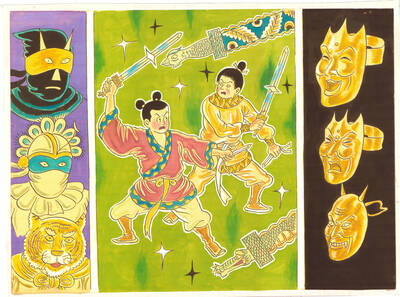
April 22 to April 28 The true identity of the mastermind behind the Demon Gang (魔鬼黨) was undoubtedly on the minds of countless schoolchildren in late 1958. In the days leading up to the big reveal, more than 10,000 guesses were sent to Ta Hwa Publishing Co (大華文化社) for a chance to win prizes. The smash success of the comic series Great Battle Against the Demon Gang (大戰魔鬼黨) came as a surprise to author Yeh Hung-chia (葉宏甲), who had long given up on his dream after being jailed for 10 months in 1947 over political cartoons. Protagonist

A fossil jawbone found by a British girl and her father on a beach in Somerset, England belongs to a gigantic marine reptile dating to 202 million years ago that appears to have been among the largest animals ever on Earth. Researchers said on Wednesday the bone, called a surangular, was from a type of ocean-going reptile called an ichthyosaur. Based on its dimensions compared to the same bone in closely related ichthyosaurs, the researchers estimated that the Triassic Period creature, which they named Ichthyotitan severnensis, was between 22-26 meters long. That would make it perhaps the largest-known marine reptile and would


 RSS
RSS