


The Palace of Eternal Youth (長生殿) is one of the most celebrated Kunju opera classics. On Tuesday the largest-scale production in the last 100 years -- the result of a collaboration of Chinese, Taiwanese and Hong Kong talents -- will premiere at Taipei's Novel Hall (新舞臺) before touring the country.
With a fund of over NT$20 million from Taiwan organizer the Chien Huei Cultural and Educational Foundation (建輝社會文教基金會), Suzhou Kunju Opera Institute; Suzhou Opera Museum and Suzhou Kunju Opera Troupe gathered some 200 people to form the Jiangsu Kun Opera "The Palace of Eternal Youth" Troupe (江蘇省崑劇長生殿藝術團) for the show. Oscar-winning Hong Kong designer Yip Kam-tim (葉錦添) was picked to work on costume and stage design.
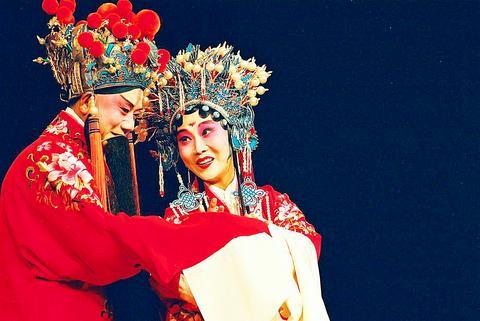
PHOTO COURTESY OF CHIEN HUEI CULTURAL AND EDUCATIONAL FOUNDATION
Most importantly for Kunju fans, director Gu Du-huang (顧篤璜) has selected 28 of the play's 55 episodes, to be performed on three consecutive evenings. As most troupes these days perform only five episodes, the new show is much more comprehensive. Roughly half of the 28 episodes have not been performed in the last 100 years.
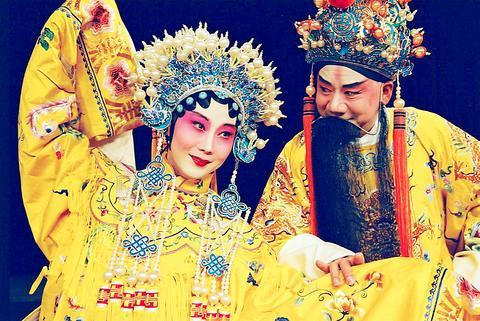
PHOTO COURTESY OF CHIEN HUEI CULTURAL AND EDUCATIONAL FOUNDATION
The Palace is a love tragedy about Tang emperor Li Long-ji and his mistress Yang Yu-huan. Yang is one of the most sublime beauties from Chinese history. When the emperor first sees her she is his daughter-in-law, but he wrests her from his son. The emperor grows so obsessed with her that he ignores all affairs of state. Seeing the state sliding into mayhem, rebels launch a subversion, driving the emperor and his retinue into escape. During the escape, all palace officials blame Yang for the decline of the empire. Due to their pressure, the emperor reluctantly agrees that Yang should commit suicide.
Ching dynasty Hong Sheng's (洪昇) dramatization of the history dwells on the devastating effects of their romance on the Tang dynasty. Hong ended the play with the emperor, tortured since Yang's death by the thought of her beauty, finally joining her in heaven. It is revealed that the emperor and his concubine were two gods banished from heaven to meet again as mortals.
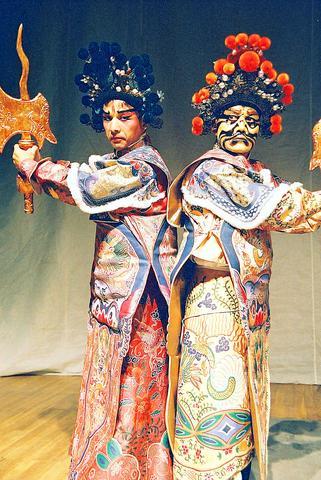
PHOTO COURTESY OF CHIEN HUEI CULTURAL AND EDUCATIONAL FOUNDATION
The best-known Kunju scholar in Kunju's hometown of Suzhou, 77-year-old Gu has devoted his life to research and perform Kunju for over 50 years. The Cultural Revolution of the 1960s and funding shortages in the 1980s has only fueled his passion for Kunju. Although he was not able to come to Taipei for the premiere, due to heart problems, Gu sounded excited about the performance in a telephone interview.
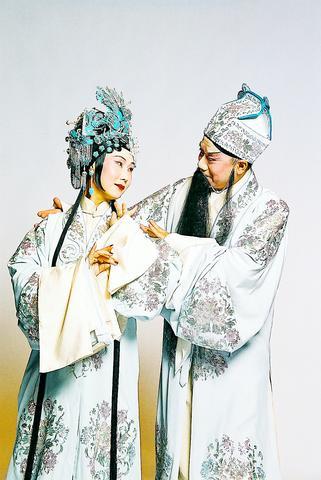
PHOTO COURTESY OF CHIEN HUEI CULTURAL AND EDUCATIONAL FOUNDATION
The charm of The Palace, Gu said, comes from its palatial period setting. "The play tells a familiar story. Its music is beautiful and its verses are of significant literary value. Most importantly, audiences past and present are both drawn to its stage setting and to all the magnificence of the Tang palace."
Gu is one of the few in China who have consistently tried to preserve Kunju traditions and resisted the prevalent trend toard innovated Kunju, which emphasizes stage effects and incorporates foreign elements.
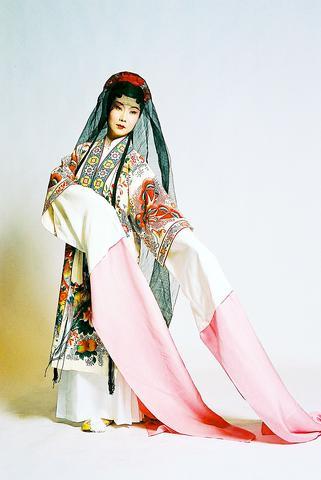
PHOTO COURTESY OF CHIEN HUEI CULTURAL AND EDUCATIONAL FOUNDATION
"There have been too many productions of innovated Kunju operas, which target younger audiences. The result is often that older audiences are unhappy with the changes and the young audiences are not really thrilled. The tradition-minded are now winning the day. The younger audiences are becoming more curious about Kunju traditions and the elders have come back into the theater."
Despite Gu's attention to tradition, directing the episodes that have not been performed over 100 years proved a difficult job. "Many episodes have not been performed continually. It's hard to ascertain how actors in ancient times sang the scores. I could only try to guess how they would have interpreted them."
Gu's insistence on an unadulterated traditional interpretation is shared by Yip, the artistic director of the show. "Our collaboration was a very happy one. Our ideas on the play were the same from the very beginning. Yeh wanted the production to be `more traditional than traditional.' That was exactly what I wanted.
"I told Yeh that all the human characters have to stick to tradition and he can do whatever he wants with the gods and supernatural characters. His designs for the stage settings also comply with tradition."
The 140 costumes are based on illustrations and portraits from Ming dynasty documents. Some 60 seasoned Suzhou tailors worked for over one year to produce the delicate patterns on the magnificent dresses of the palace characters.
A nostalgia for old-time Kunju and a concern for the preservation of the opera set the tone of Gu's discussion of the show. "Zhao Cheng-li (趙承林) and Wang Fang (王芳) [lead actor and actress] are among the best Suzhou Kunju opera performers. Zhao has an excellent singing voice and Wang is riveting as an actress. They both have decades of experience in Kunju. But I must say they cannot match the level of older generations of singers."
In Gu's hometown, there are only two such artists still alive. They are both in their 90s and still teach Kunju. Gu's deepest concern is whether their artistic achievements can be repeated by younger generations. "In the Ching dynasty, Palace was performed in its unabridged form of 55 episodes. The episodes have to be performed for young people to learn from the performers and for the traditions to survive." This is the driving force behind Gu's efforts to stage a record-setting 28 episodes.
"Kunju is the highest achievement of Chinese opera. If we are to preserve the art form in the best way, we have to preserve its completeness," Gu said.
Asked why he has supported the classic art form over 50 years, Gu said, "Kunju Opera is a trap. Once you get caught, you fall deeper and deeper in love with it."

In late October of 1873 the government of Japan decided against sending a military expedition to Korea to force that nation to open trade relations. Across the government supporters of the expedition resigned immediately. The spectacle of revolt by disaffected samurai began to loom over Japanese politics. In January of 1874 disaffected samurai attacked a senior minister in Tokyo. A month later, a group of pro-Korea expedition and anti-foreign elements from Saga prefecture in Kyushu revolted, driven in part by high food prices stemming from poor harvests. Their leader, according to Edward Drea’s classic Japan’s Imperial Army, was a samurai
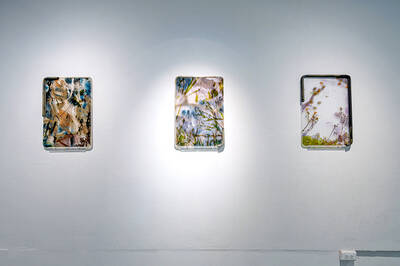
Located down a sideroad in old Wanhua District (萬華區), Waley Art (水谷藝術) has an established reputation for curating some of the more provocative indie art exhibitions in Taipei. And this month is no exception. Beyond the innocuous facade of a shophouse, the full three stories of the gallery space (including the basement) have been taken over by photographs, installation videos and abstract images courtesy of two creatives who hail from the opposite ends of the earth, Taiwan’s Hsu Yi-ting (許懿婷) and Germany’s Benjamin Janzen. “In 2019, I had an art residency in Europe,” Hsu says. “I met Benjamin in the lobby
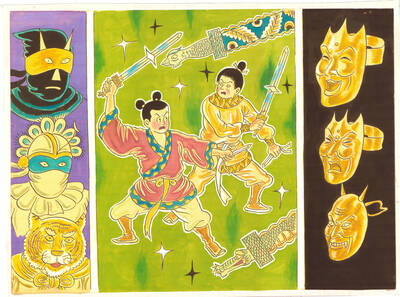
April 22 to April 28 The true identity of the mastermind behind the Demon Gang (魔鬼黨) was undoubtedly on the minds of countless schoolchildren in late 1958. In the days leading up to the big reveal, more than 10,000 guesses were sent to Ta Hwa Publishing Co (大華文化社) for a chance to win prizes. The smash success of the comic series Great Battle Against the Demon Gang (大戰魔鬼黨) came as a surprise to author Yeh Hung-chia (葉宏甲), who had long given up on his dream after being jailed for 10 months in 1947 over political cartoons. Protagonist

Peter Brighton was amazed when he found the giant jackfruit. He had been watching it grow on his farm in far north Queensland, and when it came time to pick it from the tree, it was so heavy it needed two people to do the job. “I was surprised when we cut it off and felt how heavy it was,” he says. “I grabbed it and my wife cut it — couldn’t do it by myself, it took two of us.” Weighing in at 45 kilograms, it is the heaviest jackfruit that Brighton has ever grown on his tropical fruit farm, located


 RSS
RSS