


On a typically rainy winter afternoon in Taipei, the granite pavement of Yungho's Bo-ai Street (博愛街) glistens as a couple of high school students walk quickly toward their school in the chilly wind. The silence on the street stands in sharp contrast to the buzz of commerce on the thoroughfares on nearby roads.
Renamed Bo-ai Art Street (博愛藝術街) from Bo-ai Street in 1999, the 500m avenue next to Zhungzheng Bridge once was home to booming art businesses and regular community events. At its peak in 2001, the street had up to 20 artist studios, galleries, workshops and handicraft outlets. Biweekly community events -- flea markets, concerts, seminars and portrait-sketching -- brought in visitors. For a while, it seemed that Bo-ai's art street would become the next big arts-and-crafts trade hub in the greater Taipei area.
Today, with only a handful of such shops left, it's hard to imagine the former excitement on the street. Only the expensive granite pavement and the two pigeon statues, installed around the inauguration of the art street, remained unchanged.
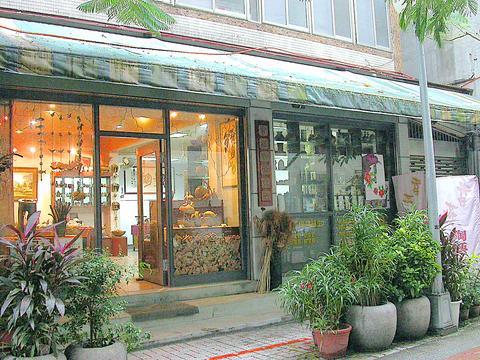
PHOTO: VICO LEE, TAIPEI TIMES
Residents here have different explanations for the street's decline. "There used to be government-organized events. They helped business a lot. With each weekend event, visitors to the performances or flea markets went to the artist studios along the street," said a volunteer worker in Yungho Art Education Foundation (
Yungho City government spent over NT$50 million on the granite pavement, community events and subsidies for artists to set up workshops here. But since 2002, the new administration stopped funding. The foundation has since organized events on a limited case-by-case basis. The number of events has decreased from more than 20, to four or five a year.
Last August and December, the foundation pooled volunteers to organize five concerts, mostly performances by local residents, which attracted up to 400 people, according to the foundation. At the same time, a dozen residents set up the Experimental Space Work Group ((ESWG)
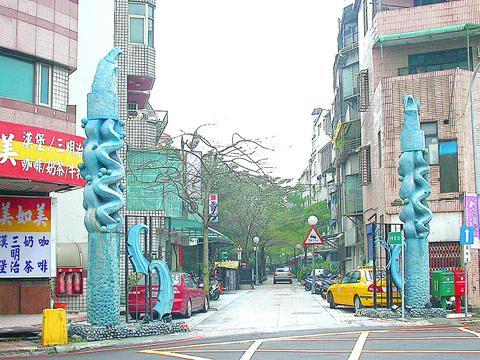
PHOTO: VICO LEE, TAIPEI TIMES
"Without the government's funding and organizing, residents and artists lack the resources to stage events to bring in visitors," said a member of ESWG, who declined to reveal her name.
Wei Yan-hui (韋燕煥), owner of Wei Yan Ceramic Art Center, a private workshop, moved to the street full of expectations when it started. Although her intention was just to have a nice environment in which to create her works and teach ceramics, she cannot help thinking of moving out since the city government stopped giving subsidies.
"The reason I moved here was to create ceramics with my students, not to make a fortune selling my works. However, I can hardly make ends meet now that there's no regular community events, and therefore few customers." Wei estimates that she loses roughly NT$10,000 each month.
Tzao Mai (草莓), a teacher at Soho Spectre Art, a children's art institute on the street, said that there are many reasons for the decline of the art street. "The space on the street is too small to accommodate large-scale events to attract enough visitors. We have the Yang San-lang Art Museum (楊三郎美術館), but it seldom opens."
On the city government's Web site, Yang San-lang Art Museum is listed as the street's major attraction, but the museum has never participated in the street's activities, said Lin Yun-lian, an employee at the museum.
"Generally speaking, the street never had a distinctive character," Tzao Mai added. The teacher also agreed with Wei that the loss of government funding was the heaviest blow to the street. "If the budget comes back, maybe Art Street will come back too," she said.
"The street is small, but other small places can thrive. The art street offers a more intimate experience with art, which museums cannot provide. There is no bigger reason for the [current] situation but the withdrawal of the city government budget," Wei said.
The city government is at present planning to construct a cultural activity venue on the larger and less-populated Kuokuang Road, (國光路) according to Lin, a civil-affairs department employee who would reveal only his surname.
"Bo-ai Street was too small and too densely populated. Kuokuang Road is more of an ideal location for artistic activities," Lin said. As for Bo-ai Street, the city government has no plan to restart the funding.
When the art street was still lined with artist studios, the Yungho Art Education Foundation held weekly book-reading groups. The studios took turn providing venues for the meetings and for free beginner courses in painting, sculpture, ceramics and other art forms.
The book-reading group meetings, the ESWG member said, have been the most meaningful thing that happened on Bo-ai's art street. "I used to think of art as something distant and serious. You have to be a professional in the art field to appreciate it. The weekly reading group made me realize art can be a part of life. It all happened because of our art street," she said.
Although the book group still meets every week, their activities have become more limited due to the departure of the private studios. In the past two years small business and karaoke bars have moved into the buildings they left.
The ESWG member likes to compare the art street to the another Taipei County attraction -- Yingge Old Street (鶯歌老街), which has over 80 ceramic shops and studios. She admits that Yingge Old Street is hard to emulate because its success is built on the foundation of 200 years of ceramic industry and the township lavishly invested NT$100 million on its infrastructure. She also compares it to Taipei's Yunkang Street (永康街), famous for antique and exotic accessories shops, as well as for food.
"All recreational places in Taiwan have to offer food to succeed. Taiwanese like their food with a little cultural atmosphere. However, Art Street has no good eateries."
The city government seems to have realized this too, as the plans for Kuokuang Road, modeled after Kaohsiung City's outdoor performance venue Urban Spotlight, include outdoor cafes with art themes.
Optimistic about a revival of the art street, ESWG member joined 200 residents last year in designing a "green promenade," which, if built, will connect a planned round-river expressway to one end of the street. There will be plants all along the route. The interior ministry's Construction and Planning Agency has accepted their suggestion.
"Yungho residents taking a walk on the promenade may stray into the nearby art street," she said.
Wei doubts if anything can bring the street back to life, however, "The flame has gone out," he said.

In late October of 1873 the government of Japan decided against sending a military expedition to Korea to force that nation to open trade relations. Across the government supporters of the expedition resigned immediately. The spectacle of revolt by disaffected samurai began to loom over Japanese politics. In January of 1874 disaffected samurai attacked a senior minister in Tokyo. A month later, a group of pro-Korea expedition and anti-foreign elements from Saga prefecture in Kyushu revolted, driven in part by high food prices stemming from poor harvests. Their leader, according to Edward Drea’s classic Japan’s Imperial Army, was a samurai

Located down a sideroad in old Wanhua District (萬華區), Waley Art (水谷藝術) has an established reputation for curating some of the more provocative indie art exhibitions in Taipei. And this month is no exception. Beyond the innocuous facade of a shophouse, the full three stories of the gallery space (including the basement) have been taken over by photographs, installation videos and abstract images courtesy of two creatives who hail from the opposite ends of the earth, Taiwan’s Hsu Yi-ting (許懿婷) and Germany’s Benjamin Janzen. “In 2019, I had an art residency in Europe,” Hsu says. “I met Benjamin in the lobby
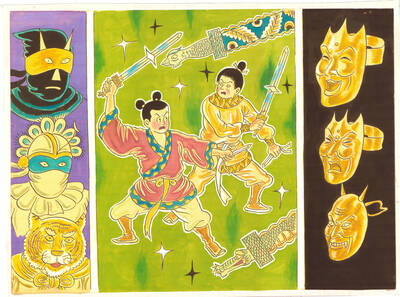
April 22 to April 28 The true identity of the mastermind behind the Demon Gang (魔鬼黨) was undoubtedly on the minds of countless schoolchildren in late 1958. In the days leading up to the big reveal, more than 10,000 guesses were sent to Ta Hwa Publishing Co (大華文化社) for a chance to win prizes. The smash success of the comic series Great Battle Against the Demon Gang (大戰魔鬼黨) came as a surprise to author Yeh Hung-chia (葉宏甲), who had long given up on his dream after being jailed for 10 months in 1947 over political cartoons. Protagonist

A fossil jawbone found by a British girl and her father on a beach in Somerset, England belongs to a gigantic marine reptile dating to 202 million years ago that appears to have been among the largest animals ever on Earth. Researchers said on Wednesday the bone, called a surangular, was from a type of ocean-going reptile called an ichthyosaur. Based on its dimensions compared to the same bone in closely related ichthyosaurs, the researchers estimated that the Triassic Period creature, which they named Ichthyotitan severnensis, was between 22-26 meters long. That would make it perhaps the largest-known marine reptile and would


 RSS
RSS