


Some friends of mine recently returned from Guangzhou in China. They described the extraordinary phenomenon, observable there on a daily basis, of Western couples, mostly from North America, in town to collect their adopted Chinese baby daughters. They were everywhere, they said -- pushing their strollers along the sidewalks, crowding the lobby and corridors of the White Swan Hotel, and a visible presence at the
airport.
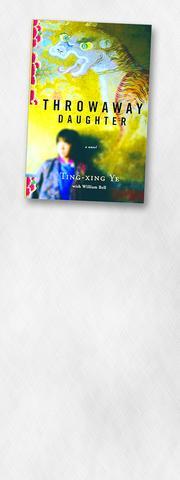
The adoption of abandoned female infants from China appears, in other words, to have become big business. Books relating their authors' experience of the process no doubt stoked the fires, especially in the early years, and prominent among them must have been Emily Prager's Wuhu Diary (reviewed in Taipei Times, Sept. 9, 2001). But books describing hard times in China during the Cultural Revolution and on into the 1980s may have also played their part, if only as background. One of these was Ye Ting-ying's A Leaf in the Bitter Wind (reviewed in Taipei Times, Sept. 3, 2000). Ye is now an established author, and Throwaway Daughter is her sixth book.
Born in 1952, Ye was exiled to a prison labor farm at 16, attempted suicide after being denounced as a counter-revolutionary, yet went on to marry and then get work as a high-level government translator. She broke with her former life after she fell in love with her English teacher, William Bell, and emigrated with him to Canada in 1987.
Throwaway Daughter is a novel about a young girl, Dong-mei, who was born in China and adopted while still an infant by her Canadian parents. At the start she hates everything Chinese, wanting instead only to be like her class-mates in every particular. But quickly the book offers different perspectives. It does this by means of chapters narrated by different characters. First come Dong-mei's adoptive parents, seen in the years when they were still waiting for permission to adopt at all. Then comes a range of characters from her original family in China -- her grandfather (an old-style revolutionary), her father (eager to further himself in village life by having a son), and her mother (glad to be married at all, and anxious to do what's best for her new family).
You have to wait almost until the book's end before Dong-mei meets her mother. By that time she's met her father, now re-
married, and understood something of her story from his perspective. You've also encountered her father's fire-eating second wife.
One of the constants in stories of daughters being adopted from China is an unspoken criticism of their birth mothers. How could a mother do such a thing as abandon a child, leave her wrapped in a blanket on the doorstep of an orphanage? This simple book's great strength is that it looks behind this presumption at what might be the realities of such a
situation.
But another, less immediately obvious, dimension of such stories is that the thought that she was originally unwanted, rejected and "thrown away" by her natural family can well form part of such an adopted child's later psychological make-up.
This book neatly and economically combines these two aspects of such situations. Dong-mei goes back to China, and as a result both understands her mother's motives in giving her up, and in so doing achieves a new kind of self-respect.
This is not a complex novel, but its simple, transparent character should be seen as its strength. Throwaway Daughter is essentially an educative work. Not only is it about someone who gets educated in the realities of life in contemporary China, as well as the China of an earlier era. It's also a book that's eminently suited for the education of the young today.
This, then, is a book that is ideal for school libraries. If I was in charge of a high-school library in Taiwan, or indeed anywhere where there were students with links with China, I'd order two or three copies. It's easy to read, combines clearly-expressed emotions with a strong story line, and deals with important issues relating to questions of ethnic origin, as well as China's recent history, clearly and honestly.
Adults are going to look at the story a little differently. They might regard it as just a touch too simple. The difference between an adult's viewpoint and that of a teenager, it could be argued, is that adults see the ironies and complexities within human relationships. Ye Ting-xing must know this better than most. When she left China for Canada she had to leave behind her Chinese husband and her five-year old daughter.
Any remorse that this entailed can't have been a simple thing to handle. This isn't something dealt with in this book. Instead, it imagines an altogther clearer-cut, emotionally simpler, situation. But anyone who's read A Leaf in the Bitter Wind might find himself asking whether the author herself has a lost daughter somewhere hidden away in her own
psychological closet.
These thoughts are not meant to detract from the virtues of this unassuming, yet in its own way sturdy, fictional work. Its qualities, as I've said, are its directness and its even-handed sympathy for all involved. There are no out-and-out villains in this story, just as there are few areas of ambiguities and few mixed motives. Its moral could be said to be that you only have to look at life from other people's points of view to understand their actions. To understand everything is to pardon everything, as the French say.
In actual fact the story does become more complex once Dong-mei is in China. Everything is far from a bed of roses there, and her arrival is met by some with mixed feelings. Even so, the complexities imposed by history aren't allowed to dominate the plot development. There's instead just sufficient resentment and truculence to make the story credible. Even an adolescent readership, after all, can have a quite astute sense of what the adult world is really like.

Last week Joseph Nye, the well-known China scholar, wrote on the Australian Strategic Policy Institute’s website about how war over Taiwan might be averted. He noted that years ago he was on a team that met with then-president Chen Shui-bian (陳水扁), “whose previous ‘unofficial’ visit to the US had caused a crisis in which China fired missiles into the sea and the US deployed carriers off the coast of Taiwan.” Yes, that’s right, mighty Chen caused that crisis all by himself. Neither the US nor the People’s Republic of China (PRC) exercised any agency. Nye then nostalgically invoked the comical specter
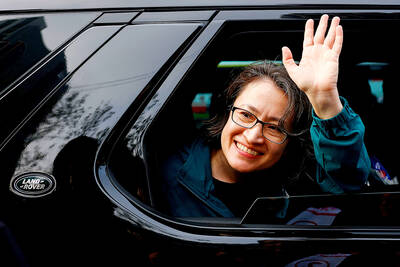
Relations between Taiwan and the Czech Republic have flourished in recent years. However, not everyone is pleased about the growing friendship between the two countries. Last month, an incident involving a Chinese diplomat tailing the car of vice president-elect Hsiao Bi-khim (蕭美琴) in Prague, drew public attention to the People’s Republic of China’s (PRC) operations to undermine Taiwan overseas. The trip was not Hsiao’s first visit to the Central European country. It was meant to be low-key, a chance to meet with local academics and politicians, until her police escort noticed a car was tailing her through the Czech capital. The
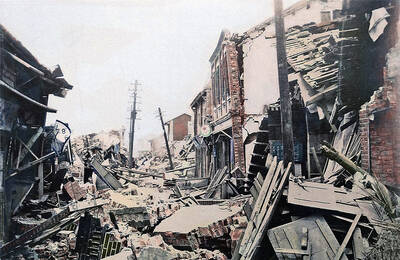
April 15 to April 21 Yang Kui (楊逵) was horrified as he drove past trucks, oxcarts and trolleys loaded with coffins on his way to Tuntzechiao (屯子腳), which he heard had been completely destroyed. The friend he came to check on was safe, but most residents were suffering in the town hit the hardest by the 7.1-magnitude Hsinchu-Taichung Earthquake on April 21, 1935. It remains the deadliest in Taiwan’s recorded history, claiming around 3,300 lives and injuring nearly 12,000. The disaster completely flattened roughly 18,000 houses and damaged countless more. The social activist and

Over the course of former President Ma Ying-jeou’s (馬英九) 11-day trip to China that included a meeting with Chinese Communist Party (CCP) leader Xi Jinping (習近平) a surprising number of people commented that the former president was now “irrelevant.” Upon reflection, it became apparent that these comments were coming from pro-Taiwan, pan-green supporters and they were expressing what they hoped was the case, rather than the reality. Ma’s ideology is so pro-China (read: deep blue) and controversial that many in his own Chinese Nationalist Party (KMT) hope he retires quickly, or at least refrains from speaking on some subjects. Regardless


 RSS
RSS