


Tens of thousands of people come here each year to a granite-walled nook in the hills just off the old pioneer trail to hear the tale of the lost Martin Handcart Company of 1856 and how a party of poor Mormon converts faced down death in a howling blizzard.
The place, called Martin's Cove -- an uninhabited hollow of sand and sage surrounded by sheer cliffs that block the wind -- sits on federal land around 75km southwest of Casper, part of the vast Western domain of the Bureau of Land Management. But the story is not told by bureau employees. Missionaries from the Church of Jesus Christ of Latter-day Saints, dispatched on six-month assignments and brimming with faith, are the trail and museum guides.
Now that unusual relationship -- a publicly owned historic site interpreted by a private and very interested party -- has been locked into law. A brief provision tucked into an energy bill signed by President Bush in December authorizes a 25-year lease agreement between the church and the government, with all but automatic renewals after that.
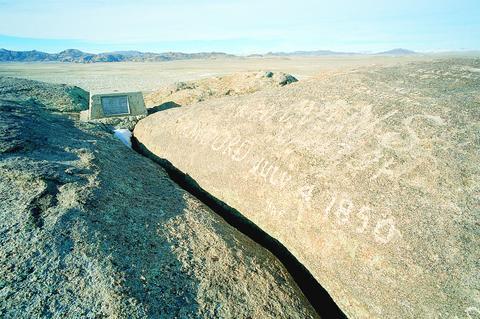
PHOTO: NY TIMES
What that means is that the Mormon Church will, in a very real way, own the Martin's Cove story, probably in perpetuity. All visitors seeking access must cross private land purchased by the church in the 1990s, and the law allows church authorities to decide, in consultation with the bureau, who may be denied admission for, say, improper deportment. On each side of the fence marking the public-private line, missionaries lead the way, happy to answer questions of history or scripture.
The arrangement and the controversy that simmers around it in Wyoming lays bare an American frontier between religious and secular life that is as raw today, in everything from school prayer to town-hall Christmas creches, as it was when the Mormons first made their way to Utah in the 1840s.
Some local residents and advocates for strict separation of church and state say they fear that history is being privatized, that spiritual lessons will supersede facts or that a religious interpretation will distill the complexity of Western history into an overly simplified fable.
"It's historical revisionism -- they're using a particular place to enshrine these deaths, but in the history of the western movement, thousands of people died, so it's very difficult to claim this particular spot as sacred ground," said Barbara Dobos, a resident of Casper and public-lands advocate who has led the opposition to the church's efforts.
Other people who have followed the issue say that historians have often missed the psychological complexities of the pioneer experience, and that perhaps only through the lens of faith can a place like Martin's Cove really be understood.
In a state where land battles usually involve the economics of energy or ranching, religious motivation is a curveball.
"Some people are quite stirred up and I suspect it's going to remain that way," said Tom Rea, a former newspaper reporter who is writing a book about the country west of Casper, including Martin's Cove.
"The Mormons came in with a whole other reason to own land -- not for resource exploitation, but for storytelling," Rea added. "That puts this in a different category than anything I can think of."
Humble handcart
At the center of it all is the humble handcart: a wheelbarrow, essentially, that was pulled from the front by converts who had no money for oxen. Only about 5,000 of the 70,000 Mormon pioneers ever used handcarts, mostly between 1856 and 1858.
Now the handcart has increasingly become one of the paramount symbols of Mormonism, with cart-pulling ceremonies and festivals held everywhere from Russia to Florida. And the church has used its economic muscle to preserve the landmarks of the pioneer experience. More than 6,474 hectares of Wyoming ranch land along the trail were purchased in the 1990s in the name of preservation.
Even the missionaries concede that balancing God and man at Martin's Cove can be dicey. After the visitors center opened in 1997, on land owned by the church, Wyoming public school students began showing up for tours as part of their state history classes. About 10 percent of Wyoming residents are Mormon.
"When the kids come, we put the literature aside," said P. Bryce Christensen, director of Mormon Handcart Historic Sites in Wyoming, which includes Martin's Cove. "We don't want anybody going back home and saying, `Guess what, Mom, we got a Book of Mormon on our field trip."'
On the other hand, Christensen said, no missionary is ever going to shrink from answering questions. At least six non-Mormon tourists have been baptized into the faith after visiting the cove, he said, though he only hears about the ones who contact him.
"We're very, very careful," Christensen said. "This is not a proselytizing mission, but if people have questions, we're very interested in helping."
What happened at Martin's Cove, named for the group's leader, Edward Martin, was harrowing. The 600 converts were poorly equipped with handcarts made of green wood that cracked and split in the desert air. And the company of travelers was fatally late, reaching what later became Wyoming just as the first snows fell, in October 1856, three months later than trail wisdom dictated. About one in four died from starvation and exposure.
One survivor later wrote in anguish about her prized possession: a fine pair of scissors she had carried from England. As hardship deepened into disaster, she used the scissors to amputate the frostbitten fingers and toes of her children. The cove became a place of death, the bodies left in the snow for wolves. The company was finally saved by a rescue party dispatched from Salt Lake City.
But the facts are easy. Here, everything is nuance.
Inside the cove on the government monuments that were installed years ago, and in a museum display in Casper, where the Bureau of Land Management operates the National Historic Trails Interpretive Center, God is conspicuously absent and the tone is grim. The pioneers were late, the displays say. They struggled and died. What drove them or what made them believe that flimsy handcarts could overcome Western terrain and fall weather is not addressed.
"When we put something on a sign or a brochure or document, we write it for everyone," said Jude Carino, an archaeologist and director of the trails center. "What we don't necessarily always do is put it through the filter of the believer."
The missionaries have no such qualms. At the visitors center, journals are displayed with entries about angels helping push the handcarts through the snow. And though the fateful decision to start too late is mentioned, the message throughout, as the missionaries admit, is the transcending power of belief.
Pioneering faith
Whether the church has found the right Martin's Cove at all -- some researchers favor a place half a mile west -- is an open question. Some critics say that with that kind of uncertainty, celebrating this cove over all others is historically untenable.
Some historians say the Mormons should be commended. Handcart pioneers were driven by different motivations than were gold seekers or cattlemen or Oregon-bound farmers, they say, and telling the story of Martin's Cove as a religious fable is perhaps truer to the actual event.
"Their inner worlds were different," said Patricia N. Limerick, a history professor and chairwoman of the Center of the American West at the University of Colorado at Boulder. "I think in our efforts to strictly avoid an advocacy of religion, we silence a whole point of view in human life."
Ron Strand, a neighbor, is also pleased with how things are turning out, and with the earthly jolt to the economy that 60,000 annual visitors can provide. He is building an eight-unit motel behind Alcova's general store, which he runs with his wife, Yolanda. Since the visitors center does not sell souvenirs, the Strands have been happy to oblige, offering everything from earrings in the shape of handcart wheels to pioneer bonnets.
"I've lived all my life here and I'd never heard of Martin's Cove until the Mormons came," Strand said. "But I'm happy to have them."

In late October of 1873 the government of Japan decided against sending a military expedition to Korea to force that nation to open trade relations. Across the government supporters of the expedition resigned immediately. The spectacle of revolt by disaffected samurai began to loom over Japanese politics. In January of 1874 disaffected samurai attacked a senior minister in Tokyo. A month later, a group of pro-Korea expedition and anti-foreign elements from Saga prefecture in Kyushu revolted, driven in part by high food prices stemming from poor harvests. Their leader, according to Edward Drea’s classic Japan’s Imperial Army, was a samurai

Located down a sideroad in old Wanhua District (萬華區), Waley Art (水谷藝術) has an established reputation for curating some of the more provocative indie art exhibitions in Taipei. And this month is no exception. Beyond the innocuous facade of a shophouse, the full three stories of the gallery space (including the basement) have been taken over by photographs, installation videos and abstract images courtesy of two creatives who hail from the opposite ends of the earth, Taiwan’s Hsu Yi-ting (許懿婷) and Germany’s Benjamin Janzen. “In 2019, I had an art residency in Europe,” Hsu says. “I met Benjamin in the lobby

April 22 to April 28 The true identity of the mastermind behind the Demon Gang (魔鬼黨) was undoubtedly on the minds of countless schoolchildren in late 1958. In the days leading up to the big reveal, more than 10,000 guesses were sent to Ta Hwa Publishing Co (大華文化社) for a chance to win prizes. The smash success of the comic series Great Battle Against the Demon Gang (大戰魔鬼黨) came as a surprise to author Yeh Hung-chia (葉宏甲), who had long given up on his dream after being jailed for 10 months in 1947 over political cartoons. Protagonist

A fossil jawbone found by a British girl and her father on a beach in Somerset, England belongs to a gigantic marine reptile dating to 202 million years ago that appears to have been among the largest animals ever on Earth. Researchers said on Wednesday the bone, called a surangular, was from a type of ocean-going reptile called an ichthyosaur. Based on its dimensions compared to the same bone in closely related ichthyosaurs, the researchers estimated that the Triassic Period creature, which they named Ichthyotitan severnensis, was between 22-26 meters long. That would make it perhaps the largest-known marine reptile and would


 RSS
RSS