


The Taoist ceremony of setting off firecrackers in Tainan or the Yanshui "feng pao" is often associated with the Lantern Festival. The annual Taoist ritual is so well-known that many Taiwanese feel it's their duty to attend the events at least once in their lives. Compared with Yanshui, Miaoli's Beng Long Ceremony -- which also takes place around the time of the Lantern Festival -- is relatively unknown outside its area of origin.
This year, the Miaoli City Government wants to change all that. "Southern Taiwan has feng pao; northern Taiwan has beng long," said Miaoli Mayor Chiu Bing-kun (
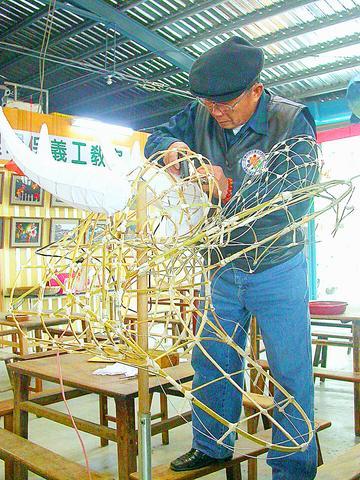
PHOTO: VICO LEE, TAIPEI TIMES
For the past five years, the city government has taken over the organization of the folk festival and expanded it in a bid to rival the feng pao spectacle. Since 2000, the ceremony has attracted around 100,000 tourists to Miaoli, according to the city government.
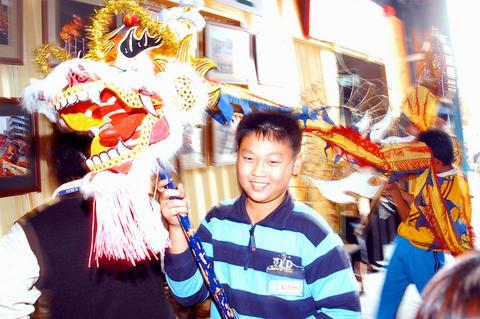
PHOTO COURTESY OF MIAOLI CITY GOVERNMENT
"Beng long means as much for Miaoli's Hakka community as feng pao and other lantern festival events do for residents in other parts of Taiwan," Chiu said. By extending the festival into the one-month Miaoli International Cultural Festival (
Beng long, which means "bombing the dragon" in the Hakka language, is an occasion for communal fun around the time of the Lantern Festival, which falls on the the 15th day of the first month on the lunar calendar. Throwing firecrackers at dragons is believed to bring good fortune for the new year. The more the dragons -- and their dancers -- are pelted with firecrackers, the more propitious the blessings from the gods.
As a traditional folk event, its history is relatively short. While the month of the Lunar New Year has always been filled with sporadic dragon-dancing and setting off firecrackers in Taiwan, the bombing of dancing dragons did not become a serious ritual until the 1950s, when the Shinkong Weaving Factory -- today's Shinkong Group (
"Bombing the dragon has indeed brought good fortune, as we can see in Shinkong's case," Mayor Chiu said.
With the hope that the ceremony brings prosperity not just to individual businesses but to all the Hakkas in Miaoli, the city government will stage the bombing at five outdoor locations throughout Miaoli on the evening of Feb 7. The collective beng long will culminate in an on-going, month-long festival, which includes a Hakka artifacts exhibition, ceramic workshops, culinary events and performances by local folk art groups and foreign expatriates.
About one month before the festival, the 40 or so dragon dancing teams start practicing and receiving commissions. Business owners these days spend over NT$100,000 to hire several dragon teams for bombing.
Using bamboo sticks indigenous to Miaoli, artisans follow a series of Taoist rules to make the holy dragon. First to be decided is the number of joints in the dragon's body. Nine, 11 and 15 are considered the luckiest numbers (a spectacular 99-joint dragon was constructed by the armed forces stationed in Miaoli some 40 years ago). The five colors -- gold, silver, blue, green and red -- on the fabric covering the bamboo frame of the dragon represent the five elements of the universe.
The finished dragon needs to go through the eye-painting ceremony to become a holy dragon. The eye-painting ceremony invites the gods to dwell inside the dragon. Without the ceremony, evil spirits can easily enter the dragon. Dragon masters, commissioners of the dragons, have to present a letter to the gods along with an animal sacrifice.
A rooster is picked for each dragon. The dragon master mixes the blood taken from the rooster's crown with cinnabar and rice wine, while incense is burned and the dragon dance team drums, kneeling next to the dragon.
The dragon master paints the eyes as well as the dots on its body and tail. Each dot has names like "gathering wealth," "boundless hearing" and "limitless eyesight," which the dragon master calls out as he or she paints them. This year, a record number of 27 teams will gather at Tuqing Temple (
ceremony.
These heavenly dragons will then set out, dancing from door-to-door, for the ying long ritual (
"When I was a kid, I used to follow the procession all night from the north to the south of Miaoli, to see dragon dancing. There were crowds of followers eager to absorb the positive energy from the dragon. The teams also compete with each other to visit as many households as possible, as families give the biggest red envelope to the first dragon to arrive at their house, seeing it as the most auspicious dragon," said Chung Chun-huei (
Besides the registered 27 teams whose dragons will be bombed according to the official schedule, there will also be teams who will dragon dance from door-to-door.
"To make the dragons more durable, artisans now use tougher materials and even iron wires. Some dragons can look still intact after hours of bombing, so the bombing ritual is more intense these days. To illuminate the dragons, dancers carry car batteries to provide power for the light bulbs. It is quite an awesome sight," Chung said.
After bringing good fortune to the mortals, the divinities inside the dragons are sent back to heaven in the "hua long fan tian" (
The roosters whose blood was used in the paint of the dragons' eyes are killed as a sacrifice to the gods. The dragon masters once again present a letter to the gods, saying where and how the dragons made their visits. After one last dance of the dragon, the team lays the dragon on a pile of golden paper money. The master scatters more golden paper money on it and finally sets fire to it.
This annual visits by the gods in the form of dancing dragons, Miaoli's Hakkas believe, keeps this county peaceful and prosperous.
The year was 1991. A Toyota Land Cruiser set out on a 67km journey up the Junda Forest Road (郡大林道) toward an old loggers’ camp, at which point the hikers inside would get out and begin their ascent of Jade Mountain (玉山). Little did they know, they would be the last group of hikers to ever enjoy this shortcut into the mountains. An approaching typhoon soon wiped out the road behind them, trapping the vehicle on the mountain and forever changing the approach to Jade Mountain. THE CONTEMPORARY ROUTE Nowadays, the approach to Jade Mountain from the north side takes an

Last week Joseph Nye, the well-known China scholar, wrote on the Australian Strategic Policy Institute’s website about how war over Taiwan might be averted. He noted that years ago he was on a team that met with then-president Chen Shui-bian (陳水扁), “whose previous ‘unofficial’ visit to the US had caused a crisis in which China fired missiles into the sea and the US deployed carriers off the coast of Taiwan.” Yes, that’s right, mighty Chen caused that crisis all by himself. Neither the US nor the People’s Republic of China (PRC) exercised any agency. Nye then nostalgically invoked the comical specter

Relations between Taiwan and the Czech Republic have flourished in recent years. However, not everyone is pleased about the growing friendship between the two countries. Last month, an incident involving a Chinese diplomat tailing the car of vice president-elect Hsiao Bi-khim (蕭美琴) in Prague, drew public attention to the People’s Republic of China’s (PRC) operations to undermine Taiwan overseas. The trip was not Hsiao’s first visit to the Central European country. It was meant to be low-key, a chance to meet with local academics and politicians, until her police escort noticed a car was tailing her through the Czech capital. The
April 15 to April 21 Yang Kui (楊逵) was horrified as he drove past trucks, oxcarts and trolleys loaded with coffins on his way to Tuntzechiao (屯子腳), which he heard had been completely destroyed. The friend he came to check on was safe, but most residents were suffering in the town hit the hardest by the 7.1-magnitude Hsinchu-Taichung Earthquake on April 21, 1935. It remains the deadliest in Taiwan’s recorded history, claiming around 3,300 lives and injuring nearly 12,000. The disaster completely flattened roughly 18,000 houses and damaged countless more. The social activist and


 RSS
RSS