


Mao Xinyu (
"In this new century, this new period of history, to publicize Mao Zedong's (
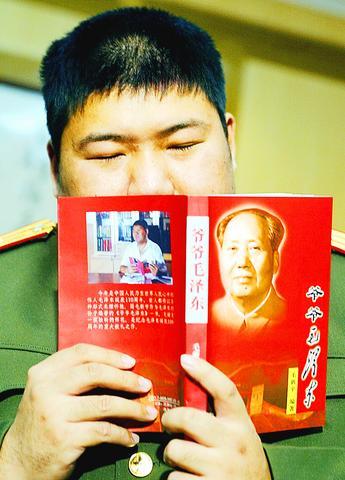
PHOTO: REUTERS
More than a quarter-century after his death in 1976, Mao's continuing status as a global pop icon contrasts with the increasingly acknowledged bankruptcy of his politics, a pretext for all kinds of irony.
The burden of reconciling China's past and present has been thrust on the distended frame of his grandson, who is said to have grown up sheltered by servants and guards, kidding classmates about what he'd do when he took power.
In a generation of "little emperors," he appeared to fit the mould better than any, logging mediocre test scores and tipping the scales at more than 114kg.
Today, as an army-trained Mao historian and lieutenant-colonel, Xinyu, 33, remains a ceremonial figure. But while he has slimmed little, he has matured a good deal.
Sitting back in a voluminous green uniform, swearing to uphold Mao's guerrilla gospel, he faintly resembles his grandfather -- part country bumpkin, part quixotic bookworm, part sprawled-out sovereign.
"Aya, there's pressure, there's pressure," he sighed, with a puffy-cheeked grin, at the end of an interview. "Because the whole nation's people have their eyes on me."
Moments after Xinyu left, one of his publicity aides at the Academy of Military Sciences explained that "pressure" was meant to convey filial respect, all the more so for an ancestor of his grandfather's stature.
Mao's 110th birthday, Dec. 26, came and went last month, making no great waves in Chinese public life.
The Communist Party aired the usual television hagiographies while capitalistic co-sponsors peddled the latest gimmicks, from books spinning Mao's wartime survival tactics into management tips to hip-hop music recordings of his trademark theories.
Xinyu, for his part, did a rare run of interviews and book signings to promote his new anecdotal history, Grandpa Mao Zedong.
The paperback has sold several tens of thousands of copies, the Ph.D. replied modestly when asked. Later he suggested, "I'll give you the rights. You can translate it!"
The Great Helmsman named him Xinyu, or "new universe."
His father, Mao Anqing, the chairman's second son, was a party interpreter before succumbing to schizophrenia; his mother Shao Hua, an esteemed photojournalist, is a major-general. His wife is also in the army.
In China's elite circles today, many so-called princelings milk their pedigree to find jobs in prize industries, from real estate (party boss Hu Jintao's (胡錦濤) daughter) to semi-conductors (military chief Jiang Zemin's (江澤民) son). Some hold official posts themselves.
For Mao's heirs, the chambers of party power were seemingly off limits, the boardrooms of business sure to incur scandal.
So the family -- said to suffer from bad genes and be subject to bad grudges by elites rehabilitated after the Chairman's 1966 to 1976 Cultural Revolution -- came to depend on the military.
Xinyu insists his clan simply have their own special calling, to act as "successors" to Mao's revolutionary work.
"As the Chairman's relatives, we must take heed to serve the people at every turn," he said.
As for those counter-revolutionaries who exploit Mao's image for personal gain, with kitsch cigarette lighters and so on, he has a rosy-red outlook. "If you ask to me look at these phenomena and what they relate to, I believe China's common people want to have beliefs and spiritual sustenance."
"Since the 100th anniversary especially, I feel that common Chinese people's spiritual beliefs and spiritual sustenance have been embodied in Chairman Mao."
That was less than apparent in the capital on Mao's 110th birthday. While many stopped to snap souvenir photos before the Tiananmen rostrum, where Mao proclaimed the People's Republic in 1949 and where his portrait still keeps watch, perhaps as many lined up outside department stores for shots with Santa Claus.
Xinyu said that one reason he wrote his book was to dispel certain Mao "myths," although he declined to cite examples.
The authorities have banned some books over the years, such as physician Li Zhisui's notorious portrayal of Mao as a randy megalomaniac.
As with many Chinese biographies of the late Chairman, 90 percent of Xinyu's volume focuses on the pre-1949 Mao, credited with emancipating the masses after millennia of feudalism. The Mao blamed for 30 to 50 million deaths from famine during the Great Leap Forward and millions more in the Cultural Revolution goes unmentioned.
But even this self-styled Mao disciple bows to the accepted verdict in China: Mao made mistakes, but his contributions exceeded them.

In late October of 1873 the government of Japan decided against sending a military expedition to Korea to force that nation to open trade relations. Across the government supporters of the expedition resigned immediately. The spectacle of revolt by disaffected samurai began to loom over Japanese politics. In January of 1874 disaffected samurai attacked a senior minister in Tokyo. A month later, a group of pro-Korea expedition and anti-foreign elements from Saga prefecture in Kyushu revolted, driven in part by high food prices stemming from poor harvests. Their leader, according to Edward Drea’s classic Japan’s Imperial Army, was a samurai

Located down a sideroad in old Wanhua District (萬華區), Waley Art (水谷藝術) has an established reputation for curating some of the more provocative indie art exhibitions in Taipei. And this month is no exception. Beyond the innocuous facade of a shophouse, the full three stories of the gallery space (including the basement) have been taken over by photographs, installation videos and abstract images courtesy of two creatives who hail from the opposite ends of the earth, Taiwan’s Hsu Yi-ting (許懿婷) and Germany’s Benjamin Janzen. “In 2019, I had an art residency in Europe,” Hsu says. “I met Benjamin in the lobby
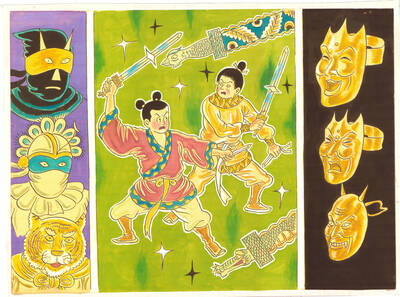
April 22 to April 28 The true identity of the mastermind behind the Demon Gang (魔鬼黨) was undoubtedly on the minds of countless schoolchildren in late 1958. In the days leading up to the big reveal, more than 10,000 guesses were sent to Ta Hwa Publishing Co (大華文化社) for a chance to win prizes. The smash success of the comic series Great Battle Against the Demon Gang (大戰魔鬼黨) came as a surprise to author Yeh Hung-chia (葉宏甲), who had long given up on his dream after being jailed for 10 months in 1947 over political cartoons. Protagonist

A fossil jawbone found by a British girl and her father on a beach in Somerset, England belongs to a gigantic marine reptile dating to 202 million years ago that appears to have been among the largest animals ever on Earth. Researchers said on Wednesday the bone, called a surangular, was from a type of ocean-going reptile called an ichthyosaur. Based on its dimensions compared to the same bone in closely related ichthyosaurs, the researchers estimated that the Triassic Period creature, which they named Ichthyotitan severnensis, was between 22-26 meters long. That would make it perhaps the largest-known marine reptile and would


 RSS
RSS