


When Athens won the right to host this year's Olympics, Greece promised to bring culture back to the Games by creating a Cultural Olympiad, a four-year sequence of arts events to rival the sports contests for prestige.
But even in the cradle of western civilization progress on the artistic venture has been dogged by the same delays and infighting that have cast a shadow over preparations for August's sporting extravaganza.
After three years and three leaders, the cultural Olympics remain largely unknown outside Greece and synonymous with controversy at home.
Initially envisaged as a revival of the Cultural Games -- poetry, music and dance competitions -- that ran alongside sports events from 1912 to 1948, the idea was a key element of the winning bid.
"At the end of each year in this four-year cultural Olympiad, an international committee will award prizes of worldwide prestige to the best creative products," the bidding file said.
Greece's Culture Minister Evangelos Venizelos promised the fine arts cycle would not be "just another festival." But it took organizers two years to unveil an emblem and critics accused the project of lacking identity and direction.
Cypriot film director Michael Cacoyannis, famous for Zorba the Greek, was among the first casualties. He quit his post as president after only three months, citing budget cutbacks and stifling bureaucracy.
"My involvement was short-lived and I resigned after three months. I'm not the kind of person to sign blind for anything," Cacoyannis said.
CENTRAL PROBLEM
His replacement, the poet Titos Patrikios, survived less than a year before resigning to concentrate full time on his writing.
Patrikios insisted on toning down the competitive element and called for a focus on promoting culture. He appeared to have won the argument when Venizelos told reporters: "Artistic creation cannot be subjugated to the terms of a sports-style competition. There are no heights, lengths or speeds to measure here."
But within months organizers performed a U-turn and announced the Kotinos (olive wreath) awards, offering cash prizes in nine categories including performing arts, literature and philosophy.
Cultural events in the run-up to the Games have been marred by fall-outs among Greece's most prominent artists.
The 2001 staging of Vangelis's Mythodea concert, which was linked with NASA's Mars mission and released on CD by Sony, was attacked as a waste of public money by fellow composer Mikis Theodorakis.
The production the following year of Theodorakis's own opera based on Aristophanes's anti-war comedy Lysistrata won international plaudits but proved to be his final Olympic contribution. Theodorakis responded to criticism of the opera's cost by withdrawing his works from Olympic-related events.
ART CONTROVERSY
With Greece's cultural leaders at odds, Venizelos admitted that the Olympiad was struggling to make its mark. "Some events didn't have the coverage we would have liked but we haven't exhausted our potential yet," he said.
In December the headlines arrived but for all the wrong reasons. Organizers' hopes that the biggest modern art show the country had seen would buck the negative trend disappeared in the time it took a populist politician to visit the exhibition.
George Karadzaferis, leader of the extreme right LAOS party, raised a storm after seeing Belgian artist Thierry de Cordier's Asperges Me (Dry Sin) and demanded its removal. The canvas featured an erect penis and a crucifix with what appeared to be semen dripping from it.
religious issues
The painting, which had hung for nearly six weeks without provoking public comment, then came under attack from the Greek Orthodox Church and the main opposition conservative party. Church of Greece spokesman Epiphanios Economou called it "an insult to our morals and customs and our religion." Within 24 hours it was taken down for "insulting religious sentiment".
The following day a 37-year-old woman slashed another canvas with a knife, claiming it was obscene. Instead of celebrating a success to put Athens on the contemporary art map, the culture minister was forced to hit out at "a climate of bigotry and obscurantism."
Organizers have promised a late rally with high-profile international artists in Greece and partner events around the world including Italy and Russia.
Greece is still hoping for its own cultural victory to round off the Olympiad this year with the return of the disputed Parthenon Marbles, removed from the Acropolis in the 19th century by Lord Elgin and now housed in the British Museum.
But a new Acropolis museum which was due to be ready this year has not progressed beyond the foundations and intense diplomatic efforts by Athens have yet to yield results.

Last week Joseph Nye, the well-known China scholar, wrote on the Australian Strategic Policy Institute’s website about how war over Taiwan might be averted. He noted that years ago he was on a team that met with then-president Chen Shui-bian (陳水扁), “whose previous ‘unofficial’ visit to the US had caused a crisis in which China fired missiles into the sea and the US deployed carriers off the coast of Taiwan.” Yes, that’s right, mighty Chen caused that crisis all by himself. Neither the US nor the People’s Republic of China (PRC) exercised any agency. Nye then nostalgically invoked the comical specter
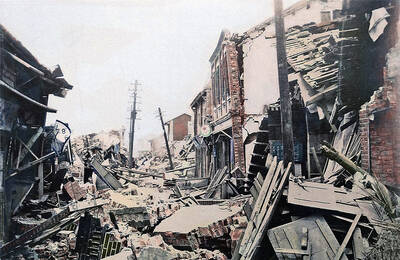
April 15 to April 21 Yang Kui (楊逵) was horrified as he drove past trucks, oxcarts and trolleys loaded with coffins on his way to Tuntzechiao (屯子腳), which he heard had been completely destroyed. The friend he came to check on was safe, but most residents were suffering in the town hit the hardest by the 7.1-magnitude Hsinchu-Taichung Earthquake on April 21, 1935. It remains the deadliest in Taiwan’s recorded history, claiming around 3,300 lives and injuring nearly 12,000. The disaster completely flattened roughly 18,000 houses and damaged countless more. The social activist and

Over the course of former President Ma Ying-jeou’s (馬英九) 11-day trip to China that included a meeting with Chinese Communist Party (CCP) leader Xi Jinping (習近平) a surprising number of people commented that the former president was now “irrelevant.” Upon reflection, it became apparent that these comments were coming from pro-Taiwan, pan-green supporters and they were expressing what they hoped was the case, rather than the reality. Ma’s ideology is so pro-China (read: deep blue) and controversial that many in his own Chinese Nationalist Party (KMT) hope he retires quickly, or at least refrains from speaking on some subjects. Regardless

Approaching her mid-30s, Xiong Yidan reckons that most of her friends are on to their second or even third babies. But Xiong has more than a dozen. There is Lucky, the street dog from Bangkok who jumped into a taxi with her and never left. There is Sophie and Ben, sibling geese, who honk from morning to night. Boop and Pan, both goats, are romantically involved. Dumpling the hedgehog enjoys a belly rub from time to time. The list goes on. Xiong nurtures her brood from her 8,000 square meter farm in Chiang Dao, a mountainous district in northern Thailand’s


 RSS
RSS