


If you don't immediately warm to the virtues of corporate capitalism, yet don't really think the state ownership advocated by Karl Marx represents the road to human happiness either, what is most likely to appeal to you is small businesses. This thought-stimulating book takes a look at such enterprises in Taipei, but those run by women. Its subtitle is Life-Worlds of Taipei Women Entrepreneurs.
Such small businesses constitute one of the joys of walking round the city. They're everywhere. Turn down the back alleys in almost any district and there are fruit shops, food stalls, motorcycle repair shops, laundries and chic little clothing boutiques, many of them open until late into the night.
Perhaps the phenomenon is characteristic of the traditional Chinese virtues of hard work and frugality, but it's surely also a product of one of the greatest passions in the human heart, the desire for independence. And it's also enormously satisfying.

Such owner-managers are characterized by the attractive appearance they give their businesses. And the friendliness that invariably goes with them, though undoubtedly good for trade, is also evidence of the personal satisfaction they derive from such endeavors. It's far more fun to run your own DVD rental store than to labor away in a factory.
It may, of course, turn out to be more profitable in the long run as well. But as the author of this book remarks, the essence is that conformity and dependence on others is exchanged for autonomy. The natural thirst for independence lies at the heart of the matter.
This book puts the percentage of Taiwan's population who are self-employed at 20 percent, but the author also points to many who suspected him of being from the tax office and didn't want to reply to questions. Either way, small businesses appear crucially and centrally characteristic of Taiwan.
Scott Simon worked on this project while he was on a two-year post-doctoral fellowship at Academia Sinica. But this is no dull thesis paying lip-service to academic fashion and theories currently in vogue. Simon is too much of a democrat and a populist for that.
"These women entrepreneurs would surely be frustrated if I transformed their stories into abstract scholarly discourse for only a few initiates of academic jargon," he writes.
Nevertheless, there is inevitably an element of contemporary politics in it too. This is hardly surprising when the author opts to study women, and he duly acknowledges the feminist anthropologists who, he says, have strongly influenced his work. But the bulk of the book consists of revealing interview material from a wide range of people.
He starts off with two street vendors, a woman who sells soy milk breakfasts from a mobile stall, and a seller of betel nuts and shaved ice. He then moves on to bead makers and a woman who sells Buddhist amulets made from the skulls of deceased Tibetan lamas. There are some theoretical terms, such as the influence on the last worker of Buddhist "narratives," but you quickly learn to recognize these words and subsequently discount them.
Among his most interesting subjects is a Mercedes-Benz-driving exporter of live eels to Japan. She claims Taiwanese such as herself still possess expertise in special areas that's inherited from the Japanese occupation. She also says she won't eat the eels she raises as they've in effect sacrificed their lives for her prosperity, so it wouldn't be proper. They're kindly creatures, she says, and only try to bite her when they're feeling out of sorts.
Also included is a chapter on Wang Li-ling, Miss China in 1961 when Taiwan was the only "China" the US recognized, and today running her Help-Save-a-Pet Fund in Neihu. She's famous in Taiwan for her campaigns against, among other things, dog-meat restaurants and Spanish bull-fighting, and is the only non-profit-oriented entrepreneur represented in the book. For more on her see her Web site http://www.hsapf.org.tw.
There's also a chapter on the culture of "flower drinking," after-hours socializing by businessmen in the company of girls who may also provide sexual services. The author points out that the possibility of adopting this way of life, if all else fails, forms the backdrop to almost all female economic activity in Taiwan. "Yet in no way does work in the various sex trades carry the same social stigma that prostitution does in the West," he interestingly adds.
For the rest there's a fashion designer, the proprietor of a lesbian bar, the Orchid Island-born owner of a breakfast cafe, and more. The prize for the most interesting lifestory, however, must go to the entrepreneur described in the chapter "A Global Cafe."
This stubbornly independent woman changed her business three times from clothing store to Middle Eastern music venue to a cafe specializing in Taiwanese Aboriginal music in almost as many years.
Social activists often talk about "empowerment," acquiring the power that's yours if only you'll seize it. Self-employment gives women power because it makes them independent of others, notably men, the author claims, surely rightly. Yet, of the women he interviewed, he says, none were part of the middle-class feminist movement, though they undoubtedly benefited from the legal changes such feminists had managed to bring about.
One of the nicest things about this book is the way it explained to me something I knew intuitively but couldn't quite put my finger on -- why I felt so comfortable living in Taiwan. I've often benefited from such businesses quick response to a customer's needs. You want it delivered? No problem! Our kid can bring it over on his bike. Imagine getting service like that from a bank.
It's significant, incidentally, that this is the fourth book about Taiwan that Taipei Times has reviewed in two months. Usually there aren't more than that published in English in an entire year. Do these books represent the beginning of an upsurge? Let's hope so. Even more extraordinary is that every one of them has been excellent.
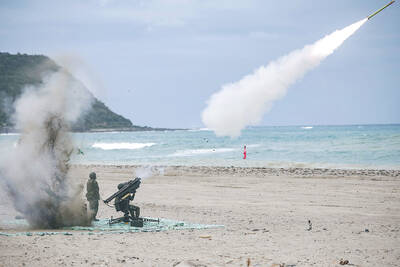
In late October of 1873 the government of Japan decided against sending a military expedition to Korea to force that nation to open trade relations. Across the government supporters of the expedition resigned immediately. The spectacle of revolt by disaffected samurai began to loom over Japanese politics. In January of 1874 disaffected samurai attacked a senior minister in Tokyo. A month later, a group of pro-Korea expedition and anti-foreign elements from Saga prefecture in Kyushu revolted, driven in part by high food prices stemming from poor harvests. Their leader, according to Edward Drea’s classic Japan’s Imperial Army, was a samurai
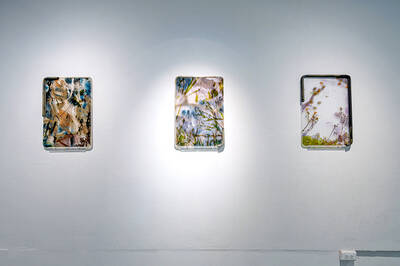
Located down a sideroad in old Wanhua District (萬華區), Waley Art (水谷藝術) has an established reputation for curating some of the more provocative indie art exhibitions in Taipei. And this month is no exception. Beyond the innocuous facade of a shophouse, the full three stories of the gallery space (including the basement) have been taken over by photographs, installation videos and abstract images courtesy of two creatives who hail from the opposite ends of the earth, Taiwan’s Hsu Yi-ting (許懿婷) and Germany’s Benjamin Janzen. “In 2019, I had an art residency in Europe,” Hsu says. “I met Benjamin in the lobby
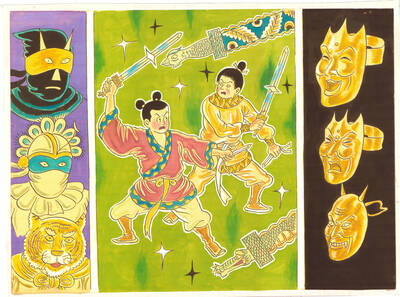
April 22 to April 28 The true identity of the mastermind behind the Demon Gang (魔鬼黨) was undoubtedly on the minds of countless schoolchildren in late 1958. In the days leading up to the big reveal, more than 10,000 guesses were sent to Ta Hwa Publishing Co (大華文化社) for a chance to win prizes. The smash success of the comic series Great Battle Against the Demon Gang (大戰魔鬼黨) came as a surprise to author Yeh Hung-chia (葉宏甲), who had long given up on his dream after being jailed for 10 months in 1947 over political cartoons. Protagonist

A fossil jawbone found by a British girl and her father on a beach in Somerset, England belongs to a gigantic marine reptile dating to 202 million years ago that appears to have been among the largest animals ever on Earth. Researchers said on Wednesday the bone, called a surangular, was from a type of ocean-going reptile called an ichthyosaur. Based on its dimensions compared to the same bone in closely related ichthyosaurs, the researchers estimated that the Triassic Period creature, which they named Ichthyotitan severnensis, was between 22-26 meters long. That would make it perhaps the largest-known marine reptile and would


 RSS
RSS