


An 84-year-old man was showing a bunch of city visitors how to weave a fishing net properly in the coastal village of Jhaoyang (
An 84-year-old called kiddie? No kidding! The speaker was a 98-year-old man who regards his younger village neighbors as kids, having grown up with them in the small and reclusive Jhaoyang Community (
It has a population of slightly more than 900 people, comprising around 200 Hakka families. Of these 200 families, more than 30 men or women are over 80 years old and more than 160 are over 70 years old, according to the head of the community development association Lee Shun-yi (
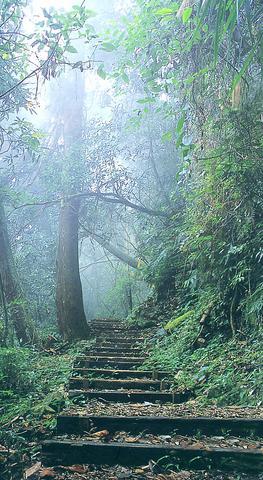
PHOTO COURTESY OF TAIWAN FORESTRY BUREAU
Village tour guide Li Wang-sui (
As an explanation of one of the reasons Jhaoyang villagers live so long, Li pointed to a hill at the rear of the village, affectionately known as Turtle Mountain (
Adults in the morning and children after school all enjoy hiking to the top of the hill nearly every day, to chat, pick fruits, collect flowers or run around the trails along the coast facing the Pacific Ocean. Fresh air, mild weather, frequent trail hiking and a thrifty village life naturally contribute to good health and longevity.
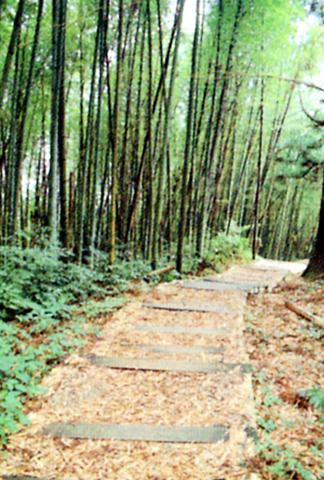
PHOTO COURTESY OF TAIWAN FORESTRY BUREAU
This newly renovated trail, officially called the National Jhaoyang Hiking Trail (
There are more than 100 natural hiking trails around the island and according to Lin Hao-chen (
The high mountain trails are called National Alpine Hiking Trails and one of the most popular is a 46km walk found in the Yu Shan (Jade Mountain) area. Yu Shan's highest peak is 3,952m and the tallest in the region.
Many hiking trails were opened up by the Aborigines, chiefly for hunting purposes. A number of other trails were chiseled out of heavy rocks by soldiers for military and transportation purposes. These types of trails generally have long and colorful histories, often marked by stone monuments and are known as National Historical Trails.
The famed Batongkuan (八通關) historical trail, starting from Tongpu(東埔) in Nantou County (南投縣), and meandering to Yuli (玉里) in Hualien County, was first built in 1800. The trail was widened and even flattened by Japanese soldiers in order to transport horses and to drag cannons up to high mountains to suppress Aboriginal uprisings in the early 20th century. It runs from central to eastern Taiwan by traversing the backbone of the Central Mountain Range.
Its 153km path, which usually takes an entire week to hike, is the oldest surviving trail in the country. In addition, there are hiking trails in rural areas and along the seashore. They are categorized into National Countryside Trails and National Coastal Trails.
Trails such as that of Jhaoyang belong to the former and are generally considered to be easy in hiking terms. The Makang (
One reason why the island is blessed with so many hiking trails may be because of Taiwan's unique colonial history. Ever since the 17th century, Dutch, Spanish, Chinese and Japanese soldiers have played important roles in building these trails. In fact, a number of trails were battle grounds between the Aboriginals, early Chinese settlers and foreign colonialists.
Their endeavors and sacrifices have made Taiwan's gorgeous mountains, beautiful lakes and wild hinterland much more accessible to us today. Their fascinating stories may be easily discovered and by getting closer to Taiwan's history you may also improve your health with a good, long walk.

In late October of 1873 the government of Japan decided against sending a military expedition to Korea to force that nation to open trade relations. Across the government supporters of the expedition resigned immediately. The spectacle of revolt by disaffected samurai began to loom over Japanese politics. In January of 1874 disaffected samurai attacked a senior minister in Tokyo. A month later, a group of pro-Korea expedition and anti-foreign elements from Saga prefecture in Kyushu revolted, driven in part by high food prices stemming from poor harvests. Their leader, according to Edward Drea’s classic Japan’s Imperial Army, was a samurai

Located down a sideroad in old Wanhua District (萬華區), Waley Art (水谷藝術) has an established reputation for curating some of the more provocative indie art exhibitions in Taipei. And this month is no exception. Beyond the innocuous facade of a shophouse, the full three stories of the gallery space (including the basement) have been taken over by photographs, installation videos and abstract images courtesy of two creatives who hail from the opposite ends of the earth, Taiwan’s Hsu Yi-ting (許懿婷) and Germany’s Benjamin Janzen. “In 2019, I had an art residency in Europe,” Hsu says. “I met Benjamin in the lobby

April 22 to April 28 The true identity of the mastermind behind the Demon Gang (魔鬼黨) was undoubtedly on the minds of countless schoolchildren in late 1958. In the days leading up to the big reveal, more than 10,000 guesses were sent to Ta Hwa Publishing Co (大華文化社) for a chance to win prizes. The smash success of the comic series Great Battle Against the Demon Gang (大戰魔鬼黨) came as a surprise to author Yeh Hung-chia (葉宏甲), who had long given up on his dream after being jailed for 10 months in 1947 over political cartoons. Protagonist

A fossil jawbone found by a British girl and her father on a beach in Somerset, England belongs to a gigantic marine reptile dating to 202 million years ago that appears to have been among the largest animals ever on Earth. Researchers said on Wednesday the bone, called a surangular, was from a type of ocean-going reptile called an ichthyosaur. Based on its dimensions compared to the same bone in closely related ichthyosaurs, the researchers estimated that the Triassic Period creature, which they named Ichthyotitan severnensis, was between 22-26 meters long. That would make it perhaps the largest-known marine reptile and would


 RSS
RSS