


Every two years, Indonesia loses about four million hectares of forest, an area roughly the size of Switzerland, to rapacious logging.
Skies in northern China glow orange in sandstorms that cross the Pacific and lay dust on the western US. In Hong Kong, raw sewage bobs in its pearl-blue harbor.
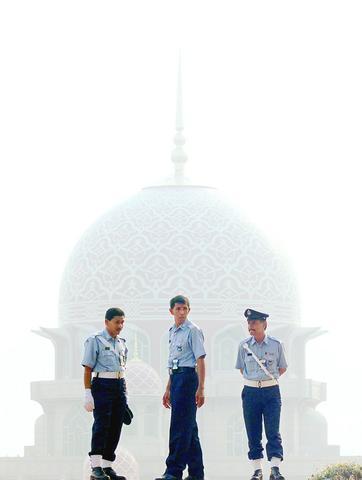
PHOTO: REUTERS
From inner Mongolia to the Indian subcontinent and tropical Southeast Asia, says one senior UN environmental official, the region's ecology and environment is deteriorating as its factories and economies boom.
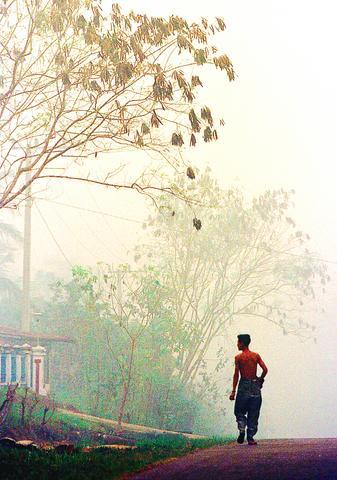
PHOTO: REUTERS
Although governments are rolling out unprecedented initiatives to tackle Asian pollution -- underscored by a meeting of Southeast Asian environment ministers in mid-December in Myanmar -- the policies are often badly enforced, the official adds.
"Things could get worse before they get better," said Ravi Sawhney, director of the environment and sustainable development division of the United Nations Economic and Social Commission for the Asia-Pacific, or UNESCAP.
Sawhney is studying Asia's environment for the UN "State of the Environment Report" released every five years. Although the next report is not due until next year, Sawhney said indications point to a broad-based worsening in environmental conditions.
"There are policy initiatives that have been taken and laws enacted and so on. But the problem is the actual implementation," he said.
As if to highlight what he says, landslips and mudslides as recently as November and mid-December in corners of Indonesia and the Philippines plagued by illegal logging swept away or buried alive whole families.
WINDS OF CHANGE
Six of the world's 15 most polluted cities are in Asia, and the region generates a third of the world's carbon dioxide emissions. In Asia's developing regions, around 785 million people lack regular access to safe water, UN statistics show.
Even so, there are pockets of improvement.
The air quality in notoriously polluted Bangkok, Dhaka, New Delhi and several Chinese cities is healthier after most of Asia, except for Indonesia, phased out lead from gasoline, said Cornie Huizenga of the Asian Development Bank's Clean Air Initiative.
Bangladesh, which is spending US$30 million over two years to bring natural gas to 100 petrol stations, is replacing high-polluting two-stroke engines in its rickshaw taxis in the capital Dhaka with cleaner-burning natural gas power.
"It's an unequal picture. There are cities where the situation is getting better," said Huizenga, adding that a growing number of cities have put up air monitoring systems.
Thailand's "tuk tuk" taxis now run on liquefied petroleum gas, while buses and taxis in New Delhi and Bombay are phasing out diesel and running instead on compressed natural gas. "This is very much the story of the future," he said.
Huizenga and other environmental experts helped the Association of South East Asian Nations (ASEAN) draw up an anti-pollution plan as rising wealth brings demands for better urban conditions after decades of squalor in some countries.
Southeast Asian Environment Ministers meeting in Myanmar approved a non-binding "framework" which calls on ASEAN to develop stronger urban anti-polluting strategies beginning with a series of workshops next year.
"Due to rapid growth, you're getting overlapping problems -- water, air, land -- on top of each other, making a very complex situation," said Peter Marcotullio, a researcher in the Institute of Advanced Studies at the United Nations University in Tokyo.
"So part of what is being done here is to tease out some of these problems so that city managers can deal with them one at a time, as opposed to what seems to be happening is that they are all coming at them at the same time."
Fixing Asia's environmental mess -- from stifling sandstorms and rapid soil erosion in China to treating sewage in Indian rivers and Southeast Asian air pollution -- is turning into a billion-dollar business.
US Department of Commerce is sending an "Environmental Technologies" trade mission to Malaysia, Thailand and Vietnam next March to scout for opportunities for US companies, citing "significant" potential for US expansion.
It estimates that Malaysia's "environmental" market is worth around US$800 million, mostly for safe water supply and sewage treatment, and says Thailand needs to spend around US$1.2 to US$1.5 billion on clean water and sanitation by 2020.
In Vietnam, a pollution control equipment and services market was worth US$450 million this year alone, it said.
FESTERING ISSUES
Other environmental problems, however, are festering.
In Indonesia, home to the world's third-largest tropical forests after Brazil and the Congo, forests have disappeared at a rate three to four times faster than those in Brazil since 1990, mostly because of logging and burning, says international environmental group Global Forest Watch.
"Every year the country is losing nearly two million hectares of forest. If this rate continues, then by 2010 most forest in Sumatra and Kalimantan will disappear," said Longgena Ginting, who is the head of local environmental group Walhi, referring to two of Indonesia's biggest islands.
Much of this feeds huge demand for timber in economically booming China where logging was banned after excessive tree-felling contributed to floods that killed around 4,000 people in 1998.
Chee Yoke Ling of the Third World Network, a Malaysian lobby group, said countries such as Malaysia had nice-sounding environmental laws but fell down on implementation, as damage to tropical forests in Borneo's Sarawak and Sabah states continues.
"We have it but we don't enforce it," she said.
Chinese sandstorms are widely attributed to over-grazing, over-ploughing and over-use of water resources.
a framework for action
ASEAN's "Framework on Environmentally Sustainable Cities" uses some European cities as a model and is partly funded with German taxpayer money through the Hanns Seidel Foundation.
"We had the same problems in Europe years ago, starting 30 years ago with completely poisoned lakes, rivers, in Germany, poisoned air," said Waldemar Mathews, managing director of the Bavarian Institute of Applied Environmental Research and Technology. "And we started with the same
discussions."
ASEAN groups Brunei, Malaysia, Indonesia, Vietnam, Singapore, Laos, Cambodia, the Philippines, Myanmar and Thailand.
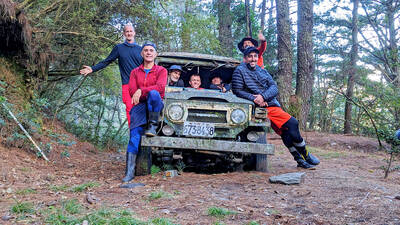
The year was 1991. A Toyota Land Cruiser set out on a 67km journey up the Junda Forest Road (郡大林道) toward an old loggers’ camp, at which point the hikers inside would get out and begin their ascent of Jade Mountain (玉山). Little did they know, they would be the last group of hikers to ever enjoy this shortcut into the mountains. An approaching typhoon soon wiped out the road behind them, trapping the vehicle on the mountain and forever changing the approach to Jade Mountain. THE CONTEMPORARY ROUTE Nowadays, the approach to Jade Mountain from the north side takes an

Last week Joseph Nye, the well-known China scholar, wrote on the Australian Strategic Policy Institute’s website about how war over Taiwan might be averted. He noted that years ago he was on a team that met with then-president Chen Shui-bian (陳水扁), “whose previous ‘unofficial’ visit to the US had caused a crisis in which China fired missiles into the sea and the US deployed carriers off the coast of Taiwan.” Yes, that’s right, mighty Chen caused that crisis all by himself. Neither the US nor the People’s Republic of China (PRC) exercised any agency. Nye then nostalgically invoked the comical specter

Relations between Taiwan and the Czech Republic have flourished in recent years. However, not everyone is pleased about the growing friendship between the two countries. Last month, an incident involving a Chinese diplomat tailing the car of vice president-elect Hsiao Bi-khim (蕭美琴) in Prague, drew public attention to the People’s Republic of China’s (PRC) operations to undermine Taiwan overseas. The trip was not Hsiao’s first visit to the Central European country. It was meant to be low-key, a chance to meet with local academics and politicians, until her police escort noticed a car was tailing her through the Czech capital. The
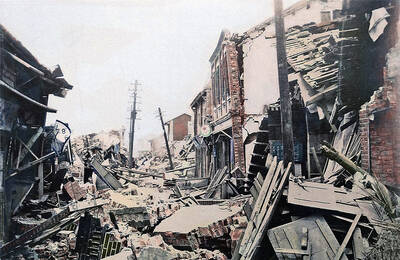
April 15 to April 21 Yang Kui (楊逵) was horrified as he drove past trucks, oxcarts and trolleys loaded with coffins on his way to Tuntzechiao (屯子腳), which he heard had been completely destroyed. The friend he came to check on was safe, but most residents were suffering in the town hit the hardest by the 7.1-magnitude Hsinchu-Taichung Earthquake on April 21, 1935. It remains the deadliest in Taiwan’s recorded history, claiming around 3,300 lives and injuring nearly 12,000. The disaster completely flattened roughly 18,000 houses and damaged countless more. The social activist and


 RSS
RSS