


With Lin Huai-min (
Luminous premiered in Tokyo in 2001 and was a hit at the Edinburgh International Festival last year. Teshigawara scored the music and designed the costumes with his long-time collaborator Kei Miyata, who is also a dancer in the performance and composer of the album Absolute Zero, from which the music is drawn.

PHOTO COURTESY OF DOMINIK MENTZOS
Teshigawara's idea of dance is the "movement of the senses," which "involves all of a person's consciousness and senses." Body movement is the visible part of this exercise, but there is also an invisible part, which is the reaching out of one sense to another when we are trying to relate to our surroundings.
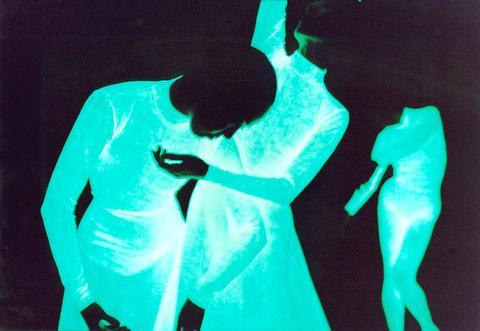
PHOTO COURTESY OF DOMINIK MENTZOS
Teshigawara launched his dance career in 1981 and founded his dance group, Karas, in Tokyo in 1985 after training in the plastic arts and classical ballet. He has choreographed for various European dance companies and has also dabbled in visual arts, film and video. For his own performances, he does scenography design, lighting and costumes.
In Luminous, Teshigawara and his company explore how the human body perceives and adapts to the spatial, visual and acoustic environment. Throughout the show, light "dances" with the performers. Dancers jump in and out of square panels of light. Mirrors create a play of light beams. Spotlights combine with the moving figures in liquid movements. Silhouettes of torsos and legs move eerily in light-boxes. When these stage devices are not present, the dancers become the light in florescent costumes, against dark backgrounds. A nun-like figure is suspended in mid-air and underneath are green figures seemingly trapped between the pages of a giant book that opens and closes. The brooding voice of English actor Evroy Deer tells a bewildering story about dark doves. In the second half of the show, Teshigawara performs a long solo to set up the mood for the highlight of the evening -- his duet with Stuart Jackson.
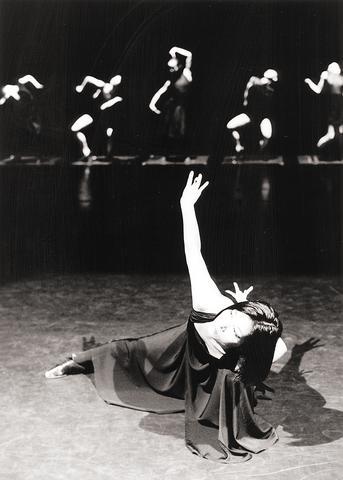
PHOTO COURTESY OF DOMINIK MENTZOS
Teshigawara was inspired to create this piece after seeing an exhibition in London on the origin of painting. Legend has it that an ancient Greek couple held candles against a wall to create silhouettes of each other, which they then drew.
"Light has always been integral to dance, but why it is so became a big puzzle for me," Teshigawara said. This was partly answered by his collaboration with Jackson, a blind and mentally challenged participant in the choreographer's STEP workshop for under-privileged teenagers in London.
"The blind do not dance to an external light but to their inner light. They become bodies of light when dancing," Teshigawara said.
"[Jackson] can't walk in straight lines. He was like an infant. But his greatest fear was putting his hands up toward the sky, which he could not sense with touch. For him, the world is what is touchable."
At the workshop, Teshigawara also trained Jackson in breathing techniques. "We used the stretch between inhale and exhale as a measure of movement .... His movements are thus not measured physically. He balances and gauges spatial distance by
breathing."
Another thing about Jackson that amazed Teshigawara was his propensity to move endlessly until he'd moved in a perfect circle. "He can't move straight but can move in perfect curves. He wouldn't stop until he'd turned a perfect circle. Come to think it, straight lines are entirely man-made. There's no straight lines on the human body. While we try to move straight, the blind circle with force and in a natural manner."
In their duet, Teshigawara and Jackson whirl hand-in-hand, again-and-again until the choreographer lets go of the blind dancer, then stands still, watching Jackson move in circles. The feeling, Teshigawara said, was like setting a bird free. "Stuart also told me that he felt free at that moment, like becoming a bird in flight."
Teshigawara's new project has taken him to France, where the 23-year-old Jackson acted as instructor to 20 blind and mentally challenged teenagers from 11 to 16 years old.
"It's the most difficult of all my projects so far. These teenagers cannot express themselves in clear language, but breathing is their common language. It breaks down the barriers set up by our different experiences. They're fragile in body but their inner being is immense. They dance like splinters of glass. It was so beautiful."
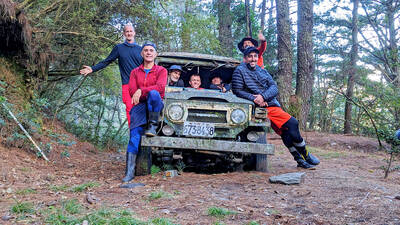
The year was 1991. A Toyota Land Cruiser set out on a 67km journey up the Junda Forest Road (郡大林道) toward an old loggers’ camp, at which point the hikers inside would get out and begin their ascent of Jade Mountain (玉山). Little did they know, they would be the last group of hikers to ever enjoy this shortcut into the mountains. An approaching typhoon soon wiped out the road behind them, trapping the vehicle on the mountain and forever changing the approach to Jade Mountain. THE CONTEMPORARY ROUTE Nowadays, the approach to Jade Mountain from the north side takes an

Last week Joseph Nye, the well-known China scholar, wrote on the Australian Strategic Policy Institute’s website about how war over Taiwan might be averted. He noted that years ago he was on a team that met with then-president Chen Shui-bian (陳水扁), “whose previous ‘unofficial’ visit to the US had caused a crisis in which China fired missiles into the sea and the US deployed carriers off the coast of Taiwan.” Yes, that’s right, mighty Chen caused that crisis all by himself. Neither the US nor the People’s Republic of China (PRC) exercised any agency. Nye then nostalgically invoked the comical specter

Relations between Taiwan and the Czech Republic have flourished in recent years. However, not everyone is pleased about the growing friendship between the two countries. Last month, an incident involving a Chinese diplomat tailing the car of vice president-elect Hsiao Bi-khim (蕭美琴) in Prague, drew public attention to the People’s Republic of China’s (PRC) operations to undermine Taiwan overseas. The trip was not Hsiao’s first visit to the Central European country. It was meant to be low-key, a chance to meet with local academics and politicians, until her police escort noticed a car was tailing her through the Czech capital. The
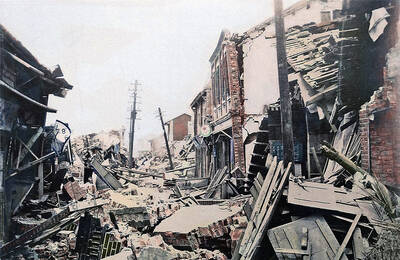
April 15 to April 21 Yang Kui (楊逵) was horrified as he drove past trucks, oxcarts and trolleys loaded with coffins on his way to Tuntzechiao (屯子腳), which he heard had been completely destroyed. The friend he came to check on was safe, but most residents were suffering in the town hit the hardest by the 7.1-magnitude Hsinchu-Taichung Earthquake on April 21, 1935. It remains the deadliest in Taiwan’s recorded history, claiming around 3,300 lives and injuring nearly 12,000. The disaster completely flattened roughly 18,000 houses and damaged countless more. The social activist and


 RSS
RSS