


Emile Biayenda wants to make you dance. Resistance is futile. The leader of Les Tambours de Brazza has brought a dozen men and as many drums to Taiwan for three shows, beginning tonight at the National Theater in Taipei. Attendees are advised to wear something to sweat in.
Les Tambours de Brazza take their name from Brazzaville, the capital of the Republic of Congo, from which they all come. More than a drum corps, Les Tambours can be considered musical diplomats from a nation in the midst of strife.
The Republic of Congo in west central Africa hosts over 50 different ethnic groups, each with not only its own local dialect, but also its own highly developed style of rhythm and dance. When he first put the group together in the early 1990s, Biayenda invited hundreds of drummers from around the nation to Brazzaville to play together, choosing the best of them to become Les Tambours de Brazza. The group made its first cassette tape together in 1992 and participated in the Jazz Mic Mac Festival in France in 1994. Since then their popularity has grown.
"It was a great group from the first day it was put together," said Biayenda in an interview from France, where the group now makes its home. "We're all from the same country, but never before had all these diverse traditions come to play with each other. We've always only ever fought each other."
Indeed, when Les Tambours toured to Europe in 1997, they were unable to return to their country as the whole region was in the middle of war and ethnic upheaval. Forced to settle in Benin, in the port city of Cotonou, they used that time to reach out to audiences in West Africa and Europe before settling in France in 2001. It was during this period that French audiences in particular began to recognize Les Tambours as something unique to Europe -- a genuine African drum corps. The group put out their first full album of music, 1997s Ahaando, followed three years later by Zangoula.
In the more than 10 years they've been together, Les Tambours have toured four continents and played such festivals as the Musiques Metisses d'Angouleme in France, the Couleur Cafe Festival in Brussels and in Denmark at the Images of Africa Festival.
Les Tambours base their music on the ngoma, a large, wood-and-goat-skin drum used for centuries to communicate across the continent and which Biayenda says is still used to celebrate the milestones of life. Ngoma translates as "power of the leopard" and to hear one of these drums beaten is something like having the animal leap at your chest. A dozen of them together can rend you apart.
"There is a contagiousness to the ngoma that is inescapable," Biayenda says. "It takes all the strength you have to play it and that energy is felt by the audience."
Biayenda, a self-educated jazz musician, actually leads the group on a standard drum kit. The rhythms he establishes, combined with the weight of the ngoma drums and lyrical melodies provided by the group's vocalist, show how much hip-hop and rhythm and blues owe to the musical traditions of the Bantu kingdoms. Les Tambours combines West African musical traditions with Western harmonies and arrangements.
While their first two albums were based on their stage shows, of which dance is an integral part, their most recent album has a more refined studio sound. Tandala, which means "Brazzaville" in the Congolese dialect, was released earlier this year. Though it still makes liberal use of the massive sound of the ngoma, Tandala departs from heavy rhythm on some tracks for the softer sounds of a simple thumb piano and vocals.
That's not to say their stage show is less ferocious than it once was. For all the energy put into pounding their drums, the group members put as much energy into an acrobatic dance routine that draws from traditional African dance, modern dance and even break dancing -- exemplifying even further how today's popular music has its roots in West African traditions.
This influence is important to Biayenda, who hopes that the members of Les Tambours and their music might one day have a similar influence on the world. "Our country has many problems," he says, citing AIDS, famine and war that have ravaged the Congo. "But they are all problems that we can overcome."
The members of Les Tambours are proof that they can be overcome. And if we can overcome these problems in Africa, where the people have so little, that should give great hope to the rest of the world.
Les Tambours de Brazza play the National Theater in Taipei on Monday, Dec. 15 and Tuesday, Dec. 16 at
7:30pm before moving to Kaohsiung for a concert at Chih Teh Hall Friday, Dec. 19 at 7:30pm. Tickets cost between NT$400 and NT$1,200 and are available through Acer Ticket outlets, on the Web at http://www.ticket.com.tw/, or at the door.

Last week Joseph Nye, the well-known China scholar, wrote on the Australian Strategic Policy Institute’s website about how war over Taiwan might be averted. He noted that years ago he was on a team that met with then-president Chen Shui-bian (陳水扁), “whose previous ‘unofficial’ visit to the US had caused a crisis in which China fired missiles into the sea and the US deployed carriers off the coast of Taiwan.” Yes, that’s right, mighty Chen caused that crisis all by himself. Neither the US nor the People’s Republic of China (PRC) exercised any agency. Nye then nostalgically invoked the comical specter

Relations between Taiwan and the Czech Republic have flourished in recent years. However, not everyone is pleased about the growing friendship between the two countries. Last month, an incident involving a Chinese diplomat tailing the car of vice president-elect Hsiao Bi-khim (蕭美琴) in Prague, drew public attention to the People’s Republic of China’s (PRC) operations to undermine Taiwan overseas. The trip was not Hsiao’s first visit to the Central European country. It was meant to be low-key, a chance to meet with local academics and politicians, until her police escort noticed a car was tailing her through the Czech capital. The
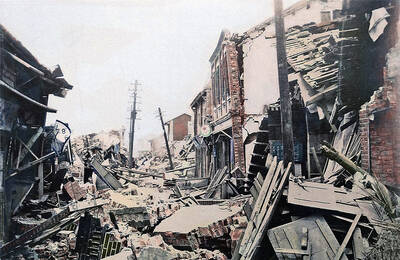
April 15 to April 21 Yang Kui (楊逵) was horrified as he drove past trucks, oxcarts and trolleys loaded with coffins on his way to Tuntzechiao (屯子腳), which he heard had been completely destroyed. The friend he came to check on was safe, but most residents were suffering in the town hit the hardest by the 7.1-magnitude Hsinchu-Taichung Earthquake on April 21, 1935. It remains the deadliest in Taiwan’s recorded history, claiming around 3,300 lives and injuring nearly 12,000. The disaster completely flattened roughly 18,000 houses and damaged countless more. The social activist and

Over the course of former President Ma Ying-jeou’s (馬英九) 11-day trip to China that included a meeting with Chinese Communist Party (CCP) leader Xi Jinping (習近平) a surprising number of people commented that the former president was now “irrelevant.” Upon reflection, it became apparent that these comments were coming from pro-Taiwan, pan-green supporters and they were expressing what they hoped was the case, rather than the reality. Ma’s ideology is so pro-China (read: deep blue) and controversial that many in his own Chinese Nationalist Party (KMT) hope he retires quickly, or at least refrains from speaking on some subjects. Regardless


 RSS
RSS