


As Americans prepare to celebrate the centennial of the Wright brothers' first flight, a whole country is cringing at what it believes to be a historical injustice against one of its most beloved heroes.
Ask anyone in Brazil who invented the airplane and they will say Alberto Santos-Dumont, a 160cm bon vivant who was as well known for his aerial prowess as he was for his dandyish dress and high-society life in Belle Epoque Paris.
As Paul Hoffman recounts in his Santos-Dumont biography Wings of Madness, the eccentric Brazilian was the first and only person to own a personal flying machine that could take him just about anywhere he wanted to go.
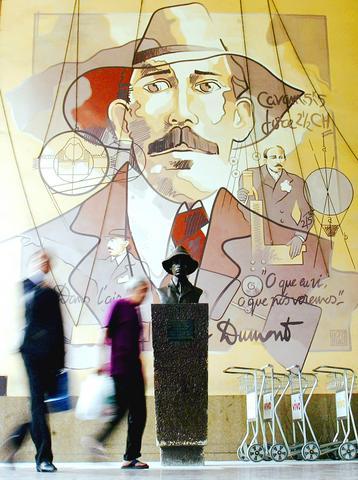
PHOTO: REUTERS
"He would keep his dirigible tied to a gas lamp post in front of his Paris apartment at the Champs-Elysees and every night he would fly to Maxim's for dinner. During the day he'd fly to go shopping, he'd fly to visit friends," Hoffman said.
An idealist who believed flight was spiritually soothing, Santos-Dumont financed his lavish lifestyle and aerial experiments in Paris with the inheritance his coffee-farming father had advanced him as a young man. Always impeccably dressed, he regularly took a gourmet lunch with him on his ballooning expeditions.
It was on Nov. 12, 1906, when Santos-Dumont flew a kite-like contraption with boxy wings called the 14-Bis some 220m in the outskirts of Paris. It being the first public flight in the world, he was hailed as the inventor of the airplane all over Europe.
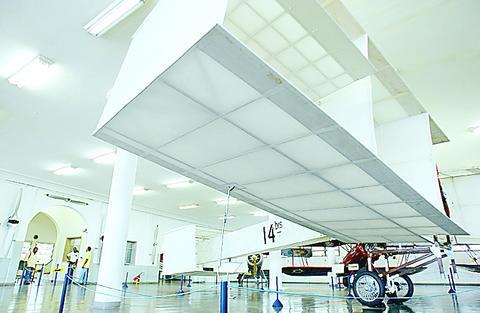
PHOTO: REUTERS
It was only later that the secretive Orville and Wilbur Wright proved they had beaten Santos-Dumont at Kitty Hawk, North Carolina, three years earlier on Dec. 17.
But to bring up the Wright brothers with a Brazilian is bound to elicit an avalanche of arguments -- some more reasonable than others -- as to why their compatriot's flight didn't count.
"It's one of the biggest frauds in history," scoffs Wagner Diogo, a taxi driver in Rio de Janeiro, of the Wrights' inaugural flight. "No one saw it and they used a catapult to launch" the airplane.
DID IT COUNT?
Apparently, the debate comes down to how you define the first flight of an airplane.
Henrique Lins de Barros, a Brazilian physicist and Santos-Dumont expert, argues that the Wright brothers' flight did not fulfil the conditions that had been set up at the time to distinguish a true flight from a prolonged hop.
But Santos-Dumont's flight did meet the criteria, which in essence meant he took off unassisted, publicly flew a predetermined length in front of experts and then landed safely.
"If we understand what the criteria were at the end of the 19th century, the Wright brothers simply do not fill any of the prerequisites," says Lins de Barros.
Brazilians also claim that the Wrights launched their Flyer in 1903 with a catapult or at an incline, thereby disqualifying it from being a true airplane because it did not take off on its own.
Even Santos-Dumont experts like Lins de Barros concede this is wrong. But he says that the strong, steady winds at Kitty Hawk were crucial for the Flyer's take-off, disqualifying the flight because there was no proof it could lift off on its own.
Peter Jakab, chairman of the aeronautics division at the National Air and Space Museum in Washington and a Wright brothers expert, says such claims are preposterous.
By the time Santos-Dumont got around to his maiden flight the Wright brothers had already flown numerous times, including one in which they flew 39km in 40 minutes.
"Even in 1903 the airplane sustained itself in the air for nearly a minute. If it's not sustaining itself under its own power it's not going to stay up that long," Jakab says.
Even in France -- never a country too eager to agree with the US point of view -- the Wrights are considered to have flown before Santos-Dumont, says Claude Carlier, the director of the French Centre for the History of Aeronautics and Space.
"There's a strong nationalist issue at play here," says Marcos Villares, Santos-Dumont's great grandnephew. "Flight was a very important step in human history, in the history of technology. Every country wants to claim priority."
FATHER TIME?
But that is not to say that Santos-Dumont does not deserve recognition for his other contributions.
By rounding the Eiffel Tower in a motorized dirigible in 1901, he helped prove that air travel could be controlled and a practical means of transportation.
"Just to show that the flying machine was practical is an incredible achievement," says Hoffman, his biographer.
At his summer home in the Brazilian mountain town of Petropolis, tour guides perpetuate myths about Santos-Dumont -- such as how he invented the wristwatch.
Santos-Dumont experts deny that assertion, although they concede he was probably the first male civilian to use a watch after asking his friend Louis Cartier to make him a timepiece he could use while flying. Previously, only royalty and soldiers had used watches.
To this day, you can still buy the Santos-model Cartier watch for only a couple of thousand dollars.

In late October of 1873 the government of Japan decided against sending a military expedition to Korea to force that nation to open trade relations. Across the government supporters of the expedition resigned immediately. The spectacle of revolt by disaffected samurai began to loom over Japanese politics. In January of 1874 disaffected samurai attacked a senior minister in Tokyo. A month later, a group of pro-Korea expedition and anti-foreign elements from Saga prefecture in Kyushu revolted, driven in part by high food prices stemming from poor harvests. Their leader, according to Edward Drea’s classic Japan’s Imperial Army, was a samurai

Located down a sideroad in old Wanhua District (萬華區), Waley Art (水谷藝術) has an established reputation for curating some of the more provocative indie art exhibitions in Taipei. And this month is no exception. Beyond the innocuous facade of a shophouse, the full three stories of the gallery space (including the basement) have been taken over by photographs, installation videos and abstract images courtesy of two creatives who hail from the opposite ends of the earth, Taiwan’s Hsu Yi-ting (許懿婷) and Germany’s Benjamin Janzen. “In 2019, I had an art residency in Europe,” Hsu says. “I met Benjamin in the lobby
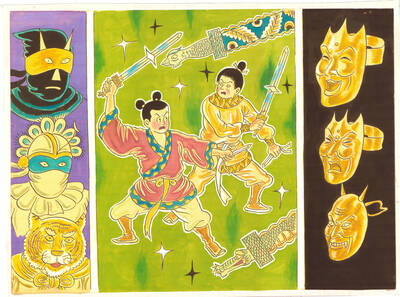
April 22 to April 28 The true identity of the mastermind behind the Demon Gang (魔鬼黨) was undoubtedly on the minds of countless schoolchildren in late 1958. In the days leading up to the big reveal, more than 10,000 guesses were sent to Ta Hwa Publishing Co (大華文化社) for a chance to win prizes. The smash success of the comic series Great Battle Against the Demon Gang (大戰魔鬼黨) came as a surprise to author Yeh Hung-chia (葉宏甲), who had long given up on his dream after being jailed for 10 months in 1947 over political cartoons. Protagonist

Peter Brighton was amazed when he found the giant jackfruit. He had been watching it grow on his farm in far north Queensland, and when it came time to pick it from the tree, it was so heavy it needed two people to do the job. “I was surprised when we cut it off and felt how heavy it was,” he says. “I grabbed it and my wife cut it — couldn’t do it by myself, it took two of us.” Weighing in at 45 kilograms, it is the heaviest jackfruit that Brighton has ever grown on his tropical fruit farm, located


 RSS
RSS