


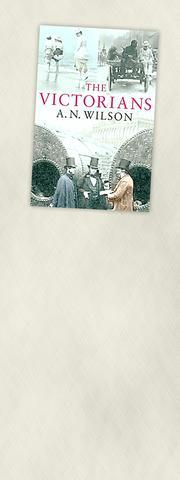
Fairness is what A.N.Wilson can most appropriately be praised for in this monumental study, now in paperback, of the era when the UK ruled a large part of the earth.
His long chapter on the Indian Mutiny of 1857 is typical. All his instincts, you feel, are on the side of the Indians. The sepoys who were the first to refuse to use the new cartridges that they feared were greased with the fat of animals their religions forbade them to touch -- and 85 of whom were severely humiliated for their refusal -- turned out to be the most loyal to the British of all the Indian troops in the widespread insurrection that subsequently broke out. Wilson, moreover, even refuses to call it a mutiny, putting the word in "inverted commas" and suggesting it may best be seen as the start of the Indian struggle for independence, finally won 90 years later.
Yet his is essentially a balanced view. The atrocities committed were equal on both sides, he thinks, and elsewhere writes of the
development of higher education in India under the British, and the number of Indians attending British universities. And he wonders whether, in retrospect, the imperial mantle ever really suited the British at all.
Much of Britain's enormous wealth in Victorian times derived from Asia. Hong Kong, originally acquired as a port through which to sell opium into China, quickly became the entrepot for the whole world's trade with the Celestial Empire. And George Gordon, hero (in British eyes) of Khartoum, was always known as "Chinese Gordon" following his perceived role in helping end the Taiping Rebellion of 1850 to 1864.
If there is a single theme in this big book it's Wilson's search for an alternative radicalism to Karl Marx's. Once the British national tone becomes one of "an alarming triumph song," he is left with the feeling that "only in its dissentient voices is redemption found." Why there was no revolution in Britain, when the inequalities of wealth were so huge and the condition of the poor so very terrible, is one of his constant concerns.
His heroes turn out to be the Christian radicals such as Henry Manning, later cardinal, whose image the Amalgamated Society of Watermen and Lightermen of Greenwich, a trades union, stitched so lovingly onto its processional banner; and Josephine Butler, campaigner against legislation that effectively victimized the women, but not their male customers, involved in licensed prostitution in areas surrounding military barracks.
Wilson's championing of Christian social activists is not unexpected. He has all his life been involved in some way with Christianity. He's written biographies of Jesus, St. Paul, John Milton (author of Paradise Lost) and the 20th century Christian apologist C.S. Lewis. And the book that preceded The Victorians was God's Funeral, about the extensive loss of faith in Christianity among educated Europeans in the latter part of the 19th century.
Unbelief was far more widespread among the ruling elite than is popularly supposed, Wilson insists. The Duke of Sussex, for instance, uncle of Queen Victoria, had drawn a hand in a prayer book he owned pointing at the Athanasian Creed and written "I don't believe a word of it." Novelist George Eliot was only one of many eminent non-believers.
Wilson is also something of a sexual radical. His 1998 novel Dream Children portrayed a relationship between an adult man and a distinctly under-age girl without any obvious censure. And in The Victorians there is plenty of detail on the sexual proclivities of leading figures.
He describes having been told in his youth by the socialite Lady Diana Cooper how, as a young girl, she sat at a dinner next to Earl Asquith, the British prime minister during World War I. He took her hand, she related, and placed it inside his trousers under the tablecloth. When she complained of this to her mother, she was told to be grateful she hadn't attracted British commander-in-chief, Lord Kitchener. His enthusiasm was apparently for sodomy, whether with a woman or another man didn't much matter.
This is a long book, but the Victorians need length. The mind reels under the images left from reading it -- railways increasing the speed man could move across land 20 times; five postal deliveries a day in central London, the post-boys resplendent in their red and gold uniforms; men strapped (standing) to the mouths of cannon and blasted to smithereens by grapeshot in reprisals for the Indian Mutiny; a peaceful solution to the problem of Ireland -- still unresolved -- within arm's reach until Charles Stewart Parnell (pronounced PARn'll, Wilson points out) was accused of adultery; Catholicism's re-emergence in English life, and so much more. The massive energy that displayed itself in almost all walks of life was phenomenal.
Some of Wilson's other heroes are Thomas Carlyle (whose complete works in 30 volumes the philosopher Anthony Quinton gave him when moving house and trimming his library), Prince Albert, Robert Browning, Charles Dickens, W.E. Gladstone and Charles Kingsley, author of The Water Babies. But there are so many, and you can't help feeling that once he got down to studying a particular figure, Wilson soon found much to praise.
The book actually feels as if it was pasted together from sections, each of around three pages, and the resulting mass of papers shuffled into a huge and totally engrossing compilation. (Wilson attests to the fact that he completed the entire project in longhand). And how else could such a mammoth task be accomplished? A typical section will cover a character and his or her achievements, a topic or a major event. Each such section can be seen as about a day's work, and you can imagine Wilson setting off on foot from his home in London's Camden Town to the British Library, rubbing his hands together in anticipation and saying "Let's do Alfred Tennyson today!"
If you enjoy history, and are going away for Christmas and want to take one book to last you the whole trip, this could be an ideal choice.

In late October of 1873 the government of Japan decided against sending a military expedition to Korea to force that nation to open trade relations. Across the government supporters of the expedition resigned immediately. The spectacle of revolt by disaffected samurai began to loom over Japanese politics. In January of 1874 disaffected samurai attacked a senior minister in Tokyo. A month later, a group of pro-Korea expedition and anti-foreign elements from Saga prefecture in Kyushu revolted, driven in part by high food prices stemming from poor harvests. Their leader, according to Edward Drea’s classic Japan’s Imperial Army, was a samurai

Approaching her mid-30s, Xiong Yidan reckons that most of her friends are on to their second or even third babies. But Xiong has more than a dozen. There is Lucky, the street dog from Bangkok who jumped into a taxi with her and never left. There is Sophie and Ben, sibling geese, who honk from morning to night. Boop and Pan, both goats, are romantically involved. Dumpling the hedgehog enjoys a belly rub from time to time. The list goes on. Xiong nurtures her brood from her 8,000 square meter farm in Chiang Dao, a mountainous district in northern Thailand’s

Located down a sideroad in old Wanhua District (萬華區), Waley Art (水谷藝術) has an established reputation for curating some of the more provocative indie art exhibitions in Taipei. And this month is no exception. Beyond the innocuous facade of a shophouse, the full three stories of the gallery space (including the basement) have been taken over by photographs, installation videos and abstract images courtesy of two creatives who hail from the opposite ends of the earth, Taiwan’s Hsu Yi-ting (許懿婷) and Germany’s Benjamin Janzen. “In 2019, I had an art residency in Europe,” Hsu says. “I met Benjamin in the lobby
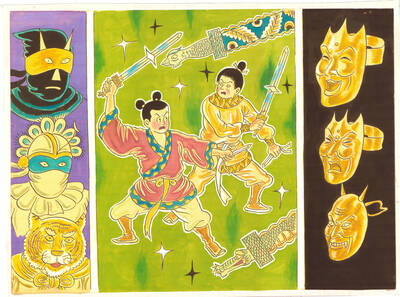
April 22 to April 28 The true identity of the mastermind behind the Demon Gang (魔鬼黨) was undoubtedly on the minds of countless schoolchildren in late 1958. In the days leading up to the big reveal, more than 10,000 guesses were sent to Ta Hwa Publishing Co (大華文化社) for a chance to win prizes. The smash success of the comic series Great Battle Against the Demon Gang (大戰魔鬼黨) came as a surprise to author Yeh Hung-chia (葉宏甲), who had long given up on his dream after being jailed for 10 months in 1947 over political cartoons. Protagonist


 RSS
RSS