


First, I thought dance is such a visual thing that I would never understand it, but now I find that I can enjoy it to the full," said Chan Zhi-ping (
In the screening room of the Chinese Culture University in Taipei last Saturday, an audience of some 40 visually impaired people felt the 12 pairs of tap dance shoes that were making sounds in the room, while listening to the audio description of an Irish tap dance group's most celebrated work. With the thrilling traditional music and Irish ballads in the background, a female voice described the tap dancing steps, as well as the stage settings, special effects and lighting. More voices dubbed the dialogues of the show. It was a busy 90 minutes in which complicated bodily movements were translated into language.
To describe a dance film is the Audio Description Association's (
"I realize that dance shows are not off-limits for me after all. Now I would like to explore the world of performance arts of other kinds, too," Chan said.
For four years, the association, the only organization in Taiwan to produce audio description programs, has made over 20 films and plays, starting with Public Television Service's drama series Sun Yat-sen. The most well-known programs are the movie Crouching Tiger, Hidden Dragon and the Performance Workshop's new play Mumble Jumble.
While dialogue-heavy theater or movies are relatively easy to do, the association took one giant step forward by audio describing fine arts at last year's Fauvist painter Henri Matisse's exhibition at the National Museum of History. Next to the three-dimensional renditions of the paintings, which the French co-organizer provided, the association wrote and described their combinations of shapes and colors.
"After we'd done fine arts, we wanted to go one step further by audio describing something usually was thought to be purely visual and that is dance," said Chao Ya-li (
The film seemed to have worked its magic on the blind audience. "It reminded me of the visual world that I lost. I can picture in my head what the show was all about," Chan said.
Lee Yi-huei (
Lin Hsin-ting (
But Lin also found the description confusing as the tracks of English dialogue, Chinese translations, and captioning of the visual goings-on overlap sometimes. "It probably can't be helped because the dance shows are by nature too difficult to be fully described with words."
"The biggest difficulty in making this version is technical. A four minute long performance can fit only 240 words at most, but it's so little information compared what you can see at one glance. The person writing the descriptions has to have a good command of both performance arts and the language comprehensible to the visually impaired," Chao said.
Despite the difficulty, made worse by small size of her production team of untrained graduate students, Chao insisted on doing the dance film because the visually impaired need it. "When visually impaired people hear their sighted friends talking about the latest show, they want to know about it too so they have topics in common with other people. We chose Magic of the Dance also because the show is very popular both here and in Europe. They can talk about the show with many people," Chao said.
After the film finishes touring eight locations across Taiwan, it will become part of the collection of the Council for Cultural Affairs, which funded the project. Audio described versions of films in local libraries, however (as in the US), is nowhere near realization due to a lack of legislation regarding copyright. Copyright issues also limit the film's screenings to schools instead of theaters.
"There's a long way to go before these films become widely available. The government policies for the visually impaired at present still focus on improving their livelihood with vocational training. But a blind person's life can be more sorrowful than healthy people. Participating in cultural activities can do them good. It may also bring out their artistic talents, which then give them wider career options," Chao said.
Magic of the Dance is also the first audio described version of a foreign-language film. The need for well-known Hollywood movies, as Chan concedes, is more urgent than dance shows because it makes the visually impaired part of pop culture.
"I love foreign movies, but I have to have two friends with me in the theater. One to interpret the English dialogue and the other to describe movements," Chan said, laughing about the trouble it caused his friends.
Chao admitted that audio description was costly and involved a lot of time and personnel."It would be possible [to do more] if we had more support, particularly from the private sector, to set up systematic training programs for audio-description professionals. But this deficiency of such professionals is a world-wide problem," Chao said.
"The sighted often underestimate the blind's longing for the visual world. They are actually very curious about sights, about movies and fine arts. They can enjoy these things equally if we construct their visual world for them through language, which we all have in common," Chao concluded.

In late October of 1873 the government of Japan decided against sending a military expedition to Korea to force that nation to open trade relations. Across the government supporters of the expedition resigned immediately. The spectacle of revolt by disaffected samurai began to loom over Japanese politics. In January of 1874 disaffected samurai attacked a senior minister in Tokyo. A month later, a group of pro-Korea expedition and anti-foreign elements from Saga prefecture in Kyushu revolted, driven in part by high food prices stemming from poor harvests. Their leader, according to Edward Drea’s classic Japan’s Imperial Army, was a samurai
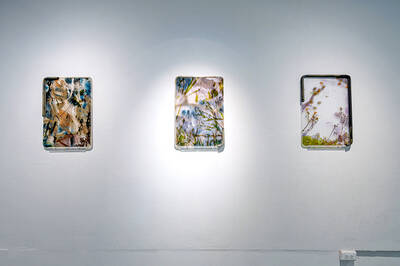
Located down a sideroad in old Wanhua District (萬華區), Waley Art (水谷藝術) has an established reputation for curating some of the more provocative indie art exhibitions in Taipei. And this month is no exception. Beyond the innocuous facade of a shophouse, the full three stories of the gallery space (including the basement) have been taken over by photographs, installation videos and abstract images courtesy of two creatives who hail from the opposite ends of the earth, Taiwan’s Hsu Yi-ting (許懿婷) and Germany’s Benjamin Janzen. “In 2019, I had an art residency in Europe,” Hsu says. “I met Benjamin in the lobby
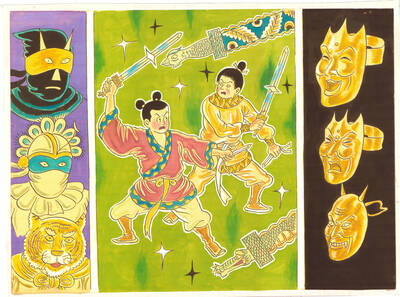
April 22 to April 28 The true identity of the mastermind behind the Demon Gang (魔鬼黨) was undoubtedly on the minds of countless schoolchildren in late 1958. In the days leading up to the big reveal, more than 10,000 guesses were sent to Ta Hwa Publishing Co (大華文化社) for a chance to win prizes. The smash success of the comic series Great Battle Against the Demon Gang (大戰魔鬼黨) came as a surprise to author Yeh Hung-chia (葉宏甲), who had long given up on his dream after being jailed for 10 months in 1947 over political cartoons. Protagonist

Peter Brighton was amazed when he found the giant jackfruit. He had been watching it grow on his farm in far north Queensland, and when it came time to pick it from the tree, it was so heavy it needed two people to do the job. “I was surprised when we cut it off and felt how heavy it was,” he says. “I grabbed it and my wife cut it — couldn’t do it by myself, it took two of us.” Weighing in at 45 kilograms, it is the heaviest jackfruit that Brighton has ever grown on his tropical fruit farm, located


 RSS
RSS