


At the beginning of Far From Heaven, the camera drifts downward toward the tidy streets of Hartford, through a screen of blood-red maple leaves. It is autumn 1957, and like the New England foliage, the people of Hartford are chilled into vivid, lurid color by the frost of middle-class, midcentury propriety.
The bright clothes they wear, the baroque interiors of their houses, the jarring pastel tones of their enormous cars all stand in contrast to the constriction of their emotional lives and the narrow range of expression their bizarre, disconcertingly familiar world allows.
The visual and aural texture of Todd Haynes's ardent and intelligent new film provides a kind of subliminal commentary on its story of thwarted desire and soul-killing pretense. All of the wild, unruly feeling that the characters must repress pops to life around them, in every detail of Mark Friedberg's production design, Edward Lachman's painterly cinematography, Sandy Powell's delectable costumes and, above all, the great Elmer Bernstein's sobbing, swooping score.
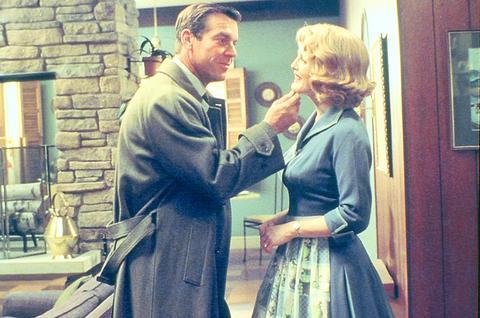
Bernstein's music, which plays beneath nearly every scene, puts the melody in this melodrama, and Haynes, fading breathlessly from one scene to the next, reaches moments of operatic intensity that seem disproportionate to his tale of genteel bigotry and marital dysfunction. But that's the point of the movie, and the source of its troubling beauty. It suggests that the 1950s facade of normalcy -- represented by the routinized, orderly lives of Frank and Cathy Whitaker (Dennis Quaid and Julianne Moore) -- concealed both incendiary passions and a ruthless social machinery devoted to their suppression.
Of course, this is hardly a new idea; it was, indeed, part of the era's understanding of itself. Far From Heaven, which opens today in Taiwan, is both a movie about the 1950s and a tribute to some of the great movies of the 1950s, in particular the Technicolor melodramas that Douglas Sirk made in collaboration with the producer Ross Hunter for Universal Pictures.
Those pictures -- including Magnificent Obsession, Written on the Wind, Imitation of Life and All That Heaven Allows -- were popular with audiences in their day, but they were regarded with condescension by critics and other sophisticates suspicious of their soapy, maudlin extravagance.

COURTESY OF SWALLOW WINGS FILMS
As was the case with so much postwar American popular culture, the subtlety and complexity of Sirk's art -- in particular his subversive knack for tucking social criticism and psychological insight into stories governed by the constraints of the Production Code and the conventions of the tear-jerker -- were appreciated only in retrospect, in part through Sirk's influence on later filmmakers, notably Ranier Werner Fassbinder.
Like Fassbinder, Haynes, whose previous features are Poison, Safe and The Velvet Goldmine, is interested both in updating Sirk and in reproducing his fluid, incandescent style. He wants, in effect, to appeal to that part of the audience that is flattered by knowing, analytical entertainments and, at the same time, to seduce us out of our intellectual cocoon into a state of pure, unbridled feeling -- to bridge the gap between the Eisenhower-era housewives who were Sirk's original audience and the aesthetes who secured his belated entry into the auteurist pantheon.
This is a remarkable ambition, but also an eminently sensible one: the union of art and sensation, intellect and feeling, mass appeal and aesthetic refinement is something the movies are uniquely able to promise, and occasionally, when a filmmaker possesses the right mixture of calculation and compassion, able to deliver.
For a director who got his start working with Barbie dolls (in Superstar, his harrowing short film about the life of Karen Carpenter), Haynes is fiercely devoted to his actors. Moore, who played the unhappy suburban housewife in Safe, here plays a heartbreaking variation on the theme. At first, Cathy is almost a caricature of domestic fulfillment, driving her daughter home from ballet class in a sky-blue station wagon, planning her annual cocktail party with her best friend, Eleanor (the splendidly wicked Patricia Clarkson), and welcoming a reporter and a photographer from the local society pages into her meticulously decorated home.
But Haynes never mocks Cathy's happiness, even as he chronicles its unraveling. Though her face is framed by stiff curls and masked with rouge and lipstick, Moore (who was pregnant during the filming) glows with warmth, curiosity and goodness -- the very qualities, Haynes suggest, that cause Cathy so much trouble.
Her life is complicated by the discovery of her husband's homosexuality and then (perhaps consequently) by her friendship with Raymond Deagan (Dennis Haysbert), a black gardener. Their relationship -- chaste, but charged with mutual longing -- and Frank's sexuality are, of course, matters that Sirk could have addressed only obliquely. But though he is more candid than he could have been in the 50s, Haynes refrains from tearing aside the veil of euphemism and hypocrisy that shrouds his characters' lives. For one thing, he is as fond of the language of the period as he is of its interior decoration; the dialogue he has written is highly stylized, at times almost to the point of Coen brothers campiness. Cathy scolds her son when he says things like "shucks" and "jeez," and Eleanor reels off a litany of insinuating synonyms for homosexual (the funniest of which turns out to be "wickedly successful Gotham art dealer").
But by observing -- and even, to some extent, exaggerating -- the decorum of the era, Haynes gives Far From Heaven an emotional impact that could not have been achieved by conventionally realistic means.
The most casual moments are suffused with a feeling of emotional extremity; the air is as charged and threatening as it might be in a horror film. Everyone in this world seems terribly alone -- Cathy increasingly so -- and at the same time under constant surveillance, spied upon and gossiped about, an instant away from betrayal or ostracism.
The film's rawer moments -- when Frank explodes into obscenity, when Cathy catches him kissing a man, when Raymond's young daughter is attacked by a group of white schoolboys -- feel almost unbearably brutal. And the actors invest their smallest gestures with the weight of inexpressible feeling.
Quaid's handsome face is twisted with suffering and self-loathing, and his performance is all the more shattering because he thwarts our compassion. Frank's misery transmutes, all too easily, into cruelty directed at his wife.
Haysbert is equally powerful in a performance that goes in the opposite direction. On the surface, Raymond is all reticence, decency and good manners -- liberal Hollywood's dream of the noble, upwardly mobile Negro. But Haysbert and Haynes conspire to subvert this stereotype, too. Along with Viola Davis, who plays Cathy's housekeeper, they pay homage to Sirk's grandest, most radical picture, Imitation of Life, in which Juanita Moore took the cinema archetype of the selfless black servant and turned her into a human being.
And this, in effect, is what Far From Heaven accomplishes for all of its characters. It rediscovers the aching, desiring humanity in a genre -- and a period -- too often subjected to easy parody or ironic appropriation. In a word, it's divine.

In late October of 1873 the government of Japan decided against sending a military expedition to Korea to force that nation to open trade relations. Across the government supporters of the expedition resigned immediately. The spectacle of revolt by disaffected samurai began to loom over Japanese politics. In January of 1874 disaffected samurai attacked a senior minister in Tokyo. A month later, a group of pro-Korea expedition and anti-foreign elements from Saga prefecture in Kyushu revolted, driven in part by high food prices stemming from poor harvests. Their leader, according to Edward Drea’s classic Japan’s Imperial Army, was a samurai

The following three paragraphs are just some of what the local Chinese-language press is reporting on breathlessly and following every twist and turn with the eagerness of a soap opera fan. For many English-language readers, it probably comes across as incomprehensibly opaque, so bear with me briefly dear reader: To the surprise of many, former pop singer and Democratic Progressive Party (DPP) ex-lawmaker Yu Tien (余天) of the Taiwan Normal Country Promotion Association (TNCPA) at the last minute dropped out of the running for committee chair of the DPP’s New Taipei City chapter, paving the way for DPP legislator Su

Located down a sideroad in old Wanhua District (萬華區), Waley Art (水谷藝術) has an established reputation for curating some of the more provocative indie art exhibitions in Taipei. And this month is no exception. Beyond the innocuous facade of a shophouse, the full three stories of the gallery space (including the basement) have been taken over by photographs, installation videos and abstract images courtesy of two creatives who hail from the opposite ends of the earth, Taiwan’s Hsu Yi-ting (許懿婷) and Germany’s Benjamin Janzen. “In 2019, I had an art residency in Europe,” Hsu says. “I met Benjamin in the lobby

It’s hard to know where to begin with Mark Tovell’s Taiwan: Roads Above the Clouds. Having published a travelogue myself, as well as having contributed to several guidebooks, at first glance Tovell’s book appears to inhabit a middle ground — the kind of hard-to-sell nowheresville publishers detest. Leaf through the pages and you’ll find them suffuse with the purple prose best associated with travel literature: “When the sun is low on a warm, clear morning, and with the heat already rising, we stand at the riverside bike path leading south from Sanxia’s old cobble streets.” Hardly the stuff of your


 RSS
RSS