


Hugely popular stage director Stan Lai (
Loosely based on -- and drawing inspiration from -- Edward Lam's hit play, Eat, Money, Man, Woman (

PHOTO: GEORGE TSRONG, TAIPEI TIMES
Along with highlighting the improvisational talents of some of Taiwan's top theater actors and actresses, Mumble Jumble also features an appearance by popular songstress, Dadawa (
"We've gathered together a really strong cast of actors, all of whom have a genuine talent for improvisation," Lai said. "The production might not be in a style that people have come to expect from us, but I think because of the talented cast, along with the topics it touches on, it will still prove popular. Even with audiences not used to such madcap and out of the ordinary theater."
Under Lai's directorship, Performance Workshop has become one of Taiwan's leading contemporary theater groups since being founded in 1984. Along with performing, the group has also collaborated with any of the nation's smaller theater troupes .
As one of the most influential voices in Chinese-language theater, Lai has penned a staggering 23 original plays. He has toured worldwide and his 1992 production of The Peach Blossom Land (暗戀桃花源) has been made into a film. The play has had 50 different productions in Beijing alone. His most recent production, the seven hour epic, A Dream like A Dream, received top awards at this years Hong Kong Drama Awards.
Lai's group has managed to set itself apart from many of the nation's other theater troupes because of its reliance on social-political aspects and topical features as the basis for its productions over the years.
Previous popular productions have included a reworking of Samuel Beckett's Waiting for Godot as well as the locally written Love On a Two-Way Street (
The group's most recent production was Sand and a Distant Star (
It's back down to Earth with a bang for the Performance Workshop's latest production, however. Produced in close collaboration with artists from Hong Kong and China, Mumble Jumble forges a new-brand of Chinese theater which focuses on society and politics in Taiwan in a series of improvised scenes, all of which unfold in a wild and comedic fashion.
"The production is a bit different from our previous shows in the sense that there's no central plot and some of the dialogue is improvisational," Lai said. "By welding together series of sketches and scenes we've come up with a production concept that has never been tried in Taiwan before."
With a minimalist set, which along with a digital display, consists predominantly of projected photographs of city landscapes, the production moves quickly through a series of 11 real life and imaginary scenes.
The inane skits include a lecture that turns into an exercise in democracy and a mysterious phone call that leads to an even more puzzling meeting, as well as a Taiwanese hijacker who needs three translators to get her message across to the pilot.
The most provocative sketch and one that, according to Lai, "pushes the limits of live theater," is Mother Tongue, which sees a professor teaching the audience how to cuss. Adding even more madness to the insanity are a host of characters who claim to be a dog, a concept, virtual reality, a scoop of chocolate ice cream and a cartoon.
It might all sound a bit farfetched and fanciful, but there is actually method to the madness that reigns in the Performance Workshop's Mumble Jumble.
The Performance Workshop's (

In late October of 1873 the government of Japan decided against sending a military expedition to Korea to force that nation to open trade relations. Across the government supporters of the expedition resigned immediately. The spectacle of revolt by disaffected samurai began to loom over Japanese politics. In January of 1874 disaffected samurai attacked a senior minister in Tokyo. A month later, a group of pro-Korea expedition and anti-foreign elements from Saga prefecture in Kyushu revolted, driven in part by high food prices stemming from poor harvests. Their leader, according to Edward Drea’s classic Japan’s Imperial Army, was a samurai
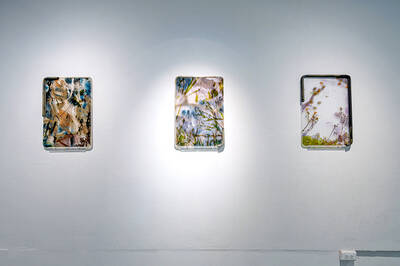
Located down a sideroad in old Wanhua District (萬華區), Waley Art (水谷藝術) has an established reputation for curating some of the more provocative indie art exhibitions in Taipei. And this month is no exception. Beyond the innocuous facade of a shophouse, the full three stories of the gallery space (including the basement) have been taken over by photographs, installation videos and abstract images courtesy of two creatives who hail from the opposite ends of the earth, Taiwan’s Hsu Yi-ting (許懿婷) and Germany’s Benjamin Janzen. “In 2019, I had an art residency in Europe,” Hsu says. “I met Benjamin in the lobby
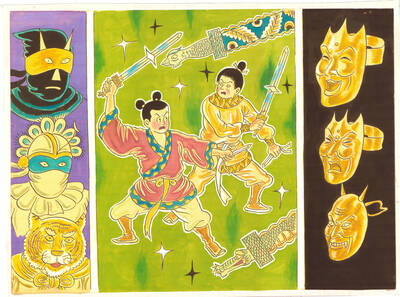
April 22 to April 28 The true identity of the mastermind behind the Demon Gang (魔鬼黨) was undoubtedly on the minds of countless schoolchildren in late 1958. In the days leading up to the big reveal, more than 10,000 guesses were sent to Ta Hwa Publishing Co (大華文化社) for a chance to win prizes. The smash success of the comic series Great Battle Against the Demon Gang (大戰魔鬼黨) came as a surprise to author Yeh Hung-chia (葉宏甲), who had long given up on his dream after being jailed for 10 months in 1947 over political cartoons. Protagonist

A fossil jawbone found by a British girl and her father on a beach in Somerset, England belongs to a gigantic marine reptile dating to 202 million years ago that appears to have been among the largest animals ever on Earth. Researchers said on Wednesday the bone, called a surangular, was from a type of ocean-going reptile called an ichthyosaur. Based on its dimensions compared to the same bone in closely related ichthyosaurs, the researchers estimated that the Triassic Period creature, which they named Ichthyotitan severnensis, was between 22-26 meters long. That would make it perhaps the largest-known marine reptile and would


 RSS
RSS