


After suffering in silence in largely conservative societies, homosexuals in Asia are beginning to speak up. But not for them the luxuries of American homosexuals who are empowered enough to lobby for same-sex marriages: Asian gays are still fighting for the right to exist as ordinary human beings.
Gays and lesbians in much of the region are reeling under an atmosphere of extreme homophobia where they are constantly harassed, humiliated,
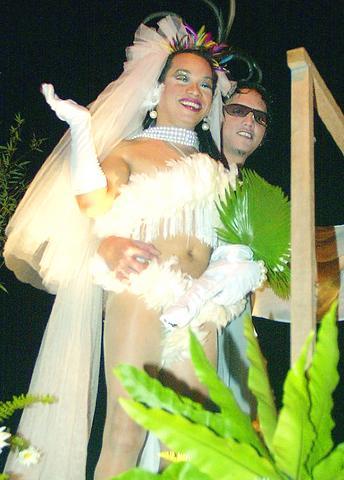
PHOTO: AFP
shunned or even beaten up in societies that cannot accept them for what they are, rights activists say.
"What we are asking for is non-discrimination. That's all we can afford to ask for now," Anna Leah Sarabia, a senior Asian official of the International Lesbian and Gay Association (ILGA) said.
Brussels-based ILGA held a landmark meeting in Manila last week where 400 delegates from 30 countries tackled discrimination against homosexuals, particularly in Asia.
The meeting was ILGA's first in Asia, where the majority of gays and lesbians are afraid to live openly because homosexuality is culturally and religiously shunned. Hong Kong is the only place in Asia to have legalized homosexual acts -- in private -- between consenting adults.
Sarabia, the executive director of the ILGA's women's secretariat, said the Manila meeting gave top priority to counseling for homosexuals facing
psychological pressure and stress arising from society's discrimination.
Burdened with guilt and shame and having fallen prey to hate crimes, some are forced to go underground where they often turn to alcohol, drugs and anonymous sex, making them vulnerable to AIDS, she said.
"It is depressing to note that it is right here in Asia, the cradle of all major
religions which preach love and kindness to each other, that lesbians, gays, bisexuals and transsexuals are being condemned as evil, abnormal and unhealthy," Sarabia said.
Asian societies in ancient times were "very open" to diverse sexuality until possibly Western colonial powers institutionalized homophobia in the region, she charged.
For example, same-sex eroticism was prevalent throughout early Chinese history before Beijing considered homosexuality a mental sickness, delegates said. Only recently did China begin considering it a natural phenomenon.
In India, Sri Lanka, Malaysia and Singapore, homosexuality is outlawed by laws inherited from British rule, delegates say, suggesting that homophobia is a by-product of Western cultural expansion.
The notion that gay and lesbian rights were imported into Asia from Europe is also wrong, said Claudia Roth, Germany's human rights commissioner and keynote speaker at the ILGA meeting.
Roth, who has campaigned for many of Europe's sweeping anti-discrimination laws, said the ongoing debate in Asia on homosexual rights would also set the pace for non-discrimination legislation in the region.
"It is extremely important that this meeting took place in Asia for the first time. This shows that human rights are indivisible and must be guaranteed, irrespective of cultures and regions," she said.
"That there is already discussion on the necessity of an anti-discrimination law is a first step. Same-sex marriage and same-sex partnership will be the future," Roth assured Asian homosexuals.
She vowed to lobby harder for a resolution on the rights of homosexuals at the UN Human Rights Commission next year, despite stiff opposition from the Vatican and Muslim countries.
In an indication that Asian governments may begin to change their perception on the homosexual issue, Singapore recently allowed gays to work in the civil service although it still disallows homosexual acts.
Yves de Matteis, representing a coalition of gay and lesbian groups in Geneva, said it was a paradox that some countries championed human rights and freedom of religion when they do not accept homosexuality and refused to acknowledge transgender issues.
The Manila meeting also hailed Taiwan's proposed controversial bill to legalize gay marriages and recognize the right of homosexual couples to adopt children.
The final draft of the bill is expected to be ready for parliamentary review in December and if approved by parliament, Taiwan would be the first in Asia to legalize same-sex marriages.
"This is going to be a remarkable development and hopefully, it will set the ball rolling in Asia," Sarabia said.

Last week Joseph Nye, the well-known China scholar, wrote on the Australian Strategic Policy Institute’s website about how war over Taiwan might be averted. He noted that years ago he was on a team that met with then-president Chen Shui-bian (陳水扁), “whose previous ‘unofficial’ visit to the US had caused a crisis in which China fired missiles into the sea and the US deployed carriers off the coast of Taiwan.” Yes, that’s right, mighty Chen caused that crisis all by himself. Neither the US nor the People’s Republic of China (PRC) exercised any agency. Nye then nostalgically invoked the comical specter

Relations between Taiwan and the Czech Republic have flourished in recent years. However, not everyone is pleased about the growing friendship between the two countries. Last month, an incident involving a Chinese diplomat tailing the car of vice president-elect Hsiao Bi-khim (蕭美琴) in Prague, drew public attention to the People’s Republic of China’s (PRC) operations to undermine Taiwan overseas. The trip was not Hsiao’s first visit to the Central European country. It was meant to be low-key, a chance to meet with local academics and politicians, until her police escort noticed a car was tailing her through the Czech capital. The
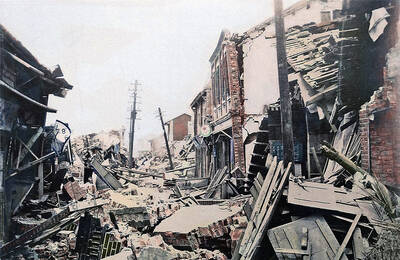
April 15 to April 21 Yang Kui (楊逵) was horrified as he drove past trucks, oxcarts and trolleys loaded with coffins on his way to Tuntzechiao (屯子腳), which he heard had been completely destroyed. The friend he came to check on was safe, but most residents were suffering in the town hit the hardest by the 7.1-magnitude Hsinchu-Taichung Earthquake on April 21, 1935. It remains the deadliest in Taiwan’s recorded history, claiming around 3,300 lives and injuring nearly 12,000. The disaster completely flattened roughly 18,000 houses and damaged countless more. The social activist and

Over the course of former President Ma Ying-jeou’s (馬英九) 11-day trip to China that included a meeting with Chinese Communist Party (CCP) leader Xi Jinping (習近平) a surprising number of people commented that the former president was now “irrelevant.” Upon reflection, it became apparent that these comments were coming from pro-Taiwan, pan-green supporters and they were expressing what they hoped was the case, rather than the reality. Ma’s ideology is so pro-China (read: deep blue) and controversial that many in his own Chinese Nationalist Party (KMT) hope he retires quickly, or at least refrains from speaking on some subjects. Regardless


 RSS
RSS