


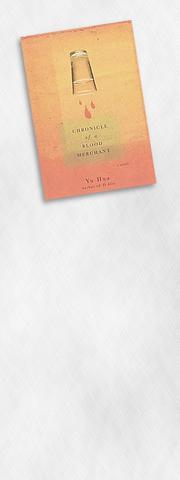
Blood is donated in Taiwan, as it is in Western democracies. But in China in the 1950s, when the bulk of this grimly farcical novel is set, it was sold, at a series of blood-plasma collection stations in public hospitals. We now know that the particular way this was done led to the widespread contamination of blood reserves with the HIV virus in the 1990s. This tragedy doesn't feature in Chronicle of a Blood Merchant, which was published in Chinese in 1995 and is this month appearing for the first time in English. Nonetheless, the horrors of this scheme are the book's main subject.
Xu Sanguan is a worker in a silk factory, though before long he's also working at smelting iron under Chairman Mao's orders for the establishment of back-yard foundries. He's married to Xu Yulan and they have three sons, Yile ("first joy"), Erle ("second joy") and Sanle ("third joy"). The last two look just like Xu Sanguan, but strangely Yile doesn't resemble him at all. Soon the truth comes out -- Yile's father is a neighbor with whom Xu Yulan briefly lost control of herself in what she calls a moment of madness.
To begin with, Xu Sanguan refuses to have anything to do with the boy. When at school he beats a classmate almost to death with a rock, Xu refuses to pay the hospital bill and instead insists the boy's real (or "blood") father should do so. But then gradually a bond begins to grow between them. By the end of the book, helping Yile -- and in fact saving his life -- becomes the driving force behind Xu Sanguan's existence. As with Bloom and Stephen in James Joyce's Ulysses, the older man acquires a spiritual son almost in spite of himself.
Stark poverty stands behind most of this story. Following the Great Leap Forward of 1958, famine ensued in much of China, and for many people selling their blood was one of the few available ways to survive. It so happens that this novel has a happy ending, with both father and son living into less impoverished times. But even so the situation of a family subsisting on corn gruel for months on end is the gaunt background to most of the tale.
And yet it remains a comedy, albeit one of a bitterly absurdist kind. The survival of most of this group of low-life characters is actually a heroic one, a testimony to their resilience and stubbornness. Like a bunch of Charlie Chaplins, they're knocked this way and that, barely understanding what's hit them, but carrying on despite everything. Just as the big guys constantly push Chaplin aside, so fate deals these characters a string of hard blows. But, like clowns in all eras, they get up again, dust themselves off, and carry on as best they can with their lives.
Other parallels that come to mind are the knock-about 18th century novels of the Scottish writer Tobias Smollett, and the antics of the traditional Italian theater known as commedia dell'arte. Speeches are short and to the point, action is fast and unrelenting. No one is defeated for long, and the guys who do the pushing remain abstract caricatures, suggesting that life will always be like this and that the forces that make it are beyond imagination, and so beyond understanding.
Nevertheless, some things are understood. The real cause of the long line of tragedies is actually Chairman Mao and his policies. He's mentioned a few times in the narrative though not explicitly blamed. The political forces exerting pressure on this novel are hazy at best, though by the 1990s a lot could be said that couldn't be said earlier. And of course the largely happy outcome is not without its political dimensions either.
But comedy prevails, just about. Certain phrases recur, as in some kinds of theater aimed at an unsophisticated audience. Time and again Xu sits down in his town's Victory Restaurant and orders fried pork livers and yellow rice wine, nicely warmed. He and the two friends who introduce him to the art of selling blood introduce him to this as well. They eat this meal to celebrate their new-found riches, and in the end Xu eats it anyway when things have gone well, whether he's just sold blood or not. It's both familiar and farcical, both gross and a genuine source of happiness and a feeling of well-being in a society where scarcity, and sometimes even starvation, are the norm.
Few words are wasted in this blunt yet touching tale. Again, the old silent movies are an inevitable parallel. The action is everywhere speeded up so that everyday things seem comic. Then the technology didn't allow for long speeches as they all had to be written out on cards. Now, the speeches are kept short for the comic effect alone. These puppet-like characters think little, but what they do think, and say, is down to earth and very much to the point. They're both comic and pathetic because their situation is so terrible and their reactions to it are so direct.
This, in other words, is popular literature at its best. No one could possibly accuse it of avoiding reality, yet at the same time it's accessible, and in Chinese no doubt very funny, in a way that the most unsophisticated readers can easily understand. It's interesting to learn that Yu Hua started off writing "experimental" fiction, and only switched to this form of popular narrative later.
Pantheon is doing a fine job introducing Chinese authors to a wider readership. This book is translated by Andrew F. Jones, an associate professor at the University of California, Berkeley. His Afterword, however, is a touch too subservient to academic fashion, possibly to compensate for the colloquial and racy nature of his translation.
He writes of "stale humanist verities" and "the stale conventions of realism" when this novel is nothing if not realistic and awash with humanistic values.
It doesn't need defending in such a fashion. It's its own best advertisement, as well as a depiction of the absurdist nightmare that was China 50 years ago. Some readers may have unwittingly encountered the author before, though. His earlier novel, To Live (
In late October of 1873 the government of Japan decided against sending a military expedition to Korea to force that nation to open trade relations. Across the government supporters of the expedition resigned immediately. The spectacle of revolt by disaffected samurai began to loom over Japanese politics. In January of 1874 disaffected samurai attacked a senior minister in Tokyo. A month later, a group of pro-Korea expedition and anti-foreign elements from Saga prefecture in Kyushu revolted, driven in part by high food prices stemming from poor harvests. Their leader, according to Edward Drea’s classic Japan’s Imperial Army, was a samurai
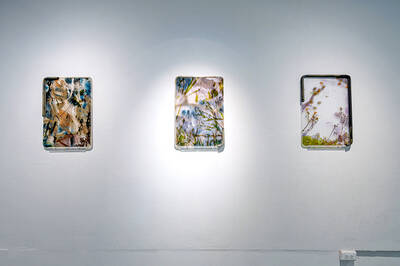
Located down a sideroad in old Wanhua District (萬華區), Waley Art (水谷藝術) has an established reputation for curating some of the more provocative indie art exhibitions in Taipei. And this month is no exception. Beyond the innocuous facade of a shophouse, the full three stories of the gallery space (including the basement) have been taken over by photographs, installation videos and abstract images courtesy of two creatives who hail from the opposite ends of the earth, Taiwan’s Hsu Yi-ting (許懿婷) and Germany’s Benjamin Janzen. “In 2019, I had an art residency in Europe,” Hsu says. “I met Benjamin in the lobby
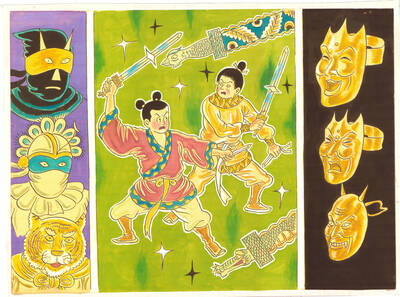
April 22 to April 28 The true identity of the mastermind behind the Demon Gang (魔鬼黨) was undoubtedly on the minds of countless schoolchildren in late 1958. In the days leading up to the big reveal, more than 10,000 guesses were sent to Ta Hwa Publishing Co (大華文化社) for a chance to win prizes. The smash success of the comic series Great Battle Against the Demon Gang (大戰魔鬼黨) came as a surprise to author Yeh Hung-chia (葉宏甲), who had long given up on his dream after being jailed for 10 months in 1947 over political cartoons. Protagonist

The following three paragraphs are just some of what the local Chinese-language press is reporting on breathlessly and following every twist and turn with the eagerness of a soap opera fan. For many English-language readers, it probably comes across as incomprehensibly opaque, so bear with me briefly dear reader: To the surprise of many, former pop singer and Democratic Progressive Party (DPP) ex-lawmaker Yu Tien (余天) of the Taiwan Normal Country Promotion Association (TNCPA) at the last minute dropped out of the running for committee chair of the DPP’s New Taipei City chapter, paving the way for DPP legislator Su


 RSS
RSS