


Covering a combined area of 25km2, Chungho (中和) and neighboring Yungho (永和) are home to 660,000 people and boast one of the world's highest population densities, with over 24,000 people per square kilometer. It's hardly surprising that, with so many people crammed into such as small area, the sister municipalities are considered by many as little more than over-populated urban nightmares.
The butt of a popular Taipei City jibe, which describes the cities "as worse places to live than Keelung," Chungho and Yungho are infamous as the home turf of the "Panther Division" of the Bamboo Union gang and have long been notorious for dodgy dealings and nefarious nightlife.
With the exception of being the birth place of the popular breakfast joint, Yungho Soybean Milk (
Over the past decade, however, Jerry Huang (
"It's pretty sad to say, but a vast majority of Chungho and Yungho residents are unaware of the area's historical significance. They view them simply as `new towns' with no history," Huang said. "The history that, was until very recently, taught in schools was about China and even now, although Taiwan history is being taught, very few schools bother to teach more localized history."
Founded in 1994, the association, which survives on donations and a miniscule annual budget from the local government, has published numerous books, while holding seminars and exhibits about of Chungho and Yungho's pasts in any museum that will take them.
Huang was so appalled with the overwhelming lack of local knowledge, that last year, the society published a textbook entitled Scenes From Chungho and Yungho Study Book (
"We figured that the best place to start building a base for local history was with the children so we published a colorful textbook that would appeal to 7 to 12-year-olds," Huang said. "As we designed it so that teachers could simply photocopy the pages and give them to students it's proved really popular and I think that its now used regularly in all the elementary schools in the area."
As the only localized history book of its kind taught in schools anywhere in Taiwan, the publication has also come to the attention of government and education officials in other towns. According to Huang, the mayor of Hsinchuang (
Even with all the help and encouragement the society receives, Huang readily admits that trying to change the cities' beleaguered image is no easy task, especially when a staggering 79 percent of the area's residents are not native to Chungho or Yungho.
"Although the area was originally home to several Aboriginal villages, the first people to open it up and establish larger settlements here were from Fujian in China, who came here for economic reasons," Huang said. "And, of course, in more recent years the area has become home to people from all over Taiwan, who, like their 16th-century predecessors, also moved here for economic reasons."
The earliest people to call the area home were the mysterious and hotly debated Ketagalan peoples, a race that reputedly lived in Taiwan some time between 6,000BC to 3,000BC.
The area became a permanent settlement in the early 1700s following Lin Cheng-tzu's (
Known then as Changho (
Little remains today of Lin's legacy in either Chungho or Yungho, save half a dozen red brick buildings dating back to the mid-1800s scattered across the area. The oldest of these homes dates back to the late 1700s and sits on Chienpa Road. Along with the Fuho Temple (福和宮), which was built in 1766, it is the oldest remaining slice of Chungho's history.
"Sadly the development is going to continue and, although several of the older buildings are protected, many will, no doubt, be demolished in the near future," he said. "We've worked so hard to develop a sense of history among local people that it would be a real shame if, one day, we lost our buildings in the same we lost our industrial and farming legacies."
Over the past 200 years, Chungho has seen its sugar cane and flax fields paved over, its brick works closed and the once-thriving mining industry all but disappear.
While the area has lost both its industry and many of its old buildings, the legacy of its favorite son remains strong even today. Born in 1919, trumpet player, Yang San-lang (
One of Taiwan's first pop stars in the 1950s, Yang, along with his Black Cat Song and Dance combo (
The historical society might have branched away from producing history books, textbooks and analytical research papers this year, but it still has lofty plans to keep the area's legacies very much alive with its series of fliers and a pocket-sized city guide.
Huang hopes these publications will prove popular with city residents and visitors alike, allowing both to discover that amid the high-rises, expressways and scooter-littered sidewalks lays a rich tapestry of local history.
"Obviously we realize that neither place is going to become a tourist Mecca, but we'd like to alter people's impressions of the areas," Huang said. "And, of course, we want to prove that the both Chungho and Yungho are far more than simply one huge culture-less urban jungle."

Last week Joseph Nye, the well-known China scholar, wrote on the Australian Strategic Policy Institute’s website about how war over Taiwan might be averted. He noted that years ago he was on a team that met with then-president Chen Shui-bian (陳水扁), “whose previous ‘unofficial’ visit to the US had caused a crisis in which China fired missiles into the sea and the US deployed carriers off the coast of Taiwan.” Yes, that’s right, mighty Chen caused that crisis all by himself. Neither the US nor the People’s Republic of China (PRC) exercised any agency. Nye then nostalgically invoked the comical specter
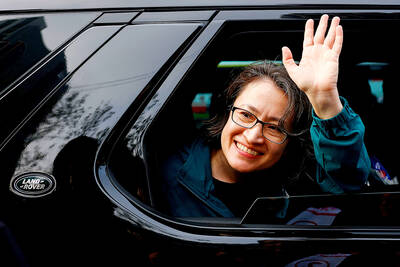
Relations between Taiwan and the Czech Republic have flourished in recent years. However, not everyone is pleased about the growing friendship between the two countries. Last month, an incident involving a Chinese diplomat tailing the car of vice president-elect Hsiao Bi-khim (蕭美琴) in Prague, drew public attention to the People’s Republic of China’s (PRC) operations to undermine Taiwan overseas. The trip was not Hsiao’s first visit to the Central European country. It was meant to be low-key, a chance to meet with local academics and politicians, until her police escort noticed a car was tailing her through the Czech capital. The
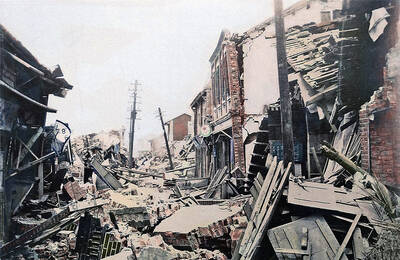
April 15 to April 21 Yang Kui (楊逵) was horrified as he drove past trucks, oxcarts and trolleys loaded with coffins on his way to Tuntzechiao (屯子腳), which he heard had been completely destroyed. The friend he came to check on was safe, but most residents were suffering in the town hit the hardest by the 7.1-magnitude Hsinchu-Taichung Earthquake on April 21, 1935. It remains the deadliest in Taiwan’s recorded history, claiming around 3,300 lives and injuring nearly 12,000. The disaster completely flattened roughly 18,000 houses and damaged countless more. The social activist and

Over the course of former President Ma Ying-jeou’s (馬英九) 11-day trip to China that included a meeting with Chinese Communist Party (CCP) leader Xi Jinping (習近平) a surprising number of people commented that the former president was now “irrelevant.” Upon reflection, it became apparent that these comments were coming from pro-Taiwan, pan-green supporters and they were expressing what they hoped was the case, rather than the reality. Ma’s ideology is so pro-China (read: deep blue) and controversial that many in his own Chinese Nationalist Party (KMT) hope he retires quickly, or at least refrains from speaking on some subjects. Regardless


 RSS
RSS