


One morning, some two years ago, a special package was left on the doorstep of St. Anne's Children's Home in Tienmu. It was a baby. He was wrapped in a blanket, placed in a basket and was found snuggling a red envelope filled with NT$100,000.
"We have children left on our doorstep quite a lot," said Sister Petronelli Keulers, who has worked at the home for the past 31 years, "but they are never so rich."
ILLUSTRATION: MOUNTAIN PEOPLE
While the child's background would prove to be unique, his present situation is the same as that of thousands of children living cheek by jowl in the nation's homes for orphans and abandoned children. Just how many children is hard say. It's even difficult to give a precise number of how many homes are dedicated to caring for them.
The fact that they have slipped through the seams in the social fabric precludes their numbers from being counted. And the fact that they are children prevents their voices from being heard.
These two variables combine to create a seemingly insolvable equation: How can society systematically care for its neediest when their need is due to the fact that they are no longer a part of the system?
Many children are needy
While the baby left on St. Anne's doorstep came with an endowment bundled in its blanket, others don't have even a blanket. Keulers estimates that of the 47 children living at the home, one third were left on the doorstep by parents who were unable to care for them. Either the parents were too poor, addicted to drugs, unmarried and wary of social stigmas, or had given birth to a child they felt unable -- or were unwilling -- to raise.
Nearly half of the children at St. Anne's are physically or mentally disabled, according to Keulers. "Some people are ashamed to have had this kind of child," she said.
Few of the children in the nation's orphanages are actually orphans. In each of the five children's homes the Taipei Times visited for this report, administrators said some 80 percent of the children in their care had been abandoned. In the regional homes operated under the Ministry of the Interior (MOI), children under 12 are admitted when their family fits any one of five criteria: if their parents have passed away; if they've been taken into custody under the Child and Youth Welfare Law, which protects children against abuse, neglect and vagrancy; if the head of the family suffers a debilitating physical or psychological problem or is in prison; if the family's income is too low to support raising a child; or in the event of an emergency.
The MOI's Central Region Children's Home (內政部中區兒童之家), in Taichung City, houses 180 youngsters from six counties as far north as Miaoli, to Chiayi in the south. The children there live in relative comfort compared with homes that aren't government-supported. "Families" of 11 to 16 kids share 100-ping living quarters in a building that resembles a high school campus. Each has a classroom, two large bedrooms to separate boys and girls, a dining area, a TV room and a bedroom for the social workers that live with the family. Each family has two social workers that stay alternate nights at the home. The youngest group, the newborns, has more social workers.
Touring the home, its director, Ma Chung-hsi (
"We do our best to make this place as close to a real home environment as is possible," Ma said.
His confidence is buoyed by cash. For each child it houses, the Central Children's Home receives NT$30,000 from the government each month to pay for their housing, meals, education, clothes and incidentals. It's an amount of money that makes Lee Hua-shu (李華淑), flush with envy.
And others are needier
Lee is the director of the Taichung Christian Herald Children's Home (
Though it houses only 63 children, it is overrun. There are no "families," but a dozen or more boys stacked in bunk beds in a dormitory with cement floors. They're all overseen by a single social worker with a weary smile. The girls live in a similar dormitory next door, the youngest children in yet another. A rusted playground sits silently in the distance.
The buildings on campus, each a half-century old, are showing their age. Termites have ravaged the woodwork and a cold draft floats through the walls. Two buildings that could house children leak when it rains and so sit abandoned.
None of this is a reflection on Lee, who is making certain that Christian Herald's meager resources are enough to see its five dozen children into adulthood. "Most of what we get comes from the local community," she said. "That's the way it's always been."
The gifts range from toys and clothes to food, such as the chickens penned up behind the dining hall. Money comes from various outreach programs, like World Vision International and other Christian organizations. A bit comes from the government, too. Twenty-seven of the children at Christian Herald were sent there by Taichung's Social Services Bureau. But unlike the NT$30,000 that accompanies each child sent to an MOI facility, the 27 kids authorities have sent to Christian Herald receive only NT$9,000 per month. The remaining 36 live hand-to-mouth off community goodwill.
One wonders if the children living at Christian Herald have seen how the other half lives and whether they had a say in where they were sent. They didn't, of course.
Director of Taichung City's Social Services Bureau Chung Chie-sui (
"Most of the children were abandoned," Chung said. "But they were left at one home or another. No one has ever left a child on our doorstep."
He explained that most kids end up living in the home at which they were left. Keulers echoed this, saying St. Anne's was given custody of each of the babies left on her doorstep in the past three decades.
A lack of solutions
The contrast between the living conditions at public and private homes brings into focus the deficits in Taiwan's child-welfare system.
Asked how the central government might improve conditions at privately-run homes, one official at the MOI's Children's Bureau (兒童局) who asked not to be named, seemed perplexed by the question.
"The government already helps private institutions as best it can. Those institutions are supported through charitable organizations," the official said, implying that it was not the government's problem to address.
Yet a quick accounting of the work done by major charities in Taiwan suggests that they could use a lot more help than they get. World Vision International claims to offer support to some 8,000 children in central Taiwan alone and another 22,000 in the rest of Taiwan, but doesn't differentiate between orphans, abandoned babies and other needy children.
"With that many children, it's impossible for us to operate on a case-by-case basis," said one World Vision worker.
An equally pressing problem -- and one that is surely harder to solve -- is social attitudes toward orphans and abandoned children.
Chung of Taichung's Social Services Bureau claimed that as many as 5 percent of orphans are adopted or placed in foster care -- the best of all solutions -- but that abandoned children with disabilities rarely benefit from adoption.
Keulers also recalled several children living at St. Anne's who were adopted by families in Holland decades ago, but they too were all healthy.
"These [disabled] children, they can't be adopted," she said. "Besides the pain of raising such a child, in Taiwan there is also shame."
After the baby with NT$100,000 was left on their doorstep, the social workers at St. Anne's were able to find its grandmother, who identified the baby's father, who is a doctor, and the mother, who is a nurse.
After discovering their baby had Down's syndrome, they abandoned it and moved to the US to restart their careers. The grandmother also refused to take the child.
"If this is how educated people react, imagine how others do," Keulers said. "If a family won't love its own child, you can't expect the government would either."

Last week Joseph Nye, the well-known China scholar, wrote on the Australian Strategic Policy Institute’s website about how war over Taiwan might be averted. He noted that years ago he was on a team that met with then-president Chen Shui-bian (陳水扁), “whose previous ‘unofficial’ visit to the US had caused a crisis in which China fired missiles into the sea and the US deployed carriers off the coast of Taiwan.” Yes, that’s right, mighty Chen caused that crisis all by himself. Neither the US nor the People’s Republic of China (PRC) exercised any agency. Nye then nostalgically invoked the comical specter
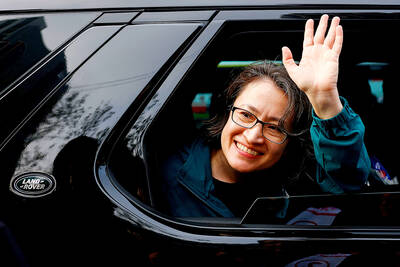
Relations between Taiwan and the Czech Republic have flourished in recent years. However, not everyone is pleased about the growing friendship between the two countries. Last month, an incident involving a Chinese diplomat tailing the car of vice president-elect Hsiao Bi-khim (蕭美琴) in Prague, drew public attention to the People’s Republic of China’s (PRC) operations to undermine Taiwan overseas. The trip was not Hsiao’s first visit to the Central European country. It was meant to be low-key, a chance to meet with local academics and politicians, until her police escort noticed a car was tailing her through the Czech capital. The
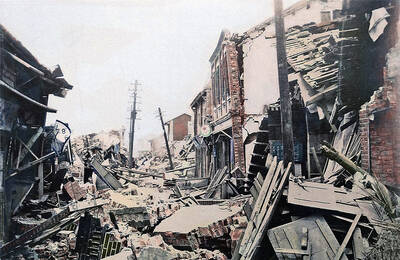
April 15 to April 21 Yang Kui (楊逵) was horrified as he drove past trucks, oxcarts and trolleys loaded with coffins on his way to Tuntzechiao (屯子腳), which he heard had been completely destroyed. The friend he came to check on was safe, but most residents were suffering in the town hit the hardest by the 7.1-magnitude Hsinchu-Taichung Earthquake on April 21, 1935. It remains the deadliest in Taiwan’s recorded history, claiming around 3,300 lives and injuring nearly 12,000. The disaster completely flattened roughly 18,000 houses and damaged countless more. The social activist and

Over the course of former President Ma Ying-jeou’s (馬英九) 11-day trip to China that included a meeting with Chinese Communist Party (CCP) leader Xi Jinping (習近平) a surprising number of people commented that the former president was now “irrelevant.” Upon reflection, it became apparent that these comments were coming from pro-Taiwan, pan-green supporters and they were expressing what they hoped was the case, rather than the reality. Ma’s ideology is so pro-China (read: deep blue) and controversial that many in his own Chinese Nationalist Party (KMT) hope he retires quickly, or at least refrains from speaking on some subjects. Regardless


 RSS
RSS