


A dramatic work will occasionally gain importance for its place in history and occasionally for its exceptional literary value. Beneath the Red Banner (
Jiao plays Lao She (
"Lao She's story is more than just a story, it's an epic tale with great historical relevance," Jiao said while meeting reporters last Friday. "As someone who lived through the Cultural Revolution, I feel quite close to the suffering portrayed in the story."
To say that 1899, when the story is set and when Lao She was born, was a time of great upheaval for China is an understatement. The Middle Kingdom was decades behind a world that had recently and rapidly modernized. The Japanese had routed the Chinese military just four years earlier and foreigners in the Chinese countryside, both Japanese and Western, were growing in numbers and helping themselves to the nation's resources. An organization of outraged Chinese, the Fists of Righteous Harmony (
To the characters of Lao She's novel, all this was a source of particular consternation. Like the Qing rulers, they were themselves Manchurians, albeit of a low societal level, and had an undying faith in the divinity of the emperor and the power of his court.
But the Qing court was itself in a state of upheaval. In his late twenties, the Emperor Guangxu tried to assert power and instigate liberal reform in the kingdom. His efforts were opposed by the empress dowager Cixi, who had adopted Guangxu as an infant and seen to it that he was made emperor at the tender age of three.
A powerful woman who ruled China literally from behind a curtain, she served as regent while the young emperor came of age. When her power became threatened by Guangxu's reforms, she had him immured in a palace outside Beijing and resumed control of government.
She cunningly co-opted the Boxers' hate for foreigners and supported their efforts to kill missionaries and rid the kingdom of outside influence. In 1900, the Boxer Rebellion would be quashed by an international military force -- 2,500 men from eight countries who had come both to rescue their missionaries and establish a permanent foothold for merchants. Cixi would flee the palace disguised as a peasant shortly before Westerners would enter the Forbidden City for the first time without an invitation.
The pain of military defeat, the strain of revolution and palace intrigue line the margins of Lao She's novel, but its pages are dedicated not to history's characters, but ordinary citizens of Beijing who bore witness to the upheaval.
This was Lao She's greatest strength as a writer. He left China and his job as the principal of an elementary school in 1924 to lecture at the School of Oriental and African Studies at London University. While there, he polished his English by reading the works of contemporary masters like Mark Twain, whose wit and ability to fully develop characters he would later put to use in his own novels. He was expert at depicting detail and in using the color of the Beijing dialect to develop his characters.
Red Banner's gentle and honest father, the thrifty and diligent mother, the sarcastic and conceited aunt, the foppish brother-in-law, the overbearing mother-in-law and her good-natured husband all show a kind of humanity, humor and hubris that was uncommon in Chinese storytelling before Lao She. It was a trait that, in 1951, earned him the title "People's Artist" by the Beijing Municipality.
Despite the fact that its events take place in the year of the author's birth, Red Banner is autobiographical and Lao She spent most of his professional life writing it, but died in 1966 before it was finished.
Like his characters who witnessed the tottering of the Qing dynasty, Lao She himself felt the changes of modern China. He suffered physical and psychological
persecution at the hands of the Red Guards and is widely believed to have taken his own life as a result. It's in this context that Red Banner takes on even greater historical weight.
Jiao brings the master storyteller to life. Something of a master storyteller himself, Jiao became famous in China and Taiwan for his turn as the emperor Kangxi in the TV movie The Yongzheng Dynasty (
"Throughout the production of this play, my sole aim has been to maintain the presence of Lao She in the story," Jiao said. "Representing him faithfully is paramount if you understand the importance of history."
The play was adapted for the stage from Lao She's novel by Lee Lungyun (
Beneath the Red Banner opened last night and will play again tonight and tomorrow night at 7:30 and Sunday, Nov. 16 at
2:30pm at the National Theater (

In late October of 1873 the government of Japan decided against sending a military expedition to Korea to force that nation to open trade relations. Across the government supporters of the expedition resigned immediately. The spectacle of revolt by disaffected samurai began to loom over Japanese politics. In January of 1874 disaffected samurai attacked a senior minister in Tokyo. A month later, a group of pro-Korea expedition and anti-foreign elements from Saga prefecture in Kyushu revolted, driven in part by high food prices stemming from poor harvests. Their leader, according to Edward Drea’s classic Japan’s Imperial Army, was a samurai

The following three paragraphs are just some of what the local Chinese-language press is reporting on breathlessly and following every twist and turn with the eagerness of a soap opera fan. For many English-language readers, it probably comes across as incomprehensibly opaque, so bear with me briefly dear reader: To the surprise of many, former pop singer and Democratic Progressive Party (DPP) ex-lawmaker Yu Tien (余天) of the Taiwan Normal Country Promotion Association (TNCPA) at the last minute dropped out of the running for committee chair of the DPP’s New Taipei City chapter, paving the way for DPP legislator Su
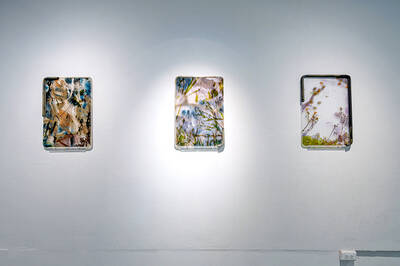
Located down a sideroad in old Wanhua District (萬華區), Waley Art (水谷藝術) has an established reputation for curating some of the more provocative indie art exhibitions in Taipei. And this month is no exception. Beyond the innocuous facade of a shophouse, the full three stories of the gallery space (including the basement) have been taken over by photographs, installation videos and abstract images courtesy of two creatives who hail from the opposite ends of the earth, Taiwan’s Hsu Yi-ting (許懿婷) and Germany’s Benjamin Janzen. “In 2019, I had an art residency in Europe,” Hsu says. “I met Benjamin in the lobby
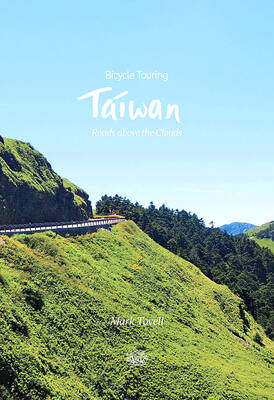
It’s hard to know where to begin with Mark Tovell’s Taiwan: Roads Above the Clouds. Having published a travelogue myself, as well as having contributed to several guidebooks, at first glance Tovell’s book appears to inhabit a middle ground — the kind of hard-to-sell nowheresville publishers detest. Leaf through the pages and you’ll find them suffuse with the purple prose best associated with travel literature: “When the sun is low on a warm, clear morning, and with the heat already rising, we stand at the riverside bike path leading south from Sanxia’s old cobble streets.” Hardly the stuff of your


 RSS
RSS