


The indigenous people who live in the hills of San Diego County hold to an old philosophy: Fire takes what it wants, floods take what is left and nothing lives long except the mountains.
"We've been living with fire forever," said Juana Majel-Dixon, a Pauma Indian. "The rain will come soon and there will be more suffering, but we'll get through it. Indian people always do."
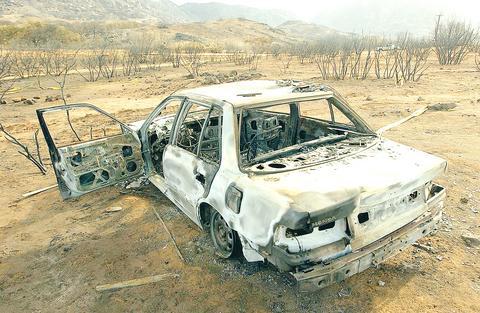
PHOTO: NY TIMES
While America's eyes were fixed on images of endangered resort towns and wealthy suburbs, it has been largely ignored that Indian territory was hit inordinately hard by the runaway wildfires.
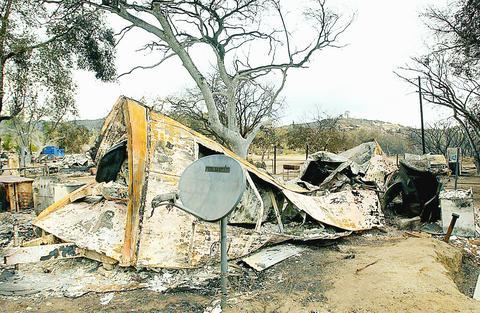
With the last of the flames all but extinguished, the statistics of San Diego's major fires, the Paradise and the Cedar, are staggering: nearly 137,590 hectares burned, 16 dead, more than 2,337 homes destroyed.
While the Indian population is small, there are 18 reservations throughout the county with an estimated 6,200 people, located in what was once inaccessible, inarable scrub. The reservations are now the outer edges of the suburban sprawl, and fire officials estimate that 10 percent of the total land burned was Indian country, with three reservations completely torched and a handful of others severely damaged. The community hardest hit was the San Pasqual reservation, about 50km north of San Diego.
The entire 567 hectares are scorched, with more than a third of the homes, mostly uninsured trailers and prefabricated units, burned to the ground. Two local people died trying to escape the inferno, and two others died on the Barona reservation to the south.
"Fire doesn't know city limits or reservation boundaries," said Allen E. Lawson, the San Pasqual tribal chairman. "It doesn't discriminate on the basis of skin color or wealth."
Indeed, much of territory has been reduced to little more than cigarette tailings, bedsprings and auto carcasses. Hectares of manzanita resemble stick men, the water canal is parched and the leaves on the oak trees are as hard as playing cards.
A casino, the sole engine of economic life here, escaped major damage. Just a wall and four slot machines were destroyed, and signs thanking firefighters for their efforts dot the reservation.
A few miles to the north, the Rincon reservation was 75 percent burned, with more than 20 homes lost. On the Barona reservation, home of one of the state's most successful casinos, two people died and 47 homes were lost, but the casino was spared. In all, 14 reservations were affected.
Rumors run rampant here. While fire officials believe a lost hunter started the Cedar fire to the south, there is no explanation of the origins of the Paradise fire, which started behind the Rincon Casino and destroyed more than 22,661 hectares and 117 homes.
A report is circulating among Indians that it may have been a white person who started the blaze, someone who harbored bad feelings against Indian people after the election that led to the recall of Governor Gray Davis.
During the campaign, Indian tribes donated millions of dollars to Lieutenant Governor Cruz Bustamante and a lesser amount to Davis. Meanwhile, Arnold Schwarzenegger criticized Indians as the type of special interests that had hamstrung state government.
"No one wants to say this was set to take out Indian country," said Michele Nelson, a council member of the Rincon Indian Nation. "But you've got to wonder with all the bad feelings around here about the recall. We got calls during the fire saying, `That's what you Indians deserve.'"
President George W. Bush surveyed the devastation by helicopter on Tuesday with Davis and Schwarzenegger, who will replace Davis on Nov. 17. They met with local officials, including some Indian leaders, allaying fears among Indian people that they would be ignored and left to their own devices.
"We've felt like we were on our own," Nelson said. "There are some hard feelings that linger around here." Lowell, the San Pasqual chairman, said that when he met with the president he would present a wish list to Bush and explain to him that most of people from his reservation who were burned out were not insured and live on trust land.
Frances Jones is one such person. At 94, she is the oldest member of the San Pasqual tribe. When she saw the fires racing up the hill toward her trailer, she grabbed her keys, purse and a sweater and drove away. In 15 minutes her uninsured home was gone. "I never thought there would be a fire like this in all my life," Jones said. "Then again, I never thought I'd live this long."
Dressed in borrowed clothes, Jones said she felt fortunate. She is staying nearby with a friend. "My daughter wants me to come to Los Angeles with her. But that's the last place I'd ever want to live," she said.
The inevitable complaining about how much could have been done or done differently has begun. Residents thank the firefighters for their efforts, but they also express criticism about the governor's slow response to the fires, nearby military equipment and personnel sitting idle and the decision to ground a sheriff's pilot due to darkness just minutes before he was to dump water on the fledgling Cedar fire.
Indian leaders also complain that too little attention is being paid to the situation of their people. "All the attention is being paid to Scripp's Ranch and those million-dollar homes," said Bobby Barrett, vice president of the Viejas Band of Kumeyaay Indians, referring to a suburban neighborhood.
Audrey Toler, 76, a Pasqual Indian who stood shoeless in a burning field while the reservation burned around her, said it is better to concentrate on the positive. "I'm happy to be alive," she said. "People should think about that."
Tribal member Steven Lovett remains in a San Diego hospital, struggling with an infection and the likely loss of his ears. Lovett, a Navy corpsman who returned from Iraq in August, was severely burned after he managed to get a young woman safely to the top of a hill before he was enveloped in flames. The woman's sister died in her car just down the road.

In late October of 1873 the government of Japan decided against sending a military expedition to Korea to force that nation to open trade relations. Across the government supporters of the expedition resigned immediately. The spectacle of revolt by disaffected samurai began to loom over Japanese politics. In January of 1874 disaffected samurai attacked a senior minister in Tokyo. A month later, a group of pro-Korea expedition and anti-foreign elements from Saga prefecture in Kyushu revolted, driven in part by high food prices stemming from poor harvests. Their leader, according to Edward Drea’s classic Japan’s Imperial Army, was a samurai

Approaching her mid-30s, Xiong Yidan reckons that most of her friends are on to their second or even third babies. But Xiong has more than a dozen. There is Lucky, the street dog from Bangkok who jumped into a taxi with her and never left. There is Sophie and Ben, sibling geese, who honk from morning to night. Boop and Pan, both goats, are romantically involved. Dumpling the hedgehog enjoys a belly rub from time to time. The list goes on. Xiong nurtures her brood from her 8,000 square meter farm in Chiang Dao, a mountainous district in northern Thailand’s

Located down a sideroad in old Wanhua District (萬華區), Waley Art (水谷藝術) has an established reputation for curating some of the more provocative indie art exhibitions in Taipei. And this month is no exception. Beyond the innocuous facade of a shophouse, the full three stories of the gallery space (including the basement) have been taken over by photographs, installation videos and abstract images courtesy of two creatives who hail from the opposite ends of the earth, Taiwan’s Hsu Yi-ting (許懿婷) and Germany’s Benjamin Janzen. “In 2019, I had an art residency in Europe,” Hsu says. “I met Benjamin in the lobby

April 22 to April 28 The true identity of the mastermind behind the Demon Gang (魔鬼黨) was undoubtedly on the minds of countless schoolchildren in late 1958. In the days leading up to the big reveal, more than 10,000 guesses were sent to Ta Hwa Publishing Co (大華文化社) for a chance to win prizes. The smash success of the comic series Great Battle Against the Demon Gang (大戰魔鬼黨) came as a surprise to author Yeh Hung-chia (葉宏甲), who had long given up on his dream after being jailed for 10 months in 1947 over political cartoons. Protagonist


 RSS
RSS