


A crackdown along the US-Mexico border designed to prevent terrorists from entering the US hasn't stopped even one known militant from slipping into America since Sept. 11, an investigation has found.
Instead, the tightening net of Border Patrol and Immigration agents has slowed trade, snarled traffic and cost American taxpayers millions, perhaps billions, of dollars, while hundreds of migrants have died trying to evade the growing army of border authorities.

PHOTO: AP
``If there are concerns about the border in national security terms, they are misplaced,'' said Claudia Smith, a migration activist who directs the California Rural Legal Assistance Foundation.

Sept. 11, 2001, was a defining moment in the politics of illegal immigration. The terrorist attacks abruptly halted major reforms designed to legalize much of the flow of workers heading north from Mexico. The reforms had won support from President George W. Bush -- a former Texas governor -- and members of the US Congress.
After more than 3,000 people died in the al-Qaeda strikes on the World Trade Center and the Pentagon, the Bush administration told Mexican officials they were concerned that easing migration restrictions could lead to another terrorist attack.

PHOTO: AP
Instead of opening the border, the US closed it further. Bush invested heavily in border protection, budgeting US$9 billion for the fiscal year that began this Oct. 1, a US$400 million increase over the previous year. The government was unable to provide budget figures for earlier years.
The number of Border Patrol agents assigned to the southern border rose from 8,500 in 2000 to at least 9,500 today. Staffing along the Mexican border for the immigration, customs and agriculture departments, which monitor legal crossing points, grew from 4,371 in fiscal 2001 to 4,873 in the fiscal year that just ended.
New technology gives Border Patrol agents state-of-the-art helicopters to search for migrants from the air and a new generation of ground sensors and remote video systems to track them on the ground.
``We have become much more vigilant than we were just a couple of years ago, without a doubt,'' said Border Patrol spokesman Mario Villarreal. Despite the crackdown, an AP investigation involving interviews with dozens of officials, immigration activists and migrants in Mexico, California, Arizona and Washington, turned up no evidence that any suspected terrorist has been prevented from getting in to America.
Mauricio Juarez, a spokesman for the Mexican government's National Migration Institute, said that Mexico hasn't arrested a single terrorist suspect headed north. And he said the US hasn't informed Mexico of any arrested on the US side -- something it presumably would do.
Spokesmen for the US Border Patrol, the FBI and Immigration and Customs Enforcement say national security guidelines prevent them from saying whether any suspected terrorists have been arrested trying to cross the border from Mexico.
Robert Bonner, commissioner of the Bureau of Customs and Border Protection, said ``hundreds of people per year from ... high interest countries, such as Pakistan'' are turned back at legal border crossings from Mexico, but he didn't give any indication any of them were terrorists.
Several Border Patrol agents along the Arizona-Mexico line said that although they have become increasingly vigilant toward the possibility of terrorists using established people-smuggling routes, they have found none.
``The people who are coming across this border are people who can only pay US$1,500 to a smuggler. A terrorist can pay US$30,000 or US$40,000 and go to the northern border where we don't have the resources to stop them,'' said agent Matt Roggow.
He navigated his Humvee across ranchers' dirt roads in the hilly desert near Tucson, leaning out the window to ``cut sign'': search for footprints in the soft dirt that betray the paths of desperate migrants through the vast desert. He knows well how difficult the trip is.
``I'd be willing to bet that a terrorist isn't going to take the chance of coming across this border,'' he said.
Up north, the Border Patrol has dramatically increased its staffing since Sept. 11, 2001, in part in response to incidents like the 1999 arrest of Ahmed Ressam, who was convicted of plotting to bomb Los Angeles International Airport during millennium celebrations.
But migration activists note that the Sept. 11 hijackers entered the US on visas, not by sneaking across any border. People-smugglers say that occasional groups of Chinese and Russian migrants pass through Mexico on their way north, but that the bulk of migrants are Mexicans and Central Americans headed for jobs that -- because of low pay or dangerous conditions -- Americans don't want.
As for terrorists, they say none would even think of crossing from Mexico.
``They have visas. They fly in,'' says Victor Saravia, a Tijuana-based people-smuggler since 1970, wearing a baseball cap and a denim shirt embroidered with the words ``US Navy.''
``Illegals have nothing to do with terrorism,'' he said.
The fallout from terrorism fears, however, has wreaked havoc with border life. Border crossings have become snarled in traffic, often with hours-long waits for Mexicans commuting to jobs or Americans heading across the border to shop.
Trade has slowed as well, with stricter checks for trucks carrying merchandise across the border, especially when the US terror alert is raised to orange. That has happened four times since the terror-alert system was introduced in March last year.
``When the level is raised above yellow, it is much slower. They stop every car, every truck. It becomes a hurdle for business,'' said Maria Luisa O'Connell, general director of the nonprofit, Phoenix-based Border Trade Alliance.
Migrants -- increasingly babies and children -- have been pushed into even more remote desert crossings, where they face bandits, snakes, dehydration and heat exposure. Since October 2001, at least 742 Mexicans -- and many more of other nationalities -- have died making the trip.
The movement to remote desert areas, mainly in Arizona, began a decade ago, when the US cracked down on illegal migration around the major cities, and it intensified with the increased vigilance after Sept. 11.
Illegal migration dropped off significantly in the weeks after the terrorist attacks. It has since rebounded. While the number of detentions by the Border Patrol has dropped steadily since Sept. 11, the number of deaths has not.
Figures are incomplete, since the Border Patrol counts only deaths reported to it along a narrow strip near the border, and the Mexican government counts only the deaths of Mexicans.
The Border Patrol reported 320 migrants died from Oct. 1, 2001 to Sept. 30, last year, and 340 in the fiscal year ending last month. From Oct. 1, 2000 to Sept. 30, 2001, it counted 336 deaths.
The Mexican government counted 371 for the last calendar year, and another 371 so far this year.
Those numbers are higher because they include deaths that occur farther from the border, such as the 19 migrants found in a locked truck in Victoria, Texas, this year, or the 11 found dead in a rail car in Iowa last year. But they don't include non-Mexicans who die making the trip.
While the Border Patrol says the fewer apprehensions indicate slowing migration, the number of illegal migrants in the US doesn't appear to be dropping.
Victor Clark, a Tijuana anthropologist who studies migration, said that if illegal migrants weren't getting in, there would be a severe labor shortage in farms along the US West Coast, where Mexican migrants make up much of the labor force. There isn't.
In fact, some figures indicate the number of illegal immigrants may be rising. The money Mexicans send home from the US, often used as an indicator of Mexican migration to the north, reached a record US$12 billion this year, compared with US$10 billion last year.
And across the border, migrants say as long as the job markets in the two countries remain unequal, the flow of people will continue no matter how hard anyone tries to stop it.
``It's all about the money,'' said Zenon Hernandez, 35, jealously watching a pigeon fly across the fence separating Tijuana, Mexico, from San Ysidro, California ``We have to keep fighting to get across, however many times it takes.''
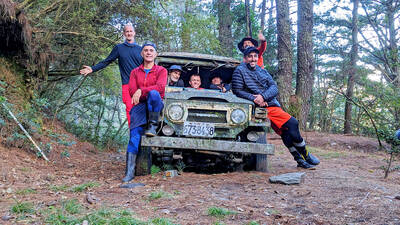
The year was 1991. A Toyota Land Cruiser set out on a 67km journey up the Junda Forest Road (郡大林道) toward an old loggers’ camp, at which point the hikers inside would get out and begin their ascent of Jade Mountain (玉山). Little did they know, they would be the last group of hikers to ever enjoy this shortcut into the mountains. An approaching typhoon soon wiped out the road behind them, trapping the vehicle on the mountain and forever changing the approach to Jade Mountain. THE CONTEMPORARY ROUTE Nowadays, the approach to Jade Mountain from the north side takes an

Last week Joseph Nye, the well-known China scholar, wrote on the Australian Strategic Policy Institute’s website about how war over Taiwan might be averted. He noted that years ago he was on a team that met with then-president Chen Shui-bian (陳水扁), “whose previous ‘unofficial’ visit to the US had caused a crisis in which China fired missiles into the sea and the US deployed carriers off the coast of Taiwan.” Yes, that’s right, mighty Chen caused that crisis all by himself. Neither the US nor the People’s Republic of China (PRC) exercised any agency. Nye then nostalgically invoked the comical specter

Relations between Taiwan and the Czech Republic have flourished in recent years. However, not everyone is pleased about the growing friendship between the two countries. Last month, an incident involving a Chinese diplomat tailing the car of vice president-elect Hsiao Bi-khim (蕭美琴) in Prague, drew public attention to the People’s Republic of China’s (PRC) operations to undermine Taiwan overseas. The trip was not Hsiao’s first visit to the Central European country. It was meant to be low-key, a chance to meet with local academics and politicians, until her police escort noticed a car was tailing her through the Czech capital. The
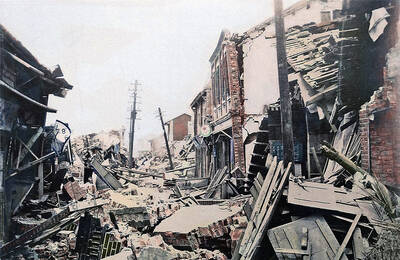
April 15 to April 21 Yang Kui (楊逵) was horrified as he drove past trucks, oxcarts and trolleys loaded with coffins on his way to Tuntzechiao (屯子腳), which he heard had been completely destroyed. The friend he came to check on was safe, but most residents were suffering in the town hit the hardest by the 7.1-magnitude Hsinchu-Taichung Earthquake on April 21, 1935. It remains the deadliest in Taiwan’s recorded history, claiming around 3,300 lives and injuring nearly 12,000. The disaster completely flattened roughly 18,000 houses and damaged countless more. The social activist and


 RSS
RSS