


For decades, scholars have debated whether the eruption of the Thera volcano in the Aegean more than 3,000 years ago brought about the mysterious collapse of Minoan civilization at the peak of its glory. The volcanic isle (whose remnants are known as Santorini) lay just 110km from Minoan Crete, so it seemed quite reasonable that its fury could have accounted for the fall of that celebrated people.
This idea suffered a blow in 1987 when Danish scientists studying cores from the Greenland icecap reported evidence that Thera exploded in 1645 BC, some 150 years before the usual date. That put so much time between the natural disaster and the Minoan decline that the linkage came to be widely doubted, seeming far-fetched at best.
Now, scientists at Columbia University, the University of Hawaii and other institutions are renewing the proposed connection.
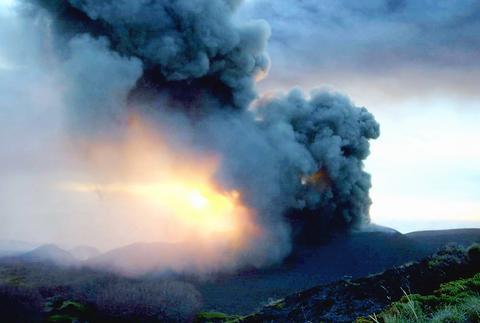
PHOTO: AFP
New findings, they say, show that Thera's upheaval was far more violent than previously calculated -- many times larger than the 1883 Krakatoa eruption, which killed more than 36,000 people. They say the Thera blast's cultural repercussions were equally large, rippling across the eastern Mediterranean for decades, even centuries.
"It had to have had a huge impact," said Floyd W. McCoy, a University of Hawaii geologist who has studied the eruption for decades and recently proposed that it was much more violent than previously thought.
The scientists say Thera's outburst produced deadly waves and dense clouds of volcanic ash over a vast region, crippling ancient cities and fleets, setting off climate changes, ruining crops and sowing wide political unrest.
For Minoan Crete, the scientists see direct and indirect consequences. McCoy discovered that towering waves from the eruption that hit Crete were up to 15m high, smashing ports and fleets and severely damaging the maritime economy.
Other scientists found indirect, long-term damage. Ash and global cooling from the volcanic pall caused wide crop failures in the eastern Mediterranean, they said, and the agricultural woes in turn set off political upheavals that undid Minoan friends and trade.
"Imagine island states without links to the outside world," William B. F. Ryan, a geologist at Columbia's Lamont-Doherty Earth Observatory, told a meeting of the American Geophysical Union.
Compelling evidence
Scientists who link Thera to the Minoan decline say the evidence is still emerging and in some cases sketchy. Even so, they say it is already compelling enough to have convinced many archaeologists, geologists and historians that the repercussions probably amounted to a death blow for Minoan Crete.
Rich and sensual, sophisticated and artistic, Minoan culture flourished in the Bronze Age between roughly 3,000 and 1,400 BC, the first high civilization of Europe. It developed an early form of writing and used maritime skill to found colonies and a trade empire.
The British archaeologist Sir Arthur Evans called the civilization Minoan, after Minos, the legendary king. His unearthed palace was huge and intricate, and had clearly been weakened by many upheavals, including fire and earthquakes.
Nearby on the volcanic island of Thera, or Santorini, archaeologists dug up Minoan buildings, artifacts and a whole city, Akrotiri, buried under volcanic ash like Pompeii. Some of its beautifully preserved frescoes depicted Egyptian motifs and animals, suggesting significant contact between the two peoples.
In 1939, Spyridon Marinatos, a Greek archaeologist, proposed that the eruption wrecked Minoan culture on Thera and Crete. He envisioned the damage as done by associated earthquakes and tsunamis. While geologists found tsunamis credible, they doubted the destructive power of Thera's earthquakes, saying volcanic ones tend to be relatively mild. The debate simmered for decades.
In the mid-1960s, scientists dredging up ooze from the bottom of the Mediterranean began to notice a thick layer of ash that they linked to Thera's eruption. They tracked it over thousands of square miles.
Such clues helped geologists estimate the amount of material Thera spewed into the sky and the height of its eruption cloud -- main factors in the Volcanic Explosivity Index. Its scale goes from zero to eight and is logarithmic, so each unit represents a tenfold increase in explosive power. Thera was given a VEI of 6.0, on a par with Krakatoa in 1883.
The similarity to Krakatoa, which lies between Sumatra and Java, helped experts better envision Thera's wrath. Krakatoa hurled rock and ash more than 35km high and its blasts could be heard 4,800km away. Its giant waves killed thousands of people.
Despite the power of Thera, the Danish scientists' evidence raised doubts about its links to the Minoan decline.
Another blow landed in 1989 when scholars on Crete found, above a Thera ash layer, a house that had been substantially rebuilt in the Minoan style. It suggested at least partial cultural survival.
By 1996, experts like Jeremy B. Rutter, head of classics at Dartmouth College, judged the chronological gap too extreme for any linkage. "No direct correlation can be established" between the volcano and the Minoan decline, he concluded.
As doubts rose about this linkage, scientists found more evidence suggesting that Thera's eruption had been unusually violent and disruptive over wide areas. Scientific maps drawn in the 1960s and 1970s showed its ash as falling mostly over nearby waters and Aegean islands.
By the 1990's, however, the affected areas had been found to include lands of the eastern Mediterranean from Anatolia to Egypt. Scientists found ash from Thera at the bottom of the Black Sea and Nile delta.
Massive anomaly
Peter I. Kuniholm, an expert at Cornell University on using tree rings to establish dates, found ancient trees in a burial mound in Anatolia, what now is in the Asian part of Turkey. For half a decade those trees had grown three times as fast as normal -- apparently because Thera's volcanic pall turned hot, dry summers into seasons that were unusually cool and wet.
"We've got an anomaly, the biggest in the past 9,000 years," Kuniholm said in an interview.
Two years ago McCoy stumbled on more evidence suggesting that Thera's ash fall had been unusually wide and heavy. During a field trip to Anafi, an island some 32km east of Thera, he found to his delight that the authorities had just cut fresh roads that exposed layers of Thera ash up to 3m thick -- a surprising amount that distance from the eruption.
And Greek colleagues showed him new seabed samples taken off the Greek mainland, suggesting that more ash blew westward than scientists had realized.
Factoring in such evidence, McCoy calculated that Thera had a VEI of 7.0 -- what geologists call colossal and exceedingly rare. In the past 10,000 years only one other volcano has exploded with that kind of gargantuan violence: Tambora, in Indonesia, in 1816, It produced an ash cloud in the upper atmosphere that reflected sunlight back into space and produced a year without a summer.
The cold led to ruinous harvests, hunger and even famine in the US, Europe and Russia.
"I presented this evidence last summer at a meeting," McCoy recalled, "and the comment from the other volcanologists was, `Hey, it was probably larger than Tambora.'"
Some prominent archaeologists have concluded that the volcano's long-term repercussions meant the end of Minoan Crete. For instance, they argue that the revolt of nature over the predictable certainties of Minoan religion probably crippled the authority of the priestly ruling class, weakening its hold on society.
In scholarly articles, Jan Driessen, an archaeologist at the Catholic University of Leuven in Belgium, and Colin F. MacDonald, an archaeologist at the British School in Athens, have argued that changes to Cretan architecture, storage, food production, artistic output and the distribution of riches imply major social dislocations, and perhaps civil war.
By 1450 BC, Mycenaean invaders from mainland Greece seized control of Crete, ending the Minoan era.
Thera's destructiveness was probably the catalyst, Driessen and MacDonald wrote, "that culminated in Crete being absorbed to a greater or lesser extent into the Mycenaean, and therefore, the Greek world."

In late October of 1873 the government of Japan decided against sending a military expedition to Korea to force that nation to open trade relations. Across the government supporters of the expedition resigned immediately. The spectacle of revolt by disaffected samurai began to loom over Japanese politics. In January of 1874 disaffected samurai attacked a senior minister in Tokyo. A month later, a group of pro-Korea expedition and anti-foreign elements from Saga prefecture in Kyushu revolted, driven in part by high food prices stemming from poor harvests. Their leader, according to Edward Drea’s classic Japan’s Imperial Army, was a samurai

The following three paragraphs are just some of what the local Chinese-language press is reporting on breathlessly and following every twist and turn with the eagerness of a soap opera fan. For many English-language readers, it probably comes across as incomprehensibly opaque, so bear with me briefly dear reader: To the surprise of many, former pop singer and Democratic Progressive Party (DPP) ex-lawmaker Yu Tien (余天) of the Taiwan Normal Country Promotion Association (TNCPA) at the last minute dropped out of the running for committee chair of the DPP’s New Taipei City chapter, paving the way for DPP legislator Su

Located down a sideroad in old Wanhua District (萬華區), Waley Art (水谷藝術) has an established reputation for curating some of the more provocative indie art exhibitions in Taipei. And this month is no exception. Beyond the innocuous facade of a shophouse, the full three stories of the gallery space (including the basement) have been taken over by photographs, installation videos and abstract images courtesy of two creatives who hail from the opposite ends of the earth, Taiwan’s Hsu Yi-ting (許懿婷) and Germany’s Benjamin Janzen. “In 2019, I had an art residency in Europe,” Hsu says. “I met Benjamin in the lobby
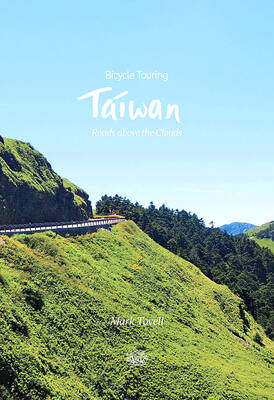
It’s hard to know where to begin with Mark Tovell’s Taiwan: Roads Above the Clouds. Having published a travelogue myself, as well as having contributed to several guidebooks, at first glance Tovell’s book appears to inhabit a middle ground — the kind of hard-to-sell nowheresville publishers detest. Leaf through the pages and you’ll find them suffuse with the purple prose best associated with travel literature: “When the sun is low on a warm, clear morning, and with the heat already rising, we stand at the riverside bike path leading south from Sanxia’s old cobble streets.” Hardly the stuff of your


 RSS
RSS