


The weekly activities at a retirement home here include bingo, shuffleboard and "ice cream social with shoulder massage." But also listed on the crowded schedule are Howa Kai (a Japanese Buddhist church service), rummi kub (a Japanese version of gin rummy played with ceramic tiles), shuji (calligraphy) and kokoro kai (a special program held three times a week and loosely translated as "a meeting of hearts and minds").
Nikkei Manor, where 46 Japanese-Americans are spending their old age, is one of a growing number of assisted-living facilities and nursing homes across the nation that cater to first- and second-generation elderly Americans. It is a fast-growing population that has begun to embrace the very American tradition of living the last years with peers, not family, a phenomenon driven by two-career families that have little time to care for their parents, increasing wealth for some immigrant populations, like the Japanese, and gradual acceptance of a lifestyle that was unheard-of a generation ago.
For many immigrants and their children, the move into nursing homes or assisted-living facilities -- which allow the elderly to live independently with some supervision and became popular with Americans beginning in the 1980s -- runs counter to deeply held beliefs about elders and family. For some, experts on elderly immigrants say, the decision to send a parent away is clouded with shame and ambivalence.
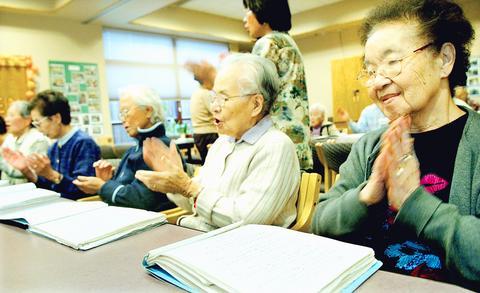
PHOTO: NY TIMES
Still, places like Nikkei Manor -- where miso soup, soba noodles, red ginger and dark-roasted tea are staples of the daily lunch and dinner menus -- are sprouting up at a rapid pace, from Seattle to the Lower East Side of Manhattan, signaling a major shift in how immigrants in this country care for their elders. Assisted-living facilities are becoming especially popular with Asian immigrants, who, along with Pacific Islanders, made up 2.2 percent of the country's 65-and-older population in 2000, or about 800,000 out of 35 million, according to census figures. By 2010, the number is expected to rise to 1.4 million.
Marie Fujii, 82, moved into Nikkei Manor three years ago, after a year at a mostly Jewish facility near Seattle, where she felt uncomfortable. Her two daughters and son agonized for months over whether she could live with one of them. In the end, the children decided it would not work because of her health care needs and their busy work schedules, said Joy Caldwell, one of her daughters.
"The family got together and discussed it," said Caldwell, who was working full time as a sales assistant for a financial services company here as her mother's health was deteriorating. "We said, `OK, we'll try, and if it doesn't work out, we'll take it from there.' But we have been thrilled."
Immigrant groups that have been here longer, like the Japanese, are more likely to accept living in an assisted-living facility, according to Namkee Choi, a gerontologist and professor of social work at the University of Texas, who specializes in elderly immigrants.
"The family norms are changing," Choi said. "The elders are thinking, `We should enjoy our lives,' and many would rather spend it with peers. It doesn't mean they don't want to see their families, but I would call it independence with lots of support from children. And it's going to be more this way in the future."
Fujii, who has Parkinson's disease, said she was relatively happy living at Nikkei Manor, although over a lunch of beef and sticky noodles recently she said, "I still get homesick."
Fujii lives down the hall from one of her childhood friends, Tomiko Suyama, 80, who moved into Nikkei Manor two months ago. The two, who play rummi kub and dine together often and refer to each other as "Buddha head," know almost everyone who lives at Nikkei Manor, having met them over the years in the Seattle area.
Fujii frequently coaxes Suyama out of her room for activities, and Suyama's son Scott, who runs the Seattle flower shop his parents opened decades ago, visits his mother four times a week, he said, because he is concerned about her adjustment.
At lunch last week Suyama said, "I like being with the family the most." But after the meal, she agreed to join a singing class and even went back to her studio apartment to freshen up her lipstick for the occasion.
Choi, who is Korean, said that assisted-living centers and nursing homes are becoming especially popular with elderly Korean women, who have famously bad relationships with their daughters-in-law, but that Hispanic immigrants, particularly recent immigrants, and their children have been more reticent.
Hispanics made up about 5 percent of the US population 65 and older in 2000, according to census data, a percentage that is expected to rise to 7.5 percent by 2010.
"Latinos tend to hold on and avoid doing that," said Maria Martinez-Montes, outreach coordinator for On Lok Senior Health Services, a federally financed program in San Francisco that provides medical care and social services to elderly immigrants, allowing them to remain in their homes.
"In my eyes, I would never put my mom in a nursing home, ever," Martinez-Montes said. "It would kill me. It would totally kill me. I would not sleep -- and it was the same with my grandmother."
There is also the question of what the elderly and their children can afford. Experts say Asian immigrants, particularly those who have been here longest, tend to have a stronger financial base than the newer immigrants. The newer Hispanic immigrants are likely to be among the working poor, so they and their children may not be able to afford the high cost of a nursing home or assisted-living facility, Choi said.
The type of care provided at assisted-living facilities like Nikkei Manor is expensive. At Nikkei Manor -- where the residents live in either studio or one-bedroom apartments -- the cost is US$2,700 monthly. That is relatively inexpensive compared with some other assisted-living facilities, which can run residents as much as US$10,000 a month.
Still, even among those who were brought up to believe that children took care of their parents no matter what -- which also meant housing them -- many welcome the move toward independent living. As much as children feel pressure to take care of their parents, many elderly parents fear being a burden on their busy children and spending too much time alone.
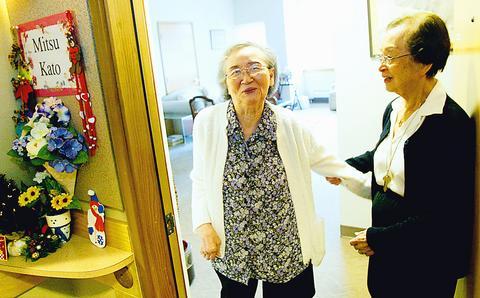
June Takeshita, 92, and Mitsu Kato, 96, are among many pairs of friends at Nikkei Manor. They live together and Takeshita often calls for Kato, who has affixed a sign to her door that says "Knock and Wait." The two eat meals together, and virtually every night they play rummi kub, their favorite game.
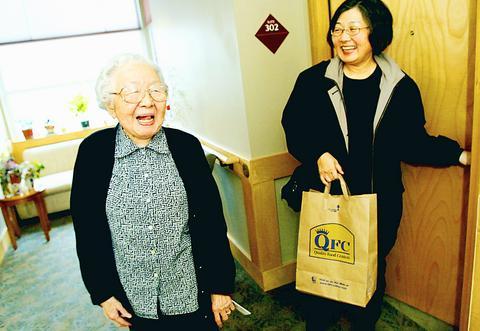
Helen Kubo, 92, who also lives on the third floor, frequently joins them for the game, unless Kubo's daughter, Fran Nishimoto, who visits two or three times a week, comes to take her mother on a gambling outing to a nearby casino. Kubo moved into Nikkei Manor soon after it opened in 1998, with her husband, Frank, who died two months ago. She was born in the US but spent much of her childhood in Japan, where, she said, children were taught to take care of their elders. It was a time when sending elderly parents into either an assisted-living center or a nursing home was unheard of, she said.
"We were taught to look after the parents," Kubo said, while her daughter was visiting her studio apartment the other day. "We were taught to be good to our parents. But I like it here. Better than with family. It's more free."
She added, "We're all getting old together, anyway. We're lucky this place exists."

In late October of 1873 the government of Japan decided against sending a military expedition to Korea to force that nation to open trade relations. Across the government supporters of the expedition resigned immediately. The spectacle of revolt by disaffected samurai began to loom over Japanese politics. In January of 1874 disaffected samurai attacked a senior minister in Tokyo. A month later, a group of pro-Korea expedition and anti-foreign elements from Saga prefecture in Kyushu revolted, driven in part by high food prices stemming from poor harvests. Their leader, according to Edward Drea’s classic Japan’s Imperial Army, was a samurai

Located down a sideroad in old Wanhua District (萬華區), Waley Art (水谷藝術) has an established reputation for curating some of the more provocative indie art exhibitions in Taipei. And this month is no exception. Beyond the innocuous facade of a shophouse, the full three stories of the gallery space (including the basement) have been taken over by photographs, installation videos and abstract images courtesy of two creatives who hail from the opposite ends of the earth, Taiwan’s Hsu Yi-ting (許懿婷) and Germany’s Benjamin Janzen. “In 2019, I had an art residency in Europe,” Hsu says. “I met Benjamin in the lobby

April 22 to April 28 The true identity of the mastermind behind the Demon Gang (魔鬼黨) was undoubtedly on the minds of countless schoolchildren in late 1958. In the days leading up to the big reveal, more than 10,000 guesses were sent to Ta Hwa Publishing Co (大華文化社) for a chance to win prizes. The smash success of the comic series Great Battle Against the Demon Gang (大戰魔鬼黨) came as a surprise to author Yeh Hung-chia (葉宏甲), who had long given up on his dream after being jailed for 10 months in 1947 over political cartoons. Protagonist

A fossil jawbone found by a British girl and her father on a beach in Somerset, England belongs to a gigantic marine reptile dating to 202 million years ago that appears to have been among the largest animals ever on Earth. Researchers said on Wednesday the bone, called a surangular, was from a type of ocean-going reptile called an ichthyosaur. Based on its dimensions compared to the same bone in closely related ichthyosaurs, the researchers estimated that the Triassic Period creature, which they named Ichthyotitan severnensis, was between 22-26 meters long. That would make it perhaps the largest-known marine reptile and would


 RSS
RSS