


Like other Sprint employees, Kent Turner has adjusted to the company's new office park here on a former soybean field in a suburb of Kansas City, but he does wonder why the elevators are so pokey when the buildings are new.
"We believe," he confided, smiling, "that it's a sinister plot to get us to take the stairs."
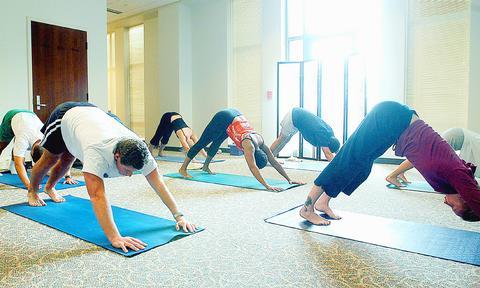
PHOTO: NY TIMES
Sinister, no; plot, yes.

Sprint planned its 82-hectare world headquarters with an eye to fitness. It banned cars, forcing employees to park in garages on the far side of a road ringing the campus and walk between buildings as much as a half-mile apart. It put in hydraulic -- that is, slow -- elevators and wide, windowed staircases to encourage people to walk rather than ride between floors.
Across the country, companies, states and schools are taking more aggressive -- if perhaps passive-aggressive -- measures to get an increasingly overweight society to move more and eat less.

The new methods go beyond putting gyms in office buildings or teaching children (or adults) the virtues of broccoli.
Union Pacific Railroad has begun offering some employees the latest prescription weight-loss drugs as part of a study to determine how best to get its workers to slim down. At the new headquarters for Capital One outside Richmond, Virginia, the architects set the food court at the end of a string of buildings, rather than at the center.
"It's a place one has to walk to," said Jim Carter, an architect with Hillier, the firm that also designed the Sprint campus. "We want people to get out of their desks and out of their offices and move around."
Programs that nudge people to move more or eat better are responding to a growing public health crisis: The federal Department of Health and Human Services puts the cost of overweight and obese Americans at US$117 billion in 2000 and said that being overweight resulted in 300,000 deaths a year.
"There are times when we as a nation feel that personal responsibility is not getting the job done, and so we have to take action," said Kelly D. Brownell, director of the Yale Center for Eating and Weight Disorders. "We could count on parents to get their children immunized, but they don't, therefore we require it. We could count on people being responsible and not smoking cigarettes, but we have a huge health crisis brought on by people smoking cigarettes."
Obesity surpassed smoking as a public health concern in a poll commissioned in May by the Harvard School of Public Health, with 79 percent saying it was a major issue.
At Union Pacific, 54 percent of the 48,000 employees are overweight. Looking at injury claims and illness records, the company estimated that reducing that percentage by one point would save US$1.7 million; five points, US$8.5 million.
But weight loss campaigns have proved difficult. About 15 years ago, the company began a comprehensive wellness program. Cholesterol, smoking and blood pressure dropped. The percentage of overweight employees, however, has risen, from 40 percent in 1990.
Company officials' best guess is that the mostly male work force is simply getting older, their railroad jobs increasingly automated and sedentary. But Union Pacific set out to find a solution, starting five separate studies with employees motivated to lose weight, including one in which 234 employees receive some combination of diet drugs, counseling, weight loss manuals and pedometers.
"We're more targeted to see what works and what doesn't," said Marcy Zauha, director of health and safety for the company.
Sprint and other companies say they have not put a dollar figure on getting employees to lose weight; they are reacting to research that shows that pedestrian-friendly places tend to promote healthier weights.
"It's, if you will, a forced wellness program," said Dan Jeakins, an architect in Dallas who has designed office buildings that encourage walking and stair-climbing. "We've had fitness centers, but that varies on who really uses those things."
The new Sprint campus, designed to look something like a college, demanded culture change.
The neighborhood around it belongs to barbecue and cars; the driveway is off a six-lane road, a bank in a mall off that road has six drive-through windows. Kansas City consistently turns up on lists of the nation's fattest cities.
Officials eased the transition, welcoming employees with big red and white umbrellas to lessen fears about walking in the rain. They ran a trolley between the buildings and parking garages for those who preferred riding.
There are signs of change. A year ago, employees would wait for the trolley even if it would have taken less time to walk. In the last few months, however, demand for the trolley dropped so much that the company stopped running it.
"Just to walk to lunch and to my car I'm walking more than I was," said Brenda Gudenkauf, 36, walking from her building on one end of the campus to a gift shop in the middle. "I was dreading moving here because I thought I'd be walking more. The garages looked like they were blocks away. I thought I'd be very unhappy. I'm very pleasantly surprised."
The stairs have proven especially popular. "If you're not going to four or above, you just walk," Turner, a 44-year-old marketing manager, said of the elevators.
Still, even small changes come hard.
Over a lunch of meat and potatoes, Tim Eschleman described watching some colleagues drive rings around the parking garage, hoping that a space would open up closer to the exit.
"Even if they're not finding anything, you see them just circle and circle around," Eschleman said, "looking for that space that's just two feet closer."

In late October of 1873 the government of Japan decided against sending a military expedition to Korea to force that nation to open trade relations. Across the government supporters of the expedition resigned immediately. The spectacle of revolt by disaffected samurai began to loom over Japanese politics. In January of 1874 disaffected samurai attacked a senior minister in Tokyo. A month later, a group of pro-Korea expedition and anti-foreign elements from Saga prefecture in Kyushu revolted, driven in part by high food prices stemming from poor harvests. Their leader, according to Edward Drea’s classic Japan’s Imperial Army, was a samurai

Located down a sideroad in old Wanhua District (萬華區), Waley Art (水谷藝術) has an established reputation for curating some of the more provocative indie art exhibitions in Taipei. And this month is no exception. Beyond the innocuous facade of a shophouse, the full three stories of the gallery space (including the basement) have been taken over by photographs, installation videos and abstract images courtesy of two creatives who hail from the opposite ends of the earth, Taiwan’s Hsu Yi-ting (許懿婷) and Germany’s Benjamin Janzen. “In 2019, I had an art residency in Europe,” Hsu says. “I met Benjamin in the lobby

April 22 to April 28 The true identity of the mastermind behind the Demon Gang (魔鬼黨) was undoubtedly on the minds of countless schoolchildren in late 1958. In the days leading up to the big reveal, more than 10,000 guesses were sent to Ta Hwa Publishing Co (大華文化社) for a chance to win prizes. The smash success of the comic series Great Battle Against the Demon Gang (大戰魔鬼黨) came as a surprise to author Yeh Hung-chia (葉宏甲), who had long given up on his dream after being jailed for 10 months in 1947 over political cartoons. Protagonist

A fossil jawbone found by a British girl and her father on a beach in Somerset, England belongs to a gigantic marine reptile dating to 202 million years ago that appears to have been among the largest animals ever on Earth. Researchers said on Wednesday the bone, called a surangular, was from a type of ocean-going reptile called an ichthyosaur. Based on its dimensions compared to the same bone in closely related ichthyosaurs, the researchers estimated that the Triassic Period creature, which they named Ichthyotitan severnensis, was between 22-26 meters long. That would make it perhaps the largest-known marine reptile and would


 RSS
RSS