


Mention the name Jhihben (知本) and most people's minds wander toward blissful soaks in natural hot springs. And rightfully so, because the village in the foothills of Taitung County has been the country's most popular hot-springs resort since the colonial Japanese administration began developing the spa town in the 1930s.
But there is more to Jhihben than hot, cool and cold spring pools. Only a few hundred meters farther up the Jhihben River valley from the garish strip of resort hotels is the 425-hectare Jhihben National Forest Recreational Area (
The park lies within view of most of the hot spring resort hotels, but somehow goes unnoticed by most of the crowds that pack the village on weekends and holidays. Those that make the added effort to visit the park are then treated to a comparatively solitary and all-together fascinating experience, as the park is, in the words of its manager Chuang Chiong-chang (莊瓊昌), a perfect example of a low-altitude tropical forest.

The recreation area has sufficiently low visitor numbers -- just under 160,000 last year -- that the park's fauna have not been entirely chased from its boundaries, which means that visitors are usually treated to the sight of several of Taiwan's most exotic animals and birds during a stroll through the forest.
There is also a large number of highly varied indigenous flora species that are characteristic of low-altitude tropical forests.
Thoughtful planning on the part of the Forestry Bureau, which operates the recreation area, has provided a range of educational resources targeted at all ages. Though the displays at the center's ultra-modern visitor center are exclusively in Chinese, the stuffed animals and insects pinned to the walls and photographs show the impressive amount of fauna that the park boasts.

The Forestry Bureau's recreation areas, of which there are 21 in total, are leisure destinations designated specifically to provide space for the growing population of people pursuing outdoor leisure activities. Unlike most government organizations, the recreation areas have enjoyed stable budget allocations even during the recent economic downturn, which has allowed them to expand facilities and protect the often fragile ecosystems they administer.
The recreational area has four immaculately maintained trails that trace loops through the forest and, as with most things, the largest rewards come to those who make an extra effort. One trail is billed as a negative-ion "green shower," which the Forestry Bureau rather hyperbolically says provides an "exploration of natural mystery, and the cultivation of disposition and intelligence."
"Most tourists in Taiwan are herded off tour buses and given a minimal amount of time to rush through a site and get back on the bus," Chuang said. "This is a pity, because on weekends it can get quite crowded on the short trail and most people only see a fraction of what the park has to offer. But I guess for those who bother to take the longer trails, they usually get to enjoy being alone in the woods with all this wildlife everywhere."
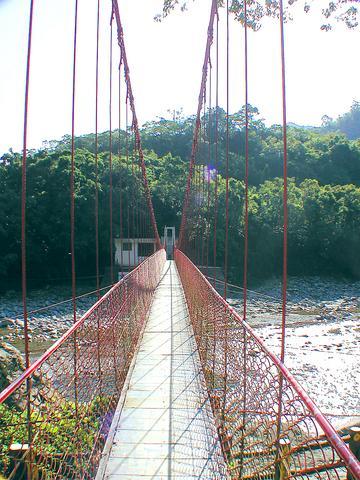
The shortest trail is the scenic trail that parallels the Jhihben River and passes through rice paddies converted into gardens and leads to a picnic area with a man-made creek bed that doubles as a foot massage path. This is the last stop for most of the elderly visitors who come to Jhihben to soak in medicinal hot springs and who walk up and down the creek bed stimulating the pressure points on the soles of their feet to improve the body's
circulation.
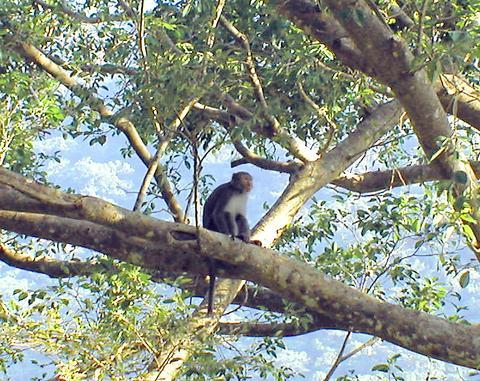
The other trails are more demanding, but it's along these that the visitor is more likely to see the variety of plants and animals that make the park special and encounter families of Taiwan macaques.

"The macaques are still afraid of humans and won't approach hikers. We've enforced a no-feeding rule so that the monkeys don't come to associate humans with food. So far, it seems to be successful," Chuang said.
"But they still stay close enough to the trails to observe them grooming each other and the young ones playing in the trees and the chief of the clan keeping guard. It seems that as long as we leave them alone they just go about their business."
The same rule applies to the many kinds of poisonous snakes that populate the park in large numbers. Early morning visitors to the park are quite likely to catch sight of at least one rare snake, such as the umbrella snake (雨傘節), bamboo snake (竹蛇) or, if you're very lucky (or unlucky, depending on how one views snakes), an endangered 100 pace snake (百步蛇) or a Russell's viper (鎖蛇). The trails have been cleared of underbrush for 5m on both sides to keep most snakes at a safe distance from hikers, but light footsteps and a sharp eye will often yield the sight of one of these killer reptiles.

The abundant presence of poisonous snakes belies the tamed appearance of the trails, so signs in the forest and displays at the visitor center warn hikers in emphatic terms to never approach one. Hikers should take heed, as well, of the signs that warn of poisonous plants, in particular the poisonous wood nettle, aptly named in Chinese as the "biting dog tree" (咬人狗), which can be found in many spots along the trails. Rubbing up against the large triangular leaves of one of these trees will result in a painful and lasting itchy rash not unlike the sting of a jellyfish.
The star trees of the park, however, are the harmless and majestic centuries-old banyan trees, several groves of which dot the forest area. These trees are the favorite haunts of the macaque families. Regrettably, owing to their un-aerodynamic form, over 50 were blown over in last month's typhoon Dujuan (
Hikers should also keep an eye out for the predatory vine that grows by enveloping a victim tree and then consuming the dying tree to fuel its own growth. Several trees can be seen alongside the park's trails in different levels of decay wrapped in these vines.
"Unlike many parks in central Taiwan, this park was spared any extensive destruction in the 921 earthquake. And aside from clearing trails after typhoons, we let nature take its course to patch itself up after typhoons," Chuang said.
One of the main draws of the park is bird watching, which requires slightly more patience and ideally a good pair of binoculars. This reporter happened upon a rare sighting of two crested serpent eagles (大冠鷲) circling together in the sky over the forest canopy. These birds have a 2m wingspan and are among the most endangered birds in Taiwan.
Flying in the lower level of trees are the colorful Muller's barbet (五色鳥), and the Formosan bulbul (烏頭翁), both of which are endemic to Taiwan.
"The recreation area tries to maintain a balance between conservation, leisure and education. With the abundance of wildlife here it's actually not a difficult balance to keep," said Lin Su-yi (林素夷) of the Taitung division of the Forestry Bureau.
Chuang had a slightly different take, though. "Because the vast majority of people are too lazy to walk the full 3km or so of the longer trails, large areas remain basically pristine forest where the presence of humans is just an occasional scary anomaly to the animals that live out there."
The staff at the recreational area understand that most people, when faced with a tropical forest, will tend to merely see a daunting and unfamiliar chaos of shades of green. So to help visitors make sense of the ecosystem they are entering, the park has expert volunteers from Taitung to lead nature tours along the trails offering explanations of the flora and fauna and the sometimes extraordinary ways they have adapted to the environment.

Last week Joseph Nye, the well-known China scholar, wrote on the Australian Strategic Policy Institute’s website about how war over Taiwan might be averted. He noted that years ago he was on a team that met with then-president Chen Shui-bian (陳水扁), “whose previous ‘unofficial’ visit to the US had caused a crisis in which China fired missiles into the sea and the US deployed carriers off the coast of Taiwan.” Yes, that’s right, mighty Chen caused that crisis all by himself. Neither the US nor the People’s Republic of China (PRC) exercised any agency. Nye then nostalgically invoked the comical specter

Relations between Taiwan and the Czech Republic have flourished in recent years. However, not everyone is pleased about the growing friendship between the two countries. Last month, an incident involving a Chinese diplomat tailing the car of vice president-elect Hsiao Bi-khim (蕭美琴) in Prague, drew public attention to the People’s Republic of China’s (PRC) operations to undermine Taiwan overseas. The trip was not Hsiao’s first visit to the Central European country. It was meant to be low-key, a chance to meet with local academics and politicians, until her police escort noticed a car was tailing her through the Czech capital. The
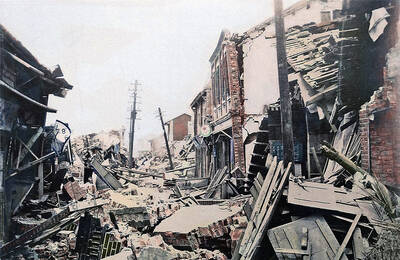
April 15 to April 21 Yang Kui (楊逵) was horrified as he drove past trucks, oxcarts and trolleys loaded with coffins on his way to Tuntzechiao (屯子腳), which he heard had been completely destroyed. The friend he came to check on was safe, but most residents were suffering in the town hit the hardest by the 7.1-magnitude Hsinchu-Taichung Earthquake on April 21, 1935. It remains the deadliest in Taiwan’s recorded history, claiming around 3,300 lives and injuring nearly 12,000. The disaster completely flattened roughly 18,000 houses and damaged countless more. The social activist and

Over the course of former President Ma Ying-jeou’s (馬英九) 11-day trip to China that included a meeting with Chinese Communist Party (CCP) leader Xi Jinping (習近平) a surprising number of people commented that the former president was now “irrelevant.” Upon reflection, it became apparent that these comments were coming from pro-Taiwan, pan-green supporters and they were expressing what they hoped was the case, rather than the reality. Ma’s ideology is so pro-China (read: deep blue) and controversial that many in his own Chinese Nationalist Party (KMT) hope he retires quickly, or at least refrains from speaking on some subjects. Regardless


 RSS
RSS