


But matters suddenly began taking an unexpected turn.
"Our business started going badly and the banks were at my throat. So I tried to get out of it the wrong way," Marcello says. The "wrong way" meant avoiding paying taxes and cooking the company books before absconding to Brazil and Africa. He eventually decided to turn himself in and in 2000 was handed a five-year prison sentence.
Having spent 20 months locked up in a 4m,3m cell with a fellow inmate, Marcello is now out on parole. Yet he has chosen to return to prison, of his own free will.
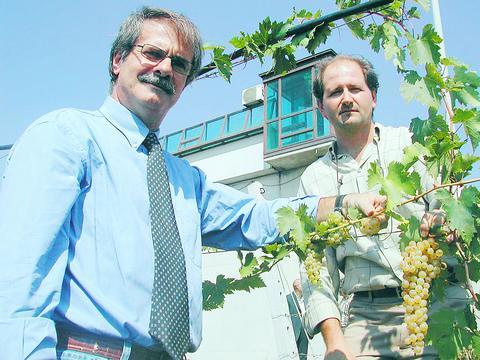
PHOTO: DPA
"When I first arrived here it felt terrible. I had lost all of my self-confidence and felt very depressed," he says.
"But I decided to come back. You see, I've been through it all, so I reckon I could help others get over the trauma as well."
Marcello is one of the key elements in a small miracle taking place in Italy. The other is Rodolfo Craia, an agronomist employed by Italy's state prison system. Together, they have turned Velletri prison into the first ever Italian wine-making prison.
Wine production this year is expected to amount to 55,000 bottles, including a surprisingly good red barrique -- a superior quality wine that has been allowed to ferment in oak casks -- and a highly acclaimed beaujolais.
The prison's winery, equipped with state of the art machinery, currently employs two other inmates and uses grapes growing in 3.5 hectares of nearby vineyards.
Until recently, the wine was only consumed by prison staff, a few magistrates and a couple of friends. But this year, Marcello and Rodolfo plan to sell it to wine bars across Italy, with the help of a local co-operative.
"Our objective is not to make money, but to train and rehabilitate our inmates," Rodolfo points out.
Built in 1991, the Casa Circondariale di Velletri -- as the bureaucrats like to call it -- is situated right in the heart of Rome's wine district, not far from where Frascati DOCs are produced. From its turrets, vineyards spread as far as the eye can see.
The prison used to be just like any other penal institution in Italy: overcrowded, understaffed and infinitely gloomy. But today, an entirely new atmosphere surrounds its confines. It is one of enthusiasm and delight; hope and pride.
Grapevines can be seen climbing up the white prison walls while olive groves help hide the window bars from sight. Strawberries and lemon trees thrive in modern greenhouses built where only a drab cement courtyard once stood.
Coming up with such a far-reaching project, Rodolfo concedes, was not easy.
"I faced enormous problems, particularly from the prison guards. When I started planting the first trees, they were shouting at me, `What do you think you are doing? This is a prison. It's not supposed to be pretty.'"
Rodolfo, backed by then governor Vincenzo Magri, was adamant that he should brave the prevailing attitudes and managed to persuade authorities to build a farm and a brand new winery costing US$472,000, financed entirely by the state.
Then Marcello entered the scene.
"Marcello's arrival was a stroke of pure luck," Rodolfo recalls. "When I saw on the registry that an enologist had entered the prison I called him up immediately and asked him to help me make a decent bottle of wine."
Marcello was equally enthusiastic about the project. "For me, it was an opportunity to get out my cell and breathe some fresh air," he says.
Today, the quality of Velletri's prison wine is inferior to none in the area. But for Rodolfo, seeing prisoners enjoy their work in the winery is far more rewarding than the quality of his wine.
"When they are here they become like any other ordinary worker," Rodolfo says.
In fact, inmates who work are paid around US$590 per month, plus social security benefits. Even more importantly, however, is the training they receive while in prison.
"I can assure you that someone with two years of experience in a winery or a modern farm like this is guaranteed to find a well-paid job once they are out.
"For example, three Romanians who helped us build this cellar now have good, steady jobs. They may only be a couple out of 100,000, but they still mean a lot to me."
At the moment, only about a dozen inmates work in the Velletri prison farm, which also makes olive oil, honey and jams. It is a tiny percentage compared to the number of prisoners who would like to work there.
"But if the wine business goes well," Rodolfo says, "we'll be able to employ a lot more inmates."

In late October of 1873 the government of Japan decided against sending a military expedition to Korea to force that nation to open trade relations. Across the government supporters of the expedition resigned immediately. The spectacle of revolt by disaffected samurai began to loom over Japanese politics. In January of 1874 disaffected samurai attacked a senior minister in Tokyo. A month later, a group of pro-Korea expedition and anti-foreign elements from Saga prefecture in Kyushu revolted, driven in part by high food prices stemming from poor harvests. Their leader, according to Edward Drea’s classic Japan’s Imperial Army, was a samurai

Located down a sideroad in old Wanhua District (萬華區), Waley Art (水谷藝術) has an established reputation for curating some of the more provocative indie art exhibitions in Taipei. And this month is no exception. Beyond the innocuous facade of a shophouse, the full three stories of the gallery space (including the basement) have been taken over by photographs, installation videos and abstract images courtesy of two creatives who hail from the opposite ends of the earth, Taiwan’s Hsu Yi-ting (許懿婷) and Germany’s Benjamin Janzen. “In 2019, I had an art residency in Europe,” Hsu says. “I met Benjamin in the lobby

April 22 to April 28 The true identity of the mastermind behind the Demon Gang (魔鬼黨) was undoubtedly on the minds of countless schoolchildren in late 1958. In the days leading up to the big reveal, more than 10,000 guesses were sent to Ta Hwa Publishing Co (大華文化社) for a chance to win prizes. The smash success of the comic series Great Battle Against the Demon Gang (大戰魔鬼黨) came as a surprise to author Yeh Hung-chia (葉宏甲), who had long given up on his dream after being jailed for 10 months in 1947 over political cartoons. Protagonist

The following three paragraphs are just some of what the local Chinese-language press is reporting on breathlessly and following every twist and turn with the eagerness of a soap opera fan. For many English-language readers, it probably comes across as incomprehensibly opaque, so bear with me briefly dear reader: To the surprise of many, former pop singer and Democratic Progressive Party (DPP) ex-lawmaker Yu Tien (余天) of the Taiwan Normal Country Promotion Association (TNCPA) at the last minute dropped out of the running for committee chair of the DPP’s New Taipei City chapter, paving the way for DPP legislator Su


 RSS
RSS