


As Pope John Paul appears ever more frail and feeble, Catholics around the world are asking: Is he still at the helm of his billion-member Church?
And is there any value left in papal trips if Parkinson's disease and the inability to walk overshadow his message?
The answers, like the Church itself, are multi-tiered.
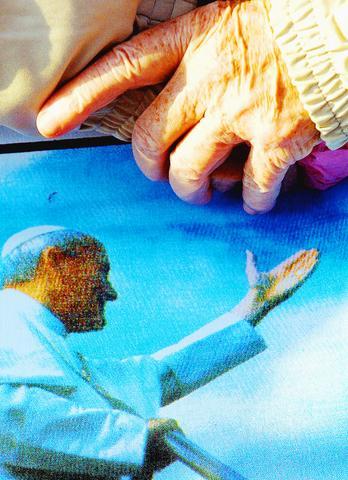
PHOTO: EPA
"He is still in charge," insists one Vatican cleric. "He is not just rubber-stamping things. Things are done at a slower pace but no-one is pulling the wool over his eyes."
Even when he was in good health, the pope was never a micro-manager. From the start, he appointed like-minded aides he could trust and delegated the details to them.
Much of the Vatican bureaucracy runs on automatic pilot, producing documents and suggesting appointments, but the pope still has to sign off -- literally -- on many of them, even if with a trembling hand.
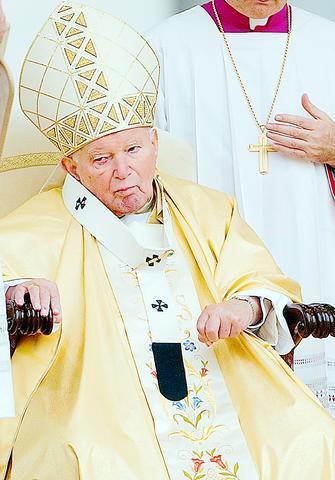
In his reign, 25 years old next Thursday, on Oct. 16, the 83-year-old Polish pope has done more than most pontiffs hoped to do.
He was a key player in the collapse of communism in eastern Europe in 1989, revolutionized relations with Jews, made more saints than all of his predecessors combined and traveled vast distances to preach his message in every corner of the globe.
Like any reign in its twilight, John Paul's final years have begged comparison -- some say unfairly -- with his vibrant past.
"Is he taking as much initiative as he did before? No. But on the other hand one has to ask, `What is there left to do? How much more initiative can he take," one source said.
Popes normally rule for life, even if they are ill. But how healthy does the pope have to be to run the Church?
Enough to communicate one way or the other, aides say.
"He is slower, not as inquisitive. A lot of people have been around him for so long that he can start the sentence and they can finish it. But that does not mean that the other people are pushing their own agenda," the Vatican cleric said.
Iraq war
Vatican officials point to the war in Iraq as an example.
The pope held the baton for the Vatican's opposition to the war and he was the one who decided to dispatch cardinals to Iraqi leader Saddam Hussein and US President George W. Bush to avert the conflict. But aides did much of the rest.
Had he been younger or in better health, he might have gone to Washington and Baghdad himself. While such a gesture would have been more dramatic, the Vatican's opposition to the war was no less clear because he could not move.
More recently, it was he who made the final decisions on the appointment of 31 new cardinals last month.
While the pope is still taking up the baton for the major issues, some lower level bureaucrats in the Vatican say they sometimes feel stagnation in their offices.
"In some departments, there is an eerie sense of one hand not knowing that the other hand is doing," another source said.
A number of key figures who have passed the retirement age of 75 are still in their jobs, including Secretary of State Cardinal Angelo Sodano, doctrinal head Cardinal Joseph Ratzinger and Cardinal Edmund Szoka, the governor of Vatican City.
"Maybe he does not want to leave his successor with younger people in key places," the source said.
"The next pope will probably want to appoint his own team."
Others have speculated there may be a reshuffle of some top Vatican positions after the celebrations of his anniversary wind up with the creation of the 31 new cardinals on Oct. 21.
The end of travel?
Another question Catholics are asking -- and the Vatican is studying -- is can the pope, should the pope, continue to travel?
When is the line crossed between when there is symbolic value in Catholics seeing him carrying on despite his suffering and when the pain of them watching it blots out the message?
"This will have to be taken into consideration the next time a decision is made on trips," a Vatican source said. "Movement is difficult, speech is difficult."
And what happens if the pope became severely disabled?
Popes usually rule until they die. No clear regulations exist if a pope is alive but incapacitated for a long time and none deal with what to do if a pope can no longer communicate.
"The ability of modern medicine to keep the body alive while the mind is deteriorating will eventually present the church with a constitutional crisis," said Father Thomas Reese, historian and editor of the US Jesuit weekly journal America.
There have been unconfirmed reports over the years that Pope John Paul has prepared a resignation letter to be used in case he became severely incapacitated and unable to rule.
While there is a provision in Church law for popes to retire, every time talk of retirement has come up in the past, John Paul has said he wants to stay on as long as God wants.
The last pope to resign willingly was Celestine V, who stepped down in 1294. Gregory XII reluctantly abdicated in 1415 when there was more than one pope reigning at the same time.
If the pope became very sick but could still communicate, he could delegate some of his authority to the cardinal secretary of state or another top Vatican official. But it would be limited to administrative matters and not include teaching authority, infallibility or the appointment of bishops.
"As with many people who are old and sick, there is a point when life itself becomes a prayer. The suffering that he endures is that kind of prayer," a prelate said.
"Divine providence is the anchor of his spirituality. He is also convinced that it affects his decisions and appointments. He knows that some people will disappoint him but he knows that it is God who is in charge of the Church," he said.

Last week Joseph Nye, the well-known China scholar, wrote on the Australian Strategic Policy Institute’s website about how war over Taiwan might be averted. He noted that years ago he was on a team that met with then-president Chen Shui-bian (陳水扁), “whose previous ‘unofficial’ visit to the US had caused a crisis in which China fired missiles into the sea and the US deployed carriers off the coast of Taiwan.” Yes, that’s right, mighty Chen caused that crisis all by himself. Neither the US nor the People’s Republic of China (PRC) exercised any agency. Nye then nostalgically invoked the comical specter
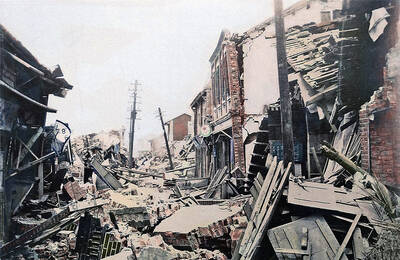
April 15 to April 21 Yang Kui (楊逵) was horrified as he drove past trucks, oxcarts and trolleys loaded with coffins on his way to Tuntzechiao (屯子腳), which he heard had been completely destroyed. The friend he came to check on was safe, but most residents were suffering in the town hit the hardest by the 7.1-magnitude Hsinchu-Taichung Earthquake on April 21, 1935. It remains the deadliest in Taiwan’s recorded history, claiming around 3,300 lives and injuring nearly 12,000. The disaster completely flattened roughly 18,000 houses and damaged countless more. The social activist and

Over the course of former President Ma Ying-jeou’s (馬英九) 11-day trip to China that included a meeting with Chinese Communist Party (CCP) leader Xi Jinping (習近平) a surprising number of people commented that the former president was now “irrelevant.” Upon reflection, it became apparent that these comments were coming from pro-Taiwan, pan-green supporters and they were expressing what they hoped was the case, rather than the reality. Ma’s ideology is so pro-China (read: deep blue) and controversial that many in his own Chinese Nationalist Party (KMT) hope he retires quickly, or at least refrains from speaking on some subjects. Regardless

Approaching her mid-30s, Xiong Yidan reckons that most of her friends are on to their second or even third babies. But Xiong has more than a dozen. There is Lucky, the street dog from Bangkok who jumped into a taxi with her and never left. There is Sophie and Ben, sibling geese, who honk from morning to night. Boop and Pan, both goats, are romantically involved. Dumpling the hedgehog enjoys a belly rub from time to time. The list goes on. Xiong nurtures her brood from her 8,000 square meter farm in Chiang Dao, a mountainous district in northern Thailand’s


 RSS
RSS