


Chinese legend holds that a Ming
dynasty (1368 to 1644) man named Wan Hu (
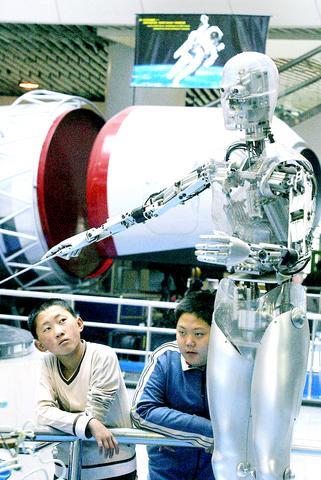
PHOTO: AP
A roar followed. After the smoke dissipated, the chair was gone, along with Wan Hu. It was unclear if what was purported to be the world's first manned rocket ever made it to the skies.
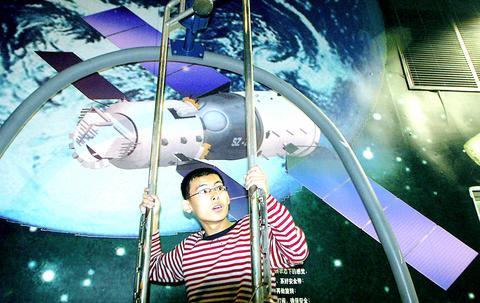
Today, China is counting down the days to its first manned space launch and hoping to avoid the same fate as Wan Hu, thanks to advanced space technology.
China, long mired in poverty but growing fast after more than two decades of market reforms, is eager for the prestige that would come with being just the third country capable of putting people into space.
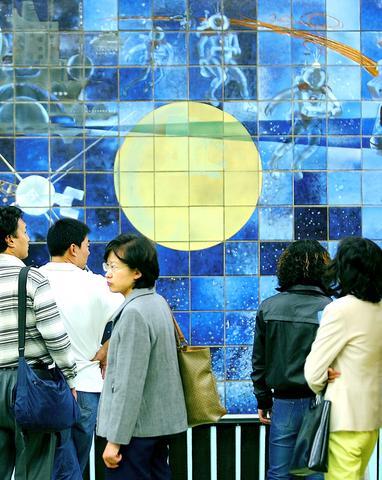
"With the launch of the Shenzhou spacecraft, China lifts its technological image into the heavens, bypassing the rest of the advanced-engineering nations," said Anthony Curtis, editor of Space Today Online.
Yu Maochun of the US Naval Academy said, "The manned space program is an essential part of the Communist Party's near fanatical quest for international respect and dignity, which [in] itself is a normal phenomenon among many rising powers in
history."
Failure looms large
A successful launch, on the heels of Beijing's winning bid to host the 2008 Olympics, could fuel nationalism and boost the Communist Party's credibility as China seeks a place on the world stage alongside the great powers.
A failure would be a loss of face and would raise questions about the necessity of a space program in a country where 140 million people live in abject poverty, or on less than US$1 a day.
"For China, as with all perilous endeavors, the chance of a deadly public failure looms large. By linking national pride and CCP [Chinese Communist Party] credibility, Beijing is jeopardizing both," Joshua Eisenman, a fellow at the New American Foundation, a public policy think tank in Washington, wrote in Singapore's Straits Times.
China has cloaked its space program in secrecy, ostensibly to avoid embarrassment in the event of failure.
Stung by a string of failed satellite launches in the 1980s and 1990s, China has kept recent lift-offs quiet, announcing them only after success was confirmed.
The date of the launch of the next Shenzhou -- meaning "Divine Ship" -- is a state secret but is expected around the Oct. 1 National Day holidays. Repeated requests to interview space officials have been rejected.
China's first astronauts -- dubbed taikonauts from taikong (太空), the Chinese word for space -- are faceless. China has yet to tell the world who they are, other than that they were plucked from the ranks of top fighter pilots in the airforce.
Military applications
There are no public details on the launch's budget, though it is believed to be a fraction of US manned space flight costs and is covered under rapidly expanding military outlays.
The launch by China is going ahead despite the loss of the US space shuttle Columbia, which disintegrated in February while re-entering the atmosphere. Seven astronauts died.
Experts said China's space program had no big technology breakthroughs but would incrementally improve existing space technologies such as computers, materials, electronics, rockets, guidance and life support.
It comes as no surprise that China's space program may have military applications.
"As the Soviet Union used its Soyuz capsules and Salyut space stations in the 1970s and 1980s to spy from space and carry out other forms of military research, so will the Chinese," said Curtis of Space Today Online.
Yu of the US Naval Academy said: "This project may boost China's R&D on strategic missile programs, but the cost will be enormous for China."
China has hinted at more starry-eyed space plans. State media have reported on designs for a lunar probe that would be a step towards sending Chinese to the moon.
One giant misstep for China?
Hard economic realities may temper those dreams.
China is running a record 320 billion yuan (US$39 billion) deficit this year. While the economy is flourishing, the health of the financial system is precarious and any sharp downturn could quickly squelch loftier ambitions for space.
Some analysts were critical of the
planned moon landing.
"A wasteful program such as the planned moon landing conducted by a developing country is just a small step for mankind and a giant misstep for China," Yu said in a wry twist on Neil Armstrong's famous quote.
Human boots have not trod on the moon since the US Apollo program ended with the Apollo XVII mission in 1972.
The Soviet Union was the first to put a man in space when Yuri Gagarin reached orbit in 1961. Weeks later, Alan Shepard became the first American in space, although an American didn't orbit Earth until John Glenn did so the following year.
Experts said China may be joining the exclusive space club four decades late, but its entry could trigger a space race in Northeast Asia with Japan and even South Korea.
"The launch of Chinese astronauts will capture the attention of everyone, especially opinion leaders," Curtis said. "That could breathe new life into the US space program as Americans realize that competition has returned after disappearing for a time since the fall of the Soviet Union."
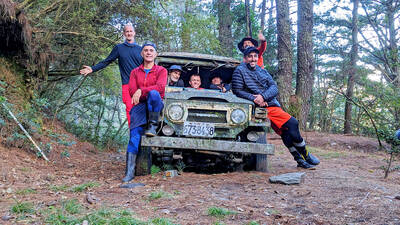
The year was 1991. A Toyota Land Cruiser set out on a 67km journey up the Junda Forest Road (郡大林道) toward an old loggers’ camp, at which point the hikers inside would get out and begin their ascent of Jade Mountain (玉山). Little did they know, they would be the last group of hikers to ever enjoy this shortcut into the mountains. An approaching typhoon soon wiped out the road behind them, trapping the vehicle on the mountain and forever changing the approach to Jade Mountain. THE CONTEMPORARY ROUTE Nowadays, the approach to Jade Mountain from the north side takes an

Last week Joseph Nye, the well-known China scholar, wrote on the Australian Strategic Policy Institute’s website about how war over Taiwan might be averted. He noted that years ago he was on a team that met with then-president Chen Shui-bian (陳水扁), “whose previous ‘unofficial’ visit to the US had caused a crisis in which China fired missiles into the sea and the US deployed carriers off the coast of Taiwan.” Yes, that’s right, mighty Chen caused that crisis all by himself. Neither the US nor the People’s Republic of China (PRC) exercised any agency. Nye then nostalgically invoked the comical specter

Relations between Taiwan and the Czech Republic have flourished in recent years. However, not everyone is pleased about the growing friendship between the two countries. Last month, an incident involving a Chinese diplomat tailing the car of vice president-elect Hsiao Bi-khim (蕭美琴) in Prague, drew public attention to the People’s Republic of China’s (PRC) operations to undermine Taiwan overseas. The trip was not Hsiao’s first visit to the Central European country. It was meant to be low-key, a chance to meet with local academics and politicians, until her police escort noticed a car was tailing her through the Czech capital. The
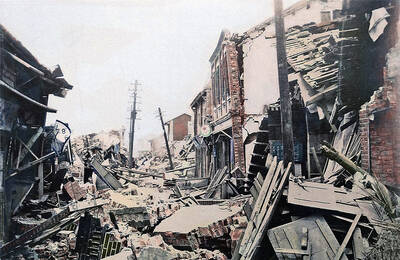
April 15 to April 21 Yang Kui (楊逵) was horrified as he drove past trucks, oxcarts and trolleys loaded with coffins on his way to Tuntzechiao (屯子腳), which he heard had been completely destroyed. The friend he came to check on was safe, but most residents were suffering in the town hit the hardest by the 7.1-magnitude Hsinchu-Taichung Earthquake on April 21, 1935. It remains the deadliest in Taiwan’s recorded history, claiming around 3,300 lives and injuring nearly 12,000. The disaster completely flattened roughly 18,000 houses and damaged countless more. The social activist and


 RSS
RSS