


The words noise and annoyance have similar origins: Noise, after all, annoys. That may even be a good definition. Noise annoys because it doesn't fit: It jars, disrupts, upsets. And it upsets because it can't be understood. There is no way to place noise in a pre-existing sonic order, no way to relate it to other sounds that have meaning and sense. Harmony joins sounds; noise merely accumulates them.
Noise, though, should be taken seriously. Sometimes, what seems to be noise is later heard as music; sometimes what is called music is later heard as noise; and sometimes what is born as noise will remain so. The ways in which noise is heard and argued about, the ways in which it is tamed or silenced or absorbed or resisted, say much about the society that produces noise, both what it knows and what it fears.
One of the first serious studies was Jacques Attali's knotty Noise: The Political Economy of Music (translated from French in 1985), in which noise takes on a polemical and pivotal role in the evolution of politics and culture. Other books have been bringing sound more deeply into the terrain of cultural studies, showing how changes in audience behavior, acoustics or technology reflect shifting conceptions of sounds and their meanings -- including, most recently, Jonathan Sterne's Audible Past: Cultural Origins of Sound Reproduction (Duke, 2003).

Now, in Victorian Soundscapes, John Picker, an assistant professor of English at Harvard, surveys an era when ordinary sound was becoming more and more like noise. During the middle of the 19th century, he explains, microphones were invented, machinery became commonplace and cities grew; it was a "period of unprecedented amplification, unheard-of loudness."
Picker is suggestive, intelligent and insightful, but ultimately, amid his subject's clamor, harmony eludes him. His four "case histories" from that period don't really find common cause; his examination of sound in Dickens' Dombey and Son seems out of place, his examination of the invention of the phonograph too cursory. Still, there are enough fine chords struck and suggestions made so his own soundscape keeps resonating after the book is closed.
The best part is concerned with that "unheard-of loudness" on the streets of London. Dickens, Carlyle and sundry others lobbied to place legal restrictions on street musicians, whom Dickens described as "brazen performers on brazen instruments, beaters of drums, grinders of organs, bangers of banjos, clashers of cymbals, worriers of fiddles, and bellowers of ballads."
The mathematician Charles Babbage, the inventor of the first modern computer, was a leading polemicist. When he was asked if he really believed a man's brain could be harmed by a street organ, he said, "certainly not; for the obvious reason that no man having a brain ever listened to street musicians."
Babbage must have also had a reputation as a bit of an anti-street music crank: His activism, he said, led to taunting mobs, dead cats left at his door, broken windows and neighbors who he believed were torturing him by deliberately squawking on broken wind
instruments.
Thomas Carlyle felt similarly but in response built what he heralded as a "Soundless Room!" "The world, which can do me no good, shall at least not torment me." But alas, the room was, he later found, a "flattering delusion of an ingenious needy builder." It turned out to be the noisiest in the house. Picker, almost gleefully recounts these battles, around which hinge one of the great sociological issues of noise. Critics, all from the upper-middle classes, associated street clamor with the lower social strata. Some attacks were xenophobic: Carlyle referred to a "vile yellow Italian" organ grinder whom he only half-jestingly said he might murder.
But it is also too easy to fit this controversy into the contemporary academic mold, as Picker sometimes does, arguing that the street musicians presented "a challenge to centralized class-based and political control," as if the conflict were simply between populist liberty and elitist oppression. Wouldn't Picker similarly object to clamor -- of whatever origin -- outside his Harvard office while he was trying to write? Picker practically acknowledges as much, as he confesses that "battles continue for spaces to concentrate and to write," but that doesn't prevent him from invoking tropes about the critics' "aggressive desire for separation along lines of nation, class and body."
More information is really needed: What were the sounds of the London streets, the assumptions of its dwellers, the goals of the players, the ambitions of the regulators? Is this really a matter of listeners condemning "noise" primarily because they scorned the class of music and its players? Hurdy gurdys, after all, were music boxes whose melodies could easily become monotonous drones. They might not have been the heroic victims Picker portrays, offering "an alternative to acceptable middle-class definitions of music."
Picker speculates that the novel's view of sound and resonance partly developed out of George Eliot's study of the German scientist Hermann Helmholtz, who did ground-breaking studies of the ear, acoustics and the effects of resonant sound. Whatever the influences, though, in lyrically sounding her characters' emotional strings, in finding, as she once put it, that "vibrations that make human agonies are often a mere whisper in the roar of hurrying existence," Eliot succeeded in disclosing the secret human harmonies hidden under society's roaring noise.

In late October of 1873 the government of Japan decided against sending a military expedition to Korea to force that nation to open trade relations. Across the government supporters of the expedition resigned immediately. The spectacle of revolt by disaffected samurai began to loom over Japanese politics. In January of 1874 disaffected samurai attacked a senior minister in Tokyo. A month later, a group of pro-Korea expedition and anti-foreign elements from Saga prefecture in Kyushu revolted, driven in part by high food prices stemming from poor harvests. Their leader, according to Edward Drea’s classic Japan’s Imperial Army, was a samurai

The following three paragraphs are just some of what the local Chinese-language press is reporting on breathlessly and following every twist and turn with the eagerness of a soap opera fan. For many English-language readers, it probably comes across as incomprehensibly opaque, so bear with me briefly dear reader: To the surprise of many, former pop singer and Democratic Progressive Party (DPP) ex-lawmaker Yu Tien (余天) of the Taiwan Normal Country Promotion Association (TNCPA) at the last minute dropped out of the running for committee chair of the DPP’s New Taipei City chapter, paving the way for DPP legislator Su
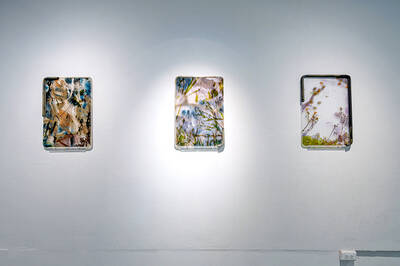
Located down a sideroad in old Wanhua District (萬華區), Waley Art (水谷藝術) has an established reputation for curating some of the more provocative indie art exhibitions in Taipei. And this month is no exception. Beyond the innocuous facade of a shophouse, the full three stories of the gallery space (including the basement) have been taken over by photographs, installation videos and abstract images courtesy of two creatives who hail from the opposite ends of the earth, Taiwan’s Hsu Yi-ting (許懿婷) and Germany’s Benjamin Janzen. “In 2019, I had an art residency in Europe,” Hsu says. “I met Benjamin in the lobby

It’s hard to know where to begin with Mark Tovell’s Taiwan: Roads Above the Clouds. Having published a travelogue myself, as well as having contributed to several guidebooks, at first glance Tovell’s book appears to inhabit a middle ground — the kind of hard-to-sell nowheresville publishers detest. Leaf through the pages and you’ll find them suffuse with the purple prose best associated with travel literature: “When the sun is low on a warm, clear morning, and with the heat already rising, we stand at the riverside bike path leading south from Sanxia’s old cobble streets.” Hardly the stuff of your


 RSS
RSS