


Ultima Vez has been called a modern dance company, an advant garde troupe and a theater project. The confusion is understandable. How do you label a group of artists, actors, dancers and designers whose dance performances are seamlessly interwoven with film and video? How do you describe the work of a choreographer who requires his dancers to speak?
Exploring boundaries, blurring boundaries and then pushing beyond them is what Ultima Vez is all about.

PHOTO COURTESY OF ULTIMA VEZ
And if you want to find out for yourself, the Brussels-based group will be back in Taipei next week after a two year absence with its latest production, Blush.
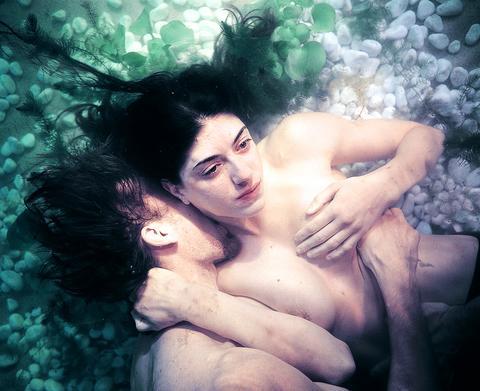
At the center of this maelstrom is the group's founder, Belgian-born Wim Vandekeybus, a choreographer, dancer, director, photographer and film director. Ultima Vez -- and Vandekeybus -- have won international renown for performances that are a dynamic mix of intensely physical, energetic, often confrontational choreography, short films or videos and music, a unique fusion of screen, stage and technology.
When they were last in Taipei, Ultima Vez performed Vandekeybus' Inasmuch as Life is Borrowed. At that time, in an interview with the Taipei Times in June 2001, Vandekeybus talked about how he likes to have his dancers speak.
"Sometimes people say, `stop making dancers speak.' But I think when a person speaks, everything changes ? Many dancers have really never worked with text -- so I say, `Tell me a story.' Sometimes top dancers get rejected in auditions because they can't speak," he said.
He also said that for him the creative process starts with a title or a theme.
As usual with Vandekeybus' pieces, Blush is a collaborative effort. He says he comes up with an idea and then opens it up to the company -- in this case, companies, since Blush is a joint production of Ultima Vez and the Royal Flemish Theater/de bottelarij -- and then works with a musician or composer to come up with the score.
The starting point for Blush is the tale of Orpheus and Eurydice -- the classic story of boy meets girl, they fall in love, boy loses girl and then goes through hell to win her back.
In Greek mythology, Orpheus was a musician whose talent rivaled those of the gods. He fell in love with Eurydice and they married. But just after the wedding ceremony, Eurydice is bitten by a snake and dies. Orpheus, overcome with grief, decides he must descend into the underworld, the realm of the dead, to bring his beloved back.
Through the power of his music Orpheus was able to defeat all those who stood in his way and the ruler of Hades agreed to return Eurydice to him, on one condition -- he could not look back at her as they made their way out of the underworld.
Orpheus made it back to the world of sunlight before succumbing to the overwhelming desire to see his wife. But he looks back too soon, for she has not yet made it out into the sun's light, and so she is lost to him forever.
In Blush, which premiered just over a year ago, Vandekeybus has woven a tale of emotion, of communication and confrontation, of sex and of sensuality, of isolation and liberation. He asks if love is a miracle or just chemistry; is it hell or paradise? What do people try to hide and what do they not; what makes people blush?
"Extremes are important for me," he said back in that 2001 interview.
"You have to see the complexities of things," he said.
In a press release several years ago for his work What the Body Does Not Remember, Vandekeybus was quoted as saying, " If movement was to be only dance, it would not say anything to me ? I am not interested in
performances which develop linear-like from A to Z. They only lie. Our mind doesn't work like this. I am fascinated by things which are not `right,' which do not match with the rest of our life, things which we don't want to show."
Blush begins with a woman having sex with a snoring man -- who continues to snore as she reaches orgasm. Another woman enters the stage and begins screaming, which is enough to wake up the snorer, who then begins to yell at the second woman.
In another scene, dancers build a wall of bags, only to be crushed under them. Dancers dive from the stage onto the screen, transformed into water nymphs swimming through an underwater netherworld.
The 10-person cast, five men and five women, are a mix of dancers and actors, including Vandekeybus himself.
The dialogue for Blush was written by Peter Verheist, a frequent collaborator of Vandekeybus. The members of Ultima Vez are based both on the Greek myth and on stories that Verheist had originally written for his play Het Sprookjesbordeel (The Fairy Tale Brothel) last year.
For the score of Blush, Vandekeybus chose to work with the US singer-songwriter David Eugene Edwards of the group 16 Horsepower. The rock score composed by Edwards draws heavily on pieces from his Woven Hand album, plus three pieces of music specially written for this production.
For the premier of Blush and many of its European performances, Edwards and three other musicians played live on stage. In Taipei, however, audiences will have to make do, as usual, with a recorded soundtrack.
As is true with many of Vandekeybus' works, Blush is not for the prudish or faint of heart -- in Glasgow, Scotland, the Theater Royal warned that the production contains scenes which some people might find offensive and said it was not suitable for children. There should also be another caveat; it is also not for those with small bladders, since it runs for just under two hours with no intermission.
However, if Vandekeybus' previous works are anything to go by, those two hours will have passed before you know it and the only complaint will be that there was so much to watch you feel that you will have to see another performance just to make sure you caught everything.
Ultima Vez
The Metropolitan Hall (formerly the Taipei Municipal Social Education Hall), 25 Bade Rd, Sec 3, Taipei (
Wednesday to Friday, Oct. 1 to 3 at 7:30pm
Ticket prices: NT$400, NT$600, NT$800, NT$1,00, NT$1,200 and NT$1,500
Tickets are available through the Acer ticketing system online (ticket.acer121.com) or by phone at (02) 2784 1011).

In late October of 1873 the government of Japan decided against sending a military expedition to Korea to force that nation to open trade relations. Across the government supporters of the expedition resigned immediately. The spectacle of revolt by disaffected samurai began to loom over Japanese politics. In January of 1874 disaffected samurai attacked a senior minister in Tokyo. A month later, a group of pro-Korea expedition and anti-foreign elements from Saga prefecture in Kyushu revolted, driven in part by high food prices stemming from poor harvests. Their leader, according to Edward Drea’s classic Japan’s Imperial Army, was a samurai

Located down a sideroad in old Wanhua District (萬華區), Waley Art (水谷藝術) has an established reputation for curating some of the more provocative indie art exhibitions in Taipei. And this month is no exception. Beyond the innocuous facade of a shophouse, the full three stories of the gallery space (including the basement) have been taken over by photographs, installation videos and abstract images courtesy of two creatives who hail from the opposite ends of the earth, Taiwan’s Hsu Yi-ting (許懿婷) and Germany’s Benjamin Janzen. “In 2019, I had an art residency in Europe,” Hsu says. “I met Benjamin in the lobby
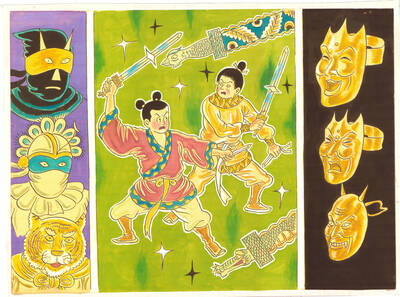
April 22 to April 28 The true identity of the mastermind behind the Demon Gang (魔鬼黨) was undoubtedly on the minds of countless schoolchildren in late 1958. In the days leading up to the big reveal, more than 10,000 guesses were sent to Ta Hwa Publishing Co (大華文化社) for a chance to win prizes. The smash success of the comic series Great Battle Against the Demon Gang (大戰魔鬼黨) came as a surprise to author Yeh Hung-chia (葉宏甲), who had long given up on his dream after being jailed for 10 months in 1947 over political cartoons. Protagonist

A fossil jawbone found by a British girl and her father on a beach in Somerset, England belongs to a gigantic marine reptile dating to 202 million years ago that appears to have been among the largest animals ever on Earth. Researchers said on Wednesday the bone, called a surangular, was from a type of ocean-going reptile called an ichthyosaur. Based on its dimensions compared to the same bone in closely related ichthyosaurs, the researchers estimated that the Triassic Period creature, which they named Ichthyotitan severnensis, was between 22-26 meters long. That would make it perhaps the largest-known marine reptile and would


 RSS
RSS