


It is impossible to imagine Venice without elegant, black gondolas plying its canals, but the centuries-old art of building them has been teetering on extinction.
Just five years ago, only a handful of aging master gondola builders were left and there were no eager young apprentices waiting to take up the oars.
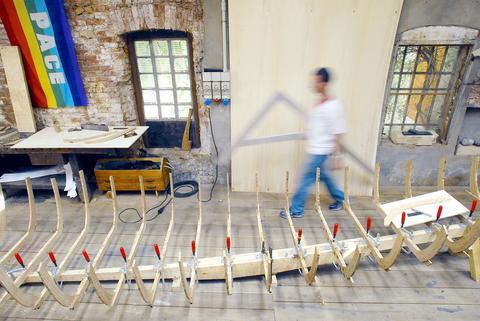
PHOTO: REUTERS
Then along came Thom Price, a university graduate from North Carolina who made it his mission to save the dying craft.
"I came with experience building traditional American wooden boats, but it has been hard getting anyone to take me seriously," admitted Price, listing the points against him when he arrived in 1996 at the age of 26 to try out his luck.
Not only was he a complete outsider, he didn't speak Italian much less the Venetian dialect, and he had a college degree.
"In Italy, if you went to college, you can't use your hands," he said.
But Price slowly won over the crusty old craftsmen, working first as an apprentice, then as an experienced hand for hire and now as a master gondola builder in his own squero, or gondola shipyard, which opened at the end of last year.
Masonry
"It hasn't been easy to be accepted, but when Venetians realized I was not here to steal the city's secrets but to help keep them alive, they opened up," Price said on an afternoon at his canal-side squero.
The ivy-covered warehouse was abuzz as his two apprentices -- a local teenager and a young German -- worked on what will be the first gondola produced at the "Squero Canaletto," named after the 18th century painter of Venetian scenes.
With the opening of the boatyard, the total number of squeros in operation in the lagoon city rose to six.
When Venice was known as the "queen of the Adriatic" in the 16th century, there were 45 squeros with private forests where trees were bent as they grew to provide the hull's soft curves.
The first gondola was recorded in 1094. The asymmetrical, flat-hulled vessels which can be maneuvered by a single oarsmen soon took over the city's narrow canals.
For centuries, they kept homes stocked with food and provided basic transport in the almost roadless isle. But with the advent of motorboats and ferries, they have become little more than a quaint tourist attraction.
Price's determination to revive the trade has convinced initial critics -- master gondola makers and
gondoliers.
"There are still skeptics out there, but people are realizing that what's important is the respect for tradition and the passion for the craft," said Eros Tedeschi, a gondolier in striped shirt and straw hat, waiting for customers.
The worry is not so much that gondolas themselves will disappear or even that they will be mass produced in factories, but that they will be slapped together by novices without any knowledge of the painstaking craft and its ancient traditions.
There are currently about 400 gondolas in circulation, and many of them have been coated in fiberglass or patched up in unorthodox ways.
It takes some 600 hours to build the entirely hand-crafted vessels from eight different kinds of wood and coat them in layers of glossy black lacquer. At the end, they are adorned with a spiny "ferro" on the bow and sumptuous cushions.
The demise of gondola building was due in large part to changes in child labor laws and modern ideas about job perspectives that undermined the long father-to-son tradition.
"I think it's a generational problem," Price said.
"Traditionally, apprentices started at the age of 10 picking up nails ... now 20 or even 30 is a good age to learn, but people want to be building not picking up nails."
Gondolas.com
He is hoping other unconventional boat builders -- both Venetian and foreign -- will rediscover a future in gondolas, which can fetch prices of US$27,000 and more.
Ironically, they may also find that the biggest market is abroad.
The half dozen gondolas that Price himself made while working in other squeros have all been sold to US buyers from cities like San Diego, Province and Austin who use them just as the Venetians do -- to ferry tourists around.
A Boston firm, for example, offers fall foliage tours down the Charles River in a gondola, complete with an accordionist.
"It's hard to say what will happen to gondolas in the future," Tedeschi said. "But I hope Thom keeps working so one day we get a chance to test them for ourselves here in Venice."

Last week Joseph Nye, the well-known China scholar, wrote on the Australian Strategic Policy Institute’s website about how war over Taiwan might be averted. He noted that years ago he was on a team that met with then-president Chen Shui-bian (陳水扁), “whose previous ‘unofficial’ visit to the US had caused a crisis in which China fired missiles into the sea and the US deployed carriers off the coast of Taiwan.” Yes, that’s right, mighty Chen caused that crisis all by himself. Neither the US nor the People’s Republic of China (PRC) exercised any agency. Nye then nostalgically invoked the comical specter
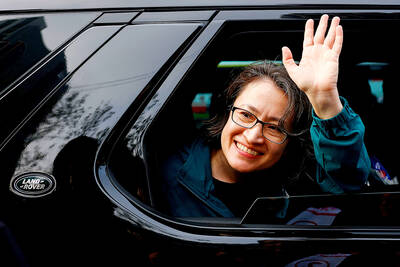
Relations between Taiwan and the Czech Republic have flourished in recent years. However, not everyone is pleased about the growing friendship between the two countries. Last month, an incident involving a Chinese diplomat tailing the car of vice president-elect Hsiao Bi-khim (蕭美琴) in Prague, drew public attention to the People’s Republic of China’s (PRC) operations to undermine Taiwan overseas. The trip was not Hsiao’s first visit to the Central European country. It was meant to be low-key, a chance to meet with local academics and politicians, until her police escort noticed a car was tailing her through the Czech capital. The
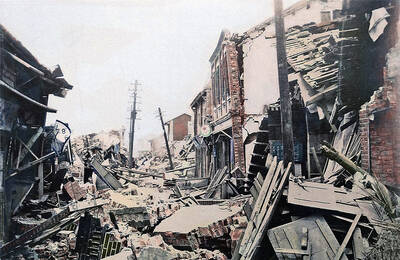
April 15 to April 21 Yang Kui (楊逵) was horrified as he drove past trucks, oxcarts and trolleys loaded with coffins on his way to Tuntzechiao (屯子腳), which he heard had been completely destroyed. The friend he came to check on was safe, but most residents were suffering in the town hit the hardest by the 7.1-magnitude Hsinchu-Taichung Earthquake on April 21, 1935. It remains the deadliest in Taiwan’s recorded history, claiming around 3,300 lives and injuring nearly 12,000. The disaster completely flattened roughly 18,000 houses and damaged countless more. The social activist and

Over the course of former President Ma Ying-jeou’s (馬英九) 11-day trip to China that included a meeting with Chinese Communist Party (CCP) leader Xi Jinping (習近平) a surprising number of people commented that the former president was now “irrelevant.” Upon reflection, it became apparent that these comments were coming from pro-Taiwan, pan-green supporters and they were expressing what they hoped was the case, rather than the reality. Ma’s ideology is so pro-China (read: deep blue) and controversial that many in his own Chinese Nationalist Party (KMT) hope he retires quickly, or at least refrains from speaking on some subjects. Regardless


 RSS
RSS