


Graham Mclaren has never doubted his choice of an all-classical repertoire for his theater company. "Show me a playwright who's ever written something as great as Oedipus [Rex]," he challenged. As the artistic director of the Scottish classical theater group Theatre Babel, Mclaren's confidence is well-grounded as the group's reputation has grown in recent years, particularly after 2001's hit Medea.
For the second week of the CKS Cultural Center's British Theater festival, Theatre Babel is bringing to Taipei Thebans, which was also a hit at the Edinburgh Fringe Festival earlier this year.
Thebans links up three myths -- Oedipus, Jokasta and Antigone, originally written by Sophocles and Euripides -- into one ambitious story "of the curse on the house of Laius, and follows through on all the stories" that make "a rollercoaster of plagues, war, love and death," as Liz Lochhead, its playwrite, described it at the play's opening last week.

PHOTO COURTESY OF THEATRE BABEL
It's Theatre Babel's second adaptation of Greek tragedies, which director Mclaren said he wanted to work on because "they are classics."
"A man or a woman tries to be greater than he or she is and challenge the gods yet inevitably fails, that's a tragedy. Euripides says just about everything there is to say about human nature, about how we live spiritually, mentally, emotionally and sexually in 75 minutes. No modern playwright could do that."
In putting the classic on stage, Mclaren worked with Lochhead, who has been hailed as "Scotland's greatest living dramatist" by Scotland on Sunday. Trained in art and having published several collections of poetry, Lochhead ventured into plays in 1982. Among her successful plays are 1987's Mary Queen of Scots Got Her Head Chopped Off and 1999's Perfect Days. Her Medea, which Mclaren also directed, won the Saltire Book of the Year Award in 2001.
Lochhead's innovative adaptations of ancient plays are not without dissenters. During a visit to Eton after the release of Medea, she was confronted by pupils angry at her "translation" of a Greek play. Replacing Greek with modern English was Lochhead's way of making the ancient works speak to a contemporary audience, which stroke a chord with Theatre Babel.
"There are people who want to keep the tradition of ancient Greek plays, but that doesn't work. The society of audiences has changed. The language has to become like the way you and I would say it," Mclaren said.
The theme of Thebans may be timeless, but Mclaren said it contained even more relevancy post-Sept. 11.
"Lochhead and I have been talking about it for years. On the evening of 9/11, we were performing Medea, a tragedy. That week we decided it's time to do the Thebans tragedies.
"The questions about how to be a human and how to be alive will come up in the audience in a tragedy like this," Mclaren said.
"As a director, all I could do was to ask people to think about how important it is to be level-headed, not to believe you're always right, like George Bush or Osama bin Laden. What I learned from the plays is that when someone says, `I will not be changed,' then something happens, and then they either have to become a tyrant or lose face, so that's what America has become. On the other side, you may also become terrorists."
If this sounds too political, Mclaren does not apologize for it.
"Tragedy is about fundamental human nature, which is political. The issue of how to be a human being is political," he said.
Thebans by Theatre Babel tonight and tomorrow at 7:30pm, tomorrow and Sunday at 2:30pm, at the Experimental Theater, inside the National Theater building. Tickets are NT$500 and available at CKS Cultural Center and Acer ticketing outlets.
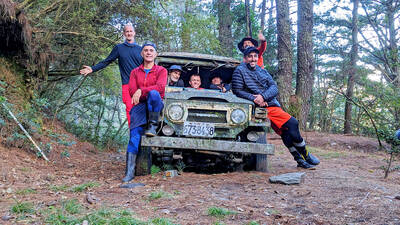
The year was 1991. A Toyota Land Cruiser set out on a 67km journey up the Junda Forest Road (郡大林道) toward an old loggers’ camp, at which point the hikers inside would get out and begin their ascent of Jade Mountain (玉山). Little did they know, they would be the last group of hikers to ever enjoy this shortcut into the mountains. An approaching typhoon soon wiped out the road behind them, trapping the vehicle on the mountain and forever changing the approach to Jade Mountain. THE CONTEMPORARY ROUTE Nowadays, the approach to Jade Mountain from the north side takes an

Last week Joseph Nye, the well-known China scholar, wrote on the Australian Strategic Policy Institute’s website about how war over Taiwan might be averted. He noted that years ago he was on a team that met with then-president Chen Shui-bian (陳水扁), “whose previous ‘unofficial’ visit to the US had caused a crisis in which China fired missiles into the sea and the US deployed carriers off the coast of Taiwan.” Yes, that’s right, mighty Chen caused that crisis all by himself. Neither the US nor the People’s Republic of China (PRC) exercised any agency. Nye then nostalgically invoked the comical specter

Relations between Taiwan and the Czech Republic have flourished in recent years. However, not everyone is pleased about the growing friendship between the two countries. Last month, an incident involving a Chinese diplomat tailing the car of vice president-elect Hsiao Bi-khim (蕭美琴) in Prague, drew public attention to the People’s Republic of China’s (PRC) operations to undermine Taiwan overseas. The trip was not Hsiao’s first visit to the Central European country. It was meant to be low-key, a chance to meet with local academics and politicians, until her police escort noticed a car was tailing her through the Czech capital. The
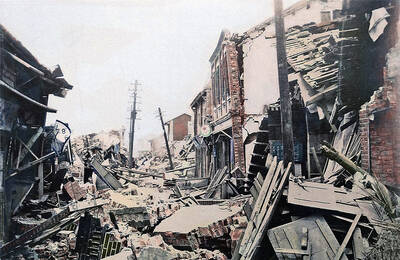
April 15 to April 21 Yang Kui (楊逵) was horrified as he drove past trucks, oxcarts and trolleys loaded with coffins on his way to Tuntzechiao (屯子腳), which he heard had been completely destroyed. The friend he came to check on was safe, but most residents were suffering in the town hit the hardest by the 7.1-magnitude Hsinchu-Taichung Earthquake on April 21, 1935. It remains the deadliest in Taiwan’s recorded history, claiming around 3,300 lives and injuring nearly 12,000. The disaster completely flattened roughly 18,000 houses and damaged countless more. The social activist and


 RSS
RSS