


As the US film industry closes a disappointing summer at the box office, Hollywood is turning away from its staple diet of massively marketed blockbusters in a new strategy to fill theater seats.
What is it banking on to outdo the avalanche of thinly plotted, stunt-laden extravaganzas aimed at pimply adolescents? The answer may surprise you: a combination of lavish musicals and sharply drawn dramatic comedies that center on flawed but inspiring female characters.
Both genres aim squarely at a demographic that has never before done much to excite the middle-aged male executives that run the nexus of the world's entertainment industry: modern 20-something women, who enjoy their freedom and have money to spend.

PHOTO: DPA
This latest crop of movies almost invariably offers them a role model they can readily identify with: "A plucky heroine who searches for her place in the big city -- usually New York, London or Los Angeles -- while holding down a job in a trendy industry such as advertising, fashion or media and often juggling a bit of romance," according to the Hollywood Reporter.
Often the models for such movies are Renee Zellwegger's Bridget Jones Diary, Reese Witherspoon's Legally Blonde or Charlie's Angels which featured the scantily clad trio of Cameron Diaz, Drew Barrymore and Lucy Liu kicking guys' butts all over the world and saving the planet at the same time.
Another influential model for the new girl pics are the complex and conflicted heroines of Sex in the City, which has been a huge TV hit in America and round the world.
The race to nab the rights to the next "babebuster" has already sparked feverish bidding wars for the latest round of books featuring these everyday superwomen.
Among the so-called "chick-lit" titles being snapped up are The Bachelorette Party, Family Trust, Man Eater, Confessions of a Shopaholic, The Nanny Diaries, Bergdorf Blondes and the fancifully titled The Devil Wears Prada about life behind the scenes at fashion mag Vogue.
Portraying women as protagonists rather than the mere love interest of leading men is not unheard of, but movies like Sex and the Single Girl and Thelma and Louise were always rare exceptions rather than the leading Hollywood trend.
"Frankly I'm surprised it's taken so long," says Professor Robert Thompson, a noted commentator on popular culture. He attributes the spate of new gal films partly to the failure of movies like The Hulk, Terminator 3 and other comic book movies to ignite the box office.
"There's a lot more that can be done with a well crafted novel than a comic book," Thompson said. "We are bored with all the special effects -- and also a lot of these movies can be made a lot cheaper than the big blockbusters."
Another advantage of the femme films is that, like Charlie's Angels, they can appeal to female audiences with a vision of empowerment and draw the guys in with sexy storylines and scantily-clad stars.
The change in theme also reflects the growing number of women in powerful positions in Hollywood, Thompson says.
Female power at the box office is also reflected in the plethora of new musicals that are set to hit the silver screen. Women are the dominant audience for these movies, and will soon be spoilt for choice.
Following on from the success of films like Moulin Rouge and Chicago viewers will soon be treated to De-lovely, MGM's musical biography of Cole Porter, which stars Kevin Kline and Ashley Judd and features renditions from the likes of Sheryl Crow, Elvis Costello, Natalie Cole and Alanis Morissette.
Morgan Freeman, meanwhile, is readying Straight Up,a musical set in south central Los Angeles about urban kids who leave the gang behind and learn to sing and dance. Warner Bros. and Joel Schumacher plan to start shooting Andrew Lloyd Webber's smash hit Phantom of the Opera, while Universal is planning a movie version of Jesus Christ Superstar and an updated Carmen starring Jennifer Lopez.
TV is also planning to get in on the act. According to Billboard magazine, titles under development include Fiddler on the Roof, 1776, The Hunchback of Notre Dame, Wuthering Heights and MTV's Hip Hopera: Faust.
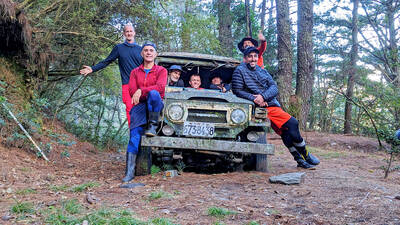
The year was 1991. A Toyota Land Cruiser set out on a 67km journey up the Junda Forest Road (郡大林道) toward an old loggers’ camp, at which point the hikers inside would get out and begin their ascent of Jade Mountain (玉山). Little did they know, they would be the last group of hikers to ever enjoy this shortcut into the mountains. An approaching typhoon soon wiped out the road behind them, trapping the vehicle on the mountain and forever changing the approach to Jade Mountain. THE CONTEMPORARY ROUTE Nowadays, the approach to Jade Mountain from the north side takes an

Relations between Taiwan and the Czech Republic have flourished in recent years. However, not everyone is pleased about the growing friendship between the two countries. Last month, an incident involving a Chinese diplomat tailing the car of vice president-elect Hsiao Bi-khim (蕭美琴) in Prague, drew public attention to the People’s Republic of China’s (PRC) operations to undermine Taiwan overseas. The trip was not Hsiao’s first visit to the Central European country. It was meant to be low-key, a chance to meet with local academics and politicians, until her police escort noticed a car was tailing her through the Czech capital. The

Last week Joseph Nye, the well-known China scholar, wrote on the Australian Strategic Policy Institute’s website about how war over Taiwan might be averted. He noted that years ago he was on a team that met with then-president Chen Shui-bian (陳水扁), “whose previous ‘unofficial’ visit to the US had caused a crisis in which China fired missiles into the sea and the US deployed carriers off the coast of Taiwan.” Yes, that’s right, mighty Chen caused that crisis all by himself. Neither the US nor the People’s Republic of China (PRC) exercised any agency. Nye then nostalgically invoked the comical specter
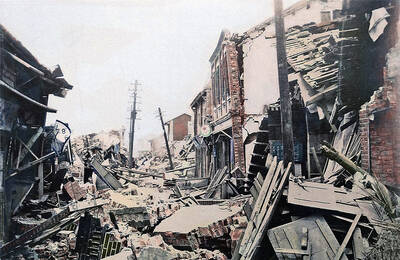
April 15 to April 21 Yang Kui (楊逵) was horrified as he drove past trucks, oxcarts and trolleys loaded with coffins on his way to Tuntzechiao (屯子腳), which he heard had been completely destroyed. The friend he came to check on was safe, but most residents were suffering in the town hit the hardest by the 7.1-magnitude Hsinchu-Taichung Earthquake on April 21, 1935. It remains the deadliest in Taiwan’s recorded history, claiming around 3,300 lives and injuring nearly 12,000. The disaster completely flattened roughly 18,000 houses and damaged countless more. The social activist and


 RSS
RSS