


In central Africa, a genocidal war has raged for nearly a decade, costing more than 4 million lives in Rwanda, Burundi and Congo and precipitating the worst humanitarian crisis in more than half a century. Central Africa shares this gruesome recent past with southeastern Europe, where in the 1990s the Balkans were swept by a wave of killing and "ethnic cleansing." In both cases, genocide was widely misunderstood to be the inevitable product of "ancient hatreds."
Jean-Pierre Chretien, a French historian with vast experience in the Great Lakes region of Africa, has undertaken the formidable task of tracing the roots of the region's violence and exposing the ideological myths on which the ancient-hatreds theory rests. In a monumental study that marches through two millenniums before approaching central Africa's contemporary agony, Chretien punctures the sense of inevitability that permeates our thinking about the Rwandan genocide. Along the way, he illuminates the responsibility of a wide range of actors from the colonial period through the present. As warlords continue today to compete for power in a thoroughly ravaged Congo, Chretien helps us understand how this all came about and why it matters that we know.
The story begins with the geography of the central African highlands. Despite its equatorial location, Chretien says, "the region is blessed with good climate, is rich with diverse soils and plants, and has prospered thanks to some strong basic techniques: the association of cattle keeping and agriculture; the diffusion of the banana a millennium ago; and the mastery of iron metallurgy two millennia ago."

In this healthy environment, complex social structures evolved in which the idea of kingship and strong central authority took hold and flourished for more than 300 years before the arrival of colonial powers in the mid-19th century.
The fertile lands around the Great Lakes were settled by indigenous Hutu cultivators, while the more mountainous areas were used for the raising of cattle by Tutsi pastoralists. In the early kingdoms of the region, agricultural and pastoral systems were integrated because they controlled complementary ecological zones and served mutually beneficial economic interests. As Chretien argues convincingly, nowhere at this time could the "social dialectic be reduced" to a Hutu-Tutsi cleavage.
That began to change in the 19th century. As social structures became more complex, the success of the central African kingdoms depended increasingly on territorial expansion through raiding, colonizing and annexing of neighboring lands. At the same time, Tutsi cattle raisers in search of more land began to emerge as a new elite and a driving force behind expansion. The kingdoms of Rwanda and Uganda were particularly expansionist, but were soon thwarted by the arrival of colonial powers. The immediate effect of colonialism was to reorient the stratified and dynamic societies of the Great Lakes around competing poles of collaboration with, and resistance to, the new foreign occupiers.
Since these remote societies had been untouched by the slave trade that ravaged Africa's coastal regions, they presented the Europeans with a range of robust aristocracies and royal courts to win over.
At this crucial point, the issue of race entered the picture. Obsessed by their theories of racial classification, 19th- and early-20th-century Europeans rewrote the history of central Africa. Imposing their own racist projection of superiority on Tutsi "Hamito-Semites" and a corresponding inferiority on Hutu "Bantu Negroes," missionary and colonial historians began to attribute the rise of the Great Lakes kingdoms to the arrival of a superior race of "black Europeans" from the north.
Anointed by the Belgians as their administrators and collaborators in Rwanda and Burundi, the Tutsis, who never constituted more than 18 percent of the population, were presented with a poisoned chalice combining ethnic elitism with economic favoritism. In educating their chosen elites, the Belgians were relentlessly racist. Starting in 1928, all primary schools in Rwanda were segregated, while at the secondary-school level Rwandan (and later Burundian) Tutsis were three to four times better represented than Hutus.
Not surprisingly, the majority Hutu population chafed at this discrimination, and in the late 1950s a Hutu counter-elite began calling for the end of "Tutsi feudalism." On the eve of independence, the growing Hutu rebellion was backed, in a catastrophic reversal, by the Roman Catholic Church and the colonial administration, which now claimed that the Hutu majority represented "democratic values." The outcome, as Chretien shows, was that "the new Rwanda declared its national past `Tutsi' and thus despicable."
The post-colonial period was marked by a zero-sum ethnic fundamentalism that destroyed the social fabric. Chretien argues that "the generation catapulted to the top of the former kingdoms thus squandered the opportunity offered by independence." The deep ethnic insecurities created by European rewriting of African history made the competing ethnic groups far more concerned about their own survival than about the task of nation-building. As a result, he writes, the elites were "haunted by a passion -- which some admitted and others covered up -- about the supremacy of their ethnic group." In Rwanda, the Hutu revolution led to a series of pogroms against the Tutsi minority, culminating in the 1994 genocide.
Thus, modern hatreds, not ancient ones, destroyed Rwanda. Far from being inbred in the country's ancient social structures, these destructive animosities were created during its recent colonial past.

Last week Joseph Nye, the well-known China scholar, wrote on the Australian Strategic Policy Institute’s website about how war over Taiwan might be averted. He noted that years ago he was on a team that met with then-president Chen Shui-bian (陳水扁), “whose previous ‘unofficial’ visit to the US had caused a crisis in which China fired missiles into the sea and the US deployed carriers off the coast of Taiwan.” Yes, that’s right, mighty Chen caused that crisis all by himself. Neither the US nor the People’s Republic of China (PRC) exercised any agency. Nye then nostalgically invoked the comical specter

Relations between Taiwan and the Czech Republic have flourished in recent years. However, not everyone is pleased about the growing friendship between the two countries. Last month, an incident involving a Chinese diplomat tailing the car of vice president-elect Hsiao Bi-khim (蕭美琴) in Prague, drew public attention to the People’s Republic of China’s (PRC) operations to undermine Taiwan overseas. The trip was not Hsiao’s first visit to the Central European country. It was meant to be low-key, a chance to meet with local academics and politicians, until her police escort noticed a car was tailing her through the Czech capital. The
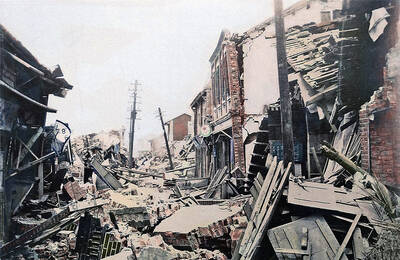
April 15 to April 21 Yang Kui (楊逵) was horrified as he drove past trucks, oxcarts and trolleys loaded with coffins on his way to Tuntzechiao (屯子腳), which he heard had been completely destroyed. The friend he came to check on was safe, but most residents were suffering in the town hit the hardest by the 7.1-magnitude Hsinchu-Taichung Earthquake on April 21, 1935. It remains the deadliest in Taiwan’s recorded history, claiming around 3,300 lives and injuring nearly 12,000. The disaster completely flattened roughly 18,000 houses and damaged countless more. The social activist and

Over the course of former President Ma Ying-jeou’s (馬英九) 11-day trip to China that included a meeting with Chinese Communist Party (CCP) leader Xi Jinping (習近平) a surprising number of people commented that the former president was now “irrelevant.” Upon reflection, it became apparent that these comments were coming from pro-Taiwan, pan-green supporters and they were expressing what they hoped was the case, rather than the reality. Ma’s ideology is so pro-China (read: deep blue) and controversial that many in his own Chinese Nationalist Party (KMT) hope he retires quickly, or at least refrains from speaking on some subjects. Regardless


 RSS
RSS