


A young Buddhist nun scrambles about for a piece of paper and quickly scribbles something down before she gets back to chanting prayers.
"Here's my e-mail address. Will you send me my photograph?" asks an excited Pema, 25, sitting hunched over a sheaf of scriptures in a nunnery in the capital of the Buddhist kingdom of Bhutan.
"I go to the market on Sundays and use the Internet."
For years, the tiny mountain nation of Bhutan, called "Druk Yul" or the Land of the Thunder Dragon, was considered the last Shangri-La, untouched by the winds of modernization sweeping the rest of the world.
But four years after the country of 700,000 people tucked between India and China opened its doors to satellite television and the Internet, Bhutan is at a cultural crossroads between tradition and modernity.
"It's an aerial invasion," said Kinley Dorji, the editor the country's only newspaper, Kuensel.
"Bhutan is a small country which may not have military might and economic strength. But its strength is its unique identity, its religion, clothes. Television exposure is seen as a dilution of this culture."
Signs of change are everywhere.
During the day, people dress in traditional clothes because it is mandatory for men to wear a gho, a long kilt-like outfit, and for women to be dressed in a kera, a Bhutanese sarong.
By night, men and women in trendy jeans and figure-hugging shirts jive to pop music at discos and hang out at snooker bars dotting the sleepy little capital of Thimphu.
MONKS AND MOVIES
Walk into one of Bhutan's many monasteries and the rhythmic chanting of Buddhist hymns by shaven-headed monks in maroon robes fills halls lit by traditional butter lamps.
Not too far away, taxi drivers listen to pop singer Shakira while shopkeepers are glued to television channels showing the latest US action dramas, sitcoms and reality shows.
Indian soaps with their melodramatic clashes between mothers-in-law and daughters-in-law are also a huge hit in Bhutan where state-run Bhutan Broadcasting Service essentially airs a mix of news, cultural and development programs.
"Opening up to TV was well thought out and well timed. But there are also some unwanted channels," said Mingbo Dukpa, the managing director of Bhutan Broadcasting Service.
"Hollywood films with too much sex and violence make our families uncomfortable. It's a bit out of context in Bhutan."
Analysts say television is leading to a dilution of traditional culture. They say children watch wrestling on television instead of playing traditional sports such as archery.
"English has become more powerful than our own language, Dzonkha," said Dasho Sangay Wangchug, secretary of the National Commission for Cultural Affairs.
"We're trying to promote the language and its literature because culturally and religiously, Dzonkha is very important. Also, people have to wear traditional dress because it's our national and cultural identity."
CULTURE SHOCK
The owner of an avant-garde cafe in Thimpu says her cousin, a reincarnate of an ancient Buddhist monk, suffered severe culture shock when he opted out of life in a monastery in his twenties.
"He's never seen all this before -- parties and other things. The family wasn't happy about his decision initially, but then they realized it was his choice," the young cafe owner said.
The meeting between the mediaeval and modern shows in the lives of people such as Gelay Jamtsho, a tour operator in Thimphu, who says he often spends his mornings online chatting with friends in America while his father milks the cow outside.
For all the changes, there are no McDonald's or Starbucks in Bhutan which remains a fiercely Buddhist country determined to protect its heritage.
All homes are built in the traditional architectural style with sloping roofs and arched windows decorated with images of dragons and snow lions.
Bhutanese say there are parts of the country where people still cringe if they see a car because it's completely alien.
Religion plays a dominant role in daily life and the country's 5,000-odd Buddhist monks are often called for ceremonies on auspicious occasions such as house-warmings or when people fall sick.
"The impact of television has been exaggerated," Rieki Crins, a Dutch scholar doing her PhD on Bhutan.
"But at the same time, you can't expect Bhutan to remain a museum forever."

Last week Joseph Nye, the well-known China scholar, wrote on the Australian Strategic Policy Institute’s website about how war over Taiwan might be averted. He noted that years ago he was on a team that met with then-president Chen Shui-bian (陳水扁), “whose previous ‘unofficial’ visit to the US had caused a crisis in which China fired missiles into the sea and the US deployed carriers off the coast of Taiwan.” Yes, that’s right, mighty Chen caused that crisis all by himself. Neither the US nor the People’s Republic of China (PRC) exercised any agency. Nye then nostalgically invoked the comical specter

Relations between Taiwan and the Czech Republic have flourished in recent years. However, not everyone is pleased about the growing friendship between the two countries. Last month, an incident involving a Chinese diplomat tailing the car of vice president-elect Hsiao Bi-khim (蕭美琴) in Prague, drew public attention to the People’s Republic of China’s (PRC) operations to undermine Taiwan overseas. The trip was not Hsiao’s first visit to the Central European country. It was meant to be low-key, a chance to meet with local academics and politicians, until her police escort noticed a car was tailing her through the Czech capital. The
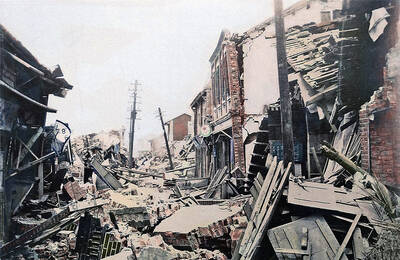
April 15 to April 21 Yang Kui (楊逵) was horrified as he drove past trucks, oxcarts and trolleys loaded with coffins on his way to Tuntzechiao (屯子腳), which he heard had been completely destroyed. The friend he came to check on was safe, but most residents were suffering in the town hit the hardest by the 7.1-magnitude Hsinchu-Taichung Earthquake on April 21, 1935. It remains the deadliest in Taiwan’s recorded history, claiming around 3,300 lives and injuring nearly 12,000. The disaster completely flattened roughly 18,000 houses and damaged countless more. The social activist and

Over the course of former President Ma Ying-jeou’s (馬英九) 11-day trip to China that included a meeting with Chinese Communist Party (CCP) leader Xi Jinping (習近平) a surprising number of people commented that the former president was now “irrelevant.” Upon reflection, it became apparent that these comments were coming from pro-Taiwan, pan-green supporters and they were expressing what they hoped was the case, rather than the reality. Ma’s ideology is so pro-China (read: deep blue) and controversial that many in his own Chinese Nationalist Party (KMT) hope he retires quickly, or at least refrains from speaking on some subjects. Regardless


 RSS
RSS