


Humans and apes separated about 6 million years ago, and ever since then humans have been careering down an evolutionary path all their own. Lucky for us, bits of bones dropped along the way became fossilized, and these remains tell much about the physical evolution of the creatures that eventually became modern humans.
Harder to follow is the path of our behavior. No one really knows what early humans acted like, who they interacted with or what kind of social groups they preferred, and so the lifestyle of our ancient ancestors is only a guess. This part of our history is so up for grabs that there is lots of room for speculation by polymaths curious enough to read the mountain of anthropological literature and piece together a credible story of human behavioral evolution.

And why not? Anthropology has a long tradition of letting others look at the data. Authors like Robert Ardrey, Elaine Morgan, Carl Sagan and Jared Diamond, among many others, have all attempted to figure out where we came from and how we did it. Because no one could possibly be right -- we have no film from the Pleistocene and no written records of our ancient past to confirm or refute anything anyone says -- each account has merit and is worthy of discussion.
Leonard Shlain, a surgeon, is the latest to jump in with Sex, Time and Power, in which he makes a case for concentrating on women and their need for the mineral iron as the key to understanding our past. Women need high stores of iron, Shlain says, because they menstruate every month, become pregnant and nurse. In our evolutionary past the best way to restore depleted iron was to eat meat. But women were probably not hunters, and so they must have manipulated men with sexual favors to bring home a blood-soaked dinner. This manipulative move, Shlain suggests, then set into motion just about every aspect of human behavior.
The reproductive biology of women supposedly supports his account: Menstruation, with a blood loss excessive compared with that of other mammals, makes women crave meat. Women have also lost the usual advertisement of fertility -- heat -- and are always open to sex. Men, who have high levels of testosterone, which increases their sex drive, are then lured into hunting and sharing meat by the promise of continuous sex from these menstruating, sexy women. The trade is meat for sex and everyone wins as genes are passed down by the iron-rich women who produce healthy, intelligent babies.
The female lust for meat, Shlain suggests, is responsible for the evolution of much of human behavior, including intimate relations between men and women, foresight and puzzle solving, complex social interactions, different psychological moods between men and women, and any number of human traits that we now see in the best and worst of us.
Shlain's account is supported by endless references to every human biological and behavioral feature that has ever been written about; he certainly has an exhaustive reading list. But everything he suggests, except for the specific detail of a need for iron, has been said before, which gives his account an old-fashioned feel.
Meat for sex? We've been hearing about this since the 1960s. Men like sex and woman just want to make babies? Hasn't this been a party line since the 1950s? Even Shlain's enthusiasm for women as the prime movers of humanity (but thanks for thinking of us) comes off as dated given that female anthropologists like Sarah Blaffer Hrdy, Helen Fisher, Alison Jolly and many others have been writing about this for years.
Shlain should know that the feminist revolution reached into anthropology more than 30 years ago and no one now doubts that women were big-time players in evolution. To suggest that women should have their own genus name, Gyno sapiens, seems not only dated, but a bit silly.
There are also some telling mistakes that undermine his thesis. For example, the human brain did not suddenly expand 150,000 years ago with the appearance of modern humans, but about 1.5 million years ago, when brain size doubled for the first time and then continued to do so. The idea that menstruating women figured out the monthly calendar is also off because women without birth control who are pregnant or lactating rarely have periods, and in any case, many cultures do not follow a monthly calendar.
Shlain also seems to believe that there is a purposeful trajectory of human evolution that landed us here as masters of the universe. Evolution is a much more zigzagging, messy process, and our history, like that of all animals, is fraught with mistakes and dead ends. Thinking that human evolution was guided along by women toward some clean and neat end is just wrong.
Shlain also pushes too far when he waxes lyrical from iron to the development of language, homosexuality, death, laughter, art, incest, fatherhood and patriarchy. Yes, human behavior is complex, but is it really necessary to speculate on every single human behavior and assume they all make evolutionary sense? In the end, the message about iron, which is an interesting tidbit, is lost in Shlain's need to impress the reader with his wide-reaching intellect.
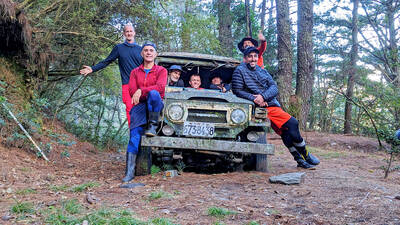
The year was 1991. A Toyota Land Cruiser set out on a 67km journey up the Junda Forest Road (郡大林道) toward an old loggers’ camp, at which point the hikers inside would get out and begin their ascent of Jade Mountain (玉山). Little did they know, they would be the last group of hikers to ever enjoy this shortcut into the mountains. An approaching typhoon soon wiped out the road behind them, trapping the vehicle on the mountain and forever changing the approach to Jade Mountain. THE CONTEMPORARY ROUTE Nowadays, the approach to Jade Mountain from the north side takes an

Last week Joseph Nye, the well-known China scholar, wrote on the Australian Strategic Policy Institute’s website about how war over Taiwan might be averted. He noted that years ago he was on a team that met with then-president Chen Shui-bian (陳水扁), “whose previous ‘unofficial’ visit to the US had caused a crisis in which China fired missiles into the sea and the US deployed carriers off the coast of Taiwan.” Yes, that’s right, mighty Chen caused that crisis all by himself. Neither the US nor the People’s Republic of China (PRC) exercised any agency. Nye then nostalgically invoked the comical specter

Relations between Taiwan and the Czech Republic have flourished in recent years. However, not everyone is pleased about the growing friendship between the two countries. Last month, an incident involving a Chinese diplomat tailing the car of vice president-elect Hsiao Bi-khim (蕭美琴) in Prague, drew public attention to the People’s Republic of China’s (PRC) operations to undermine Taiwan overseas. The trip was not Hsiao’s first visit to the Central European country. It was meant to be low-key, a chance to meet with local academics and politicians, until her police escort noticed a car was tailing her through the Czech capital. The
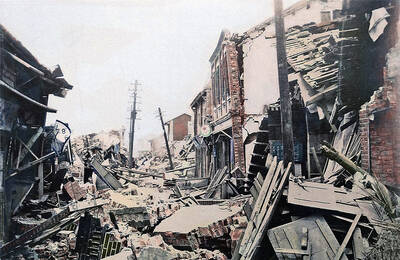
April 15 to April 21 Yang Kui (楊逵) was horrified as he drove past trucks, oxcarts and trolleys loaded with coffins on his way to Tuntzechiao (屯子腳), which he heard had been completely destroyed. The friend he came to check on was safe, but most residents were suffering in the town hit the hardest by the 7.1-magnitude Hsinchu-Taichung Earthquake on April 21, 1935. It remains the deadliest in Taiwan’s recorded history, claiming around 3,300 lives and injuring nearly 12,000. The disaster completely flattened roughly 18,000 houses and damaged countless more. The social activist and


 RSS
RSS