


"All most of us want to do is live our lives in peace, have our children, buy our houses, pay off our loans, play our sports, go on holiday. Few of us seek conflict. Who wants to see their cities bombed, their countries ravaged and their families killed? Surely it's a matter of common sense. So why did we do it?"
These are the last words of this frightening new novel. They're spoken by an international agent of Cuban-Scottish descent who's become a kind of hero. It's not giving anything away to quote them because they're there to be read in any bookstore. But everything that precedes them in this story is an attempt to answer that final question.This is not a book to cheer anyone up.
Its author is more aware than most of the horrors even the smallest of wars unleashes, let alone the nuclear one featured in his book. Nevertheless, his highly realistic appraisal of international relations, and especially in the Asia region, makes this imaginary story of future tragedy all too credible.
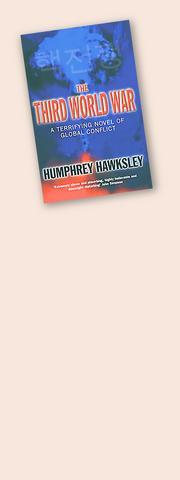
India and Pakistan stumble into war. Meanwhile conflict is also breaking out on the Korean peninsula. The North fires a missile at a US base in Japan killing 58 Americans, and in the border village of Panmunjom a South Korean lieutenant fires three shots into the head of his opposing counterpart, and then starts walking northwards.
The novel is set in the future, but it's meant to be a future not so very distant. China's president, Jamie Song, is an ex-law student from Harvard, a suave diplomat and businessman who speaks witty, idiomatic English.
The leaders of Pakistan and India are old friends, at least until the former is assassinated and the latter caught up in a devastating attack on the parliament building in Delhi. Scotland is voting on whether to part from the UK, there's been a coup in Brunei, and someone has broken into a key virology lab in Australia. Cuba, Russia and China are also inevitably involved. Most of the modern threats to peace and prosperity, in other words, make an appearance.
The frightening thought this book provokes is that in reality only half of them, if they were to happen simultaneously, could be more than enough to trigger a global catastrophe.
In this book a crisis develops just about everywhere in Asia where there could be one -- India and Pakistan, the two Koreas, the Philippines. Taiwan, remarkably, features in only a minor way when China launches an attack after just about every other highly armed state has already done so somewhere else. How do you make a political thriller like this come to life?
The method this author opts for is detail -- to have the Indian prime minister's daughter wear jeans and trainers and, while chatting on the phone to the US president's daughter, turn and ask her father if he'd like a word with her friend's dad; have a rebel in the southern Philippines concerned about his notebook's hard disk, and have the US president himself sniff the smell of spicy seafood wafting out of his National Security Advisor's wife's kitchen. Detail is all, and plenty of it almost guarantees that any book will ring true.
But when it's military or political detail, you'd better be sure you're getting it right. The fact that Hawksley does, as far as we can tell, get it right -- he is, after all, one of the BBC's most senior foreign correspondents -- makes this book even more terrifying as a credible scenario than it would otherwise have been.
The only problem with this novel is that you quickly come to suffer from overload. Just about every current threat to peace in the Asia-Pacific region is brought into play somewhere in the novel, and the world reels into disaster with all the great Asian themes playing at full volume.
In one sense this book is simply a fast-paced political thriller, setting out to frighten the reader with its jigsaw of international rivalries, strikes and counter-strikes.
But it does have a serious aspect to it as well.
What really fascinates, and appalls the author can be seen from the way he makes the various world leaders almost all admirable, amiable and well-intentioned. China's head of state is an international sophisticate, Britain's a congenial, hard-working modern statesman, America's a good-natured optimist. Pakistan's and India's leaders are old friends. Yet despite this, the world finally collapses into devastation on every hand.
What Hawksley is saying, then, is that good intentions aren't enough. If the weapons are there, some dark force moving in human society may see them triggered. It's not that some atavistic savagery in the human heart will surface. It's rather that combinations of events, strategies already put in place in research papers and blueprints, will -- or could -- combine to out-maneuver statesmen conscientiously working for cooperation, harmony and peace.
It's not "evil" in the old sense that may prevail, but an irreversible logic built into political systems in conflict-free times, things people never seriously contemplated ever being put into practice.
Humphrey Hawksley's previous fictional successes -- Dragon Fire and (with Simon Holberton) Dragon Strike -- have featured China. Here he has specialist knowledge, having set up the BBC's first TV bureau in the country in 1994.
Is there a lighter side to this new novel? Yes, occasionally. Hawksley's insider knowledge as a political journalist is said to be legendary. As a result some details simply astonish. One out of many concerns the domestic arrangements in 10, Downing Street, the British prime minister's office and official London home. It is, Hawksley speculates, probably the only head-of-state's residence in the world where the occupant and his wife have to do their own washing-up.
This book's underlying assumption, then, is that we're even now living on the edge of disaster. Whether this is in actual fact true is more or less anybody's guess.

In late October of 1873 the government of Japan decided against sending a military expedition to Korea to force that nation to open trade relations. Across the government supporters of the expedition resigned immediately. The spectacle of revolt by disaffected samurai began to loom over Japanese politics. In January of 1874 disaffected samurai attacked a senior minister in Tokyo. A month later, a group of pro-Korea expedition and anti-foreign elements from Saga prefecture in Kyushu revolted, driven in part by high food prices stemming from poor harvests. Their leader, according to Edward Drea’s classic Japan’s Imperial Army, was a samurai

Located down a sideroad in old Wanhua District (萬華區), Waley Art (水谷藝術) has an established reputation for curating some of the more provocative indie art exhibitions in Taipei. And this month is no exception. Beyond the innocuous facade of a shophouse, the full three stories of the gallery space (including the basement) have been taken over by photographs, installation videos and abstract images courtesy of two creatives who hail from the opposite ends of the earth, Taiwan’s Hsu Yi-ting (許懿婷) and Germany’s Benjamin Janzen. “In 2019, I had an art residency in Europe,” Hsu says. “I met Benjamin in the lobby
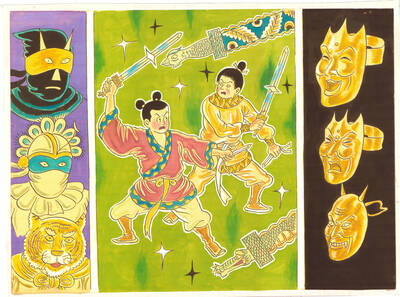
April 22 to April 28 The true identity of the mastermind behind the Demon Gang (魔鬼黨) was undoubtedly on the minds of countless schoolchildren in late 1958. In the days leading up to the big reveal, more than 10,000 guesses were sent to Ta Hwa Publishing Co (大華文化社) for a chance to win prizes. The smash success of the comic series Great Battle Against the Demon Gang (大戰魔鬼黨) came as a surprise to author Yeh Hung-chia (葉宏甲), who had long given up on his dream after being jailed for 10 months in 1947 over political cartoons. Protagonist

Peter Brighton was amazed when he found the giant jackfruit. He had been watching it grow on his farm in far north Queensland, and when it came time to pick it from the tree, it was so heavy it needed two people to do the job. “I was surprised when we cut it off and felt how heavy it was,” he says. “I grabbed it and my wife cut it — couldn’t do it by myself, it took two of us.” Weighing in at 45 kilograms, it is the heaviest jackfruit that Brighton has ever grown on his tropical fruit farm, located


 RSS
RSS