


Hot describes not only the record-breaking temperatures we have had this summer, but also the sultry dancers of the Brasil Tropical Carnival.
After attracting animated crowds on the streets of Taichung last weekend, the group is bringing its dance extravaganza to indoor venues in Kaoshiung and Taipei this weekend before spreading the festive atmosphere to other parts of Taiwan.

Even before its samba dancers took to the streets of Taichung, however, their performances caused a heated debate over whether roughly one third of the program, in which dancers go topless, should make it a restricted show.

PHOTO: VICO LEE, TAIPEI TIMES
Although all performance arts programs showing topless performers are still categorized as "restricted," the Ministry of Education has announced that an audience under 18 years of age may attend Brasil Tropical Carnival in the company of an adult.
"The Brasil Tropical dancers do not bare their breasts for the sake of nakedness but as one of the many costumes they wear to represent the spirit of the dance," said Hsu Bo-yun (許博
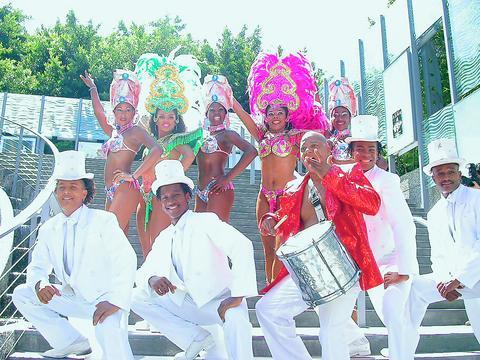
PHOTO: VICO LEE, TAIPEI TIMES
Brasil Tropical Carnival boasts an
extravagant line-up of 10 musicians, 19 singers and 27 dancers, who share over 400 sets of eye-catching costumes. Most of the performers started performing in the annual Samba Parade competition and various carnivals around Brazil. With the group, they have toured the world extensively, especially in Western Europe.
Edvaldo Carneiro, who founded the troupe over 30 years ago, used to enter the capoeira dance competition in Salvador, the capital of Bahia state, and won the top prize, or camisa, which became Carneiro's nickname. Originating in Africa, the manly dance requires power, quickness and acrobatic skills.
With a group of other capoeira enthusiasts, Carneiro has tried to create a song and dance show encompassing the different traditions in various parts of Brazil. Teaming up with rising choreographic talent Domingos Campos (a winner in the South American choreographer category of the Latin American Dance Festival), Carneiro gave birth to Brasil Tropical Carnival.
The most prominent part of the group's repertoire is the religion-influenced dances of Bahia and Salvador. The Afro-Brazilian ritual of candomble, in which Bahians pay tribute to the gods with a mysterious show of fervent drumming, singing and dancing.
The first half of the show will dramatize the young Edvaldo Carneiro's acquaintance with like-minded dancers on the streets of Salvador and go on to showcase the macumba dance, a religious ritual dance among African Brazilians. The timbalada and tamancos dance styles will also be showcased.
Male dancers will then stage a choreographed capoeira "fight" dance, at the climax of which female dancers ease the belligerent atmosphere with a seductive form of samba.
The history of black slavery will be dramatized in "Fim de Semana," which opens the second half of the show with gleeful miners drumming with hammers and spades. "Fantasias" will be the wildest part of the show, where dancers in extravagant costumes will relive the carnivals in different Brazilian cities.
Costumes are a major attraction of the show. Many of the 400 costumes are decked with real plumes from rare species indigenous to Brazil.
"What is characteristic of Bahia is bikinis. The dress represents a culture closely related to the sea and the beach. Male dancers don white suits to set off the glamor of the female dancers' glamourous dresses. It's also an arrangement which represents the historical interaction between European cultural influences on Brazil," said Lee, a major male dancer with the group.
Although male dancers' costumes are meant to play a supporting role to the female dancers, their dancing is not.
"Part of the samba style emphasizes the passionate shaking movements of the female dancers but there are also moments when the energetic movements of the male dancers come to the fore.
"Usually the male dancers are equally admired," Lee said.
Samba bikini costumes were originally meant to ease the movements of the dancers in the west African religious ritual. Excitedly twisting and shaking one's body was a way to express piety to the gods.
Later, the Brazilian women wore elaborate headdresses, a Bahian tradition, to increase the effect of movements. During carnivals, female dancers competed for attention with more and more conspicuous accessories, like the large sleeves and hoop earrings, which glitter in dazzling pinks, reds or greens.
At the performance, female dancers will also get in elaborate tie-knot and bead-stringed bikinis.
"Each of the costumes represents the tradition of one region of Brazil. The breasts-baring costume, for example, comes from the culture of the Amazon rain forest," said Maya, a major female dancer with the group.
Beaming, with her long, thick hair and, she said, natural eyelashes, Maya radiated charm as she displayed her bright green plume-adorned headdress and bikini, luxuriously fringed with long strings of beads, while standing in a pair of gold and silver high-heels, at a rehearsal last week in Taipei.
She and the other dancers' overwhelming charisma and contagious vivacity will surely make Brasil Tropical Carnival one of the most popular events this summer.
For your information:
■ Brasil Tropical Carnival will perform at Chih-de Hall (
■ Tainan Municipal Culture Center (
■ Tickets range from NT$500 to NT$1500 for Taoyuan shows and from NT$500 to NT$2500 for all other venues. Tickets are available at Era ticketing outlets.
■ For more information, call New Aspect at (02) 27093788.

In late October of 1873 the government of Japan decided against sending a military expedition to Korea to force that nation to open trade relations. Across the government supporters of the expedition resigned immediately. The spectacle of revolt by disaffected samurai began to loom over Japanese politics. In January of 1874 disaffected samurai attacked a senior minister in Tokyo. A month later, a group of pro-Korea expedition and anti-foreign elements from Saga prefecture in Kyushu revolted, driven in part by high food prices stemming from poor harvests. Their leader, according to Edward Drea’s classic Japan’s Imperial Army, was a samurai

Located down a sideroad in old Wanhua District (萬華區), Waley Art (水谷藝術) has an established reputation for curating some of the more provocative indie art exhibitions in Taipei. And this month is no exception. Beyond the innocuous facade of a shophouse, the full three stories of the gallery space (including the basement) have been taken over by photographs, installation videos and abstract images courtesy of two creatives who hail from the opposite ends of the earth, Taiwan’s Hsu Yi-ting (許懿婷) and Germany’s Benjamin Janzen. “In 2019, I had an art residency in Europe,” Hsu says. “I met Benjamin in the lobby
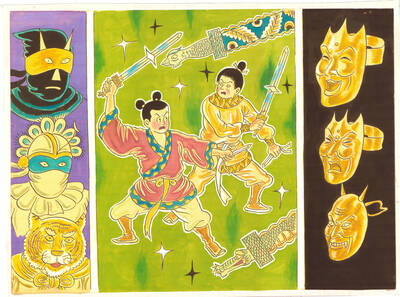
April 22 to April 28 The true identity of the mastermind behind the Demon Gang (魔鬼黨) was undoubtedly on the minds of countless schoolchildren in late 1958. In the days leading up to the big reveal, more than 10,000 guesses were sent to Ta Hwa Publishing Co (大華文化社) for a chance to win prizes. The smash success of the comic series Great Battle Against the Demon Gang (大戰魔鬼黨) came as a surprise to author Yeh Hung-chia (葉宏甲), who had long given up on his dream after being jailed for 10 months in 1947 over political cartoons. Protagonist

A fossil jawbone found by a British girl and her father on a beach in Somerset, England belongs to a gigantic marine reptile dating to 202 million years ago that appears to have been among the largest animals ever on Earth. Researchers said on Wednesday the bone, called a surangular, was from a type of ocean-going reptile called an ichthyosaur. Based on its dimensions compared to the same bone in closely related ichthyosaurs, the researchers estimated that the Triassic Period creature, which they named Ichthyotitan severnensis, was between 22-26 meters long. That would make it perhaps the largest-known marine reptile and would


 RSS
RSS