


From Bill Gates to Tony Blair, most of India's celebrity visitors make a stop at the country's high-technology crown, the once-sleepy garden city of Bangalore.
During those visits, the government of southern Karnataka state regulates traffic and keeps the power running in its capital city. Bangalore runs smoothly enough to win more investment and jobs.
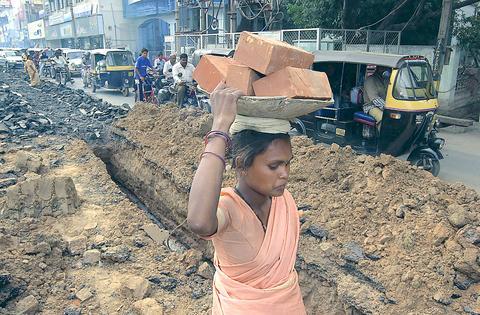
PHOTO: AP
But when the guests are gone, Bangalore's highly skilled workers navigate potholed roads and idle through hours of traffic to reach homes that lack enough water to cook and bathe. When power goes out, evenings pass with no computers or even fans to drive off mosquitoes.
``A lot of [technological] investment has taken place in the recent years, but quality of life has not improved,'' said Vinay Baindur, who coordinates Civic, an advocacy group for better roads, water and power. ``Authorities don't seem to have the capacity to plan and manage this growth.''
For a software industry that has brought US$2 billion a year in revenue to the city of 5.5 million people, poor roads mean delays and lost productivity. Technologists see their earning potential vanish in the traffic.
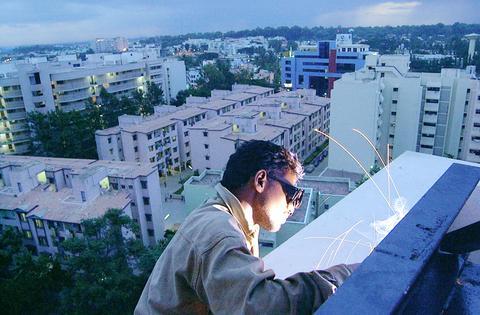
Though most companies have their own generators to keep operating during power outages, buying and fueling them eat into profits.
One company, Wipro, has given up on expanding its outsourcing businesses in Bangalore.
``It is embarrassing when there are four power cuts during one hour of discussion with clients,'' said Azim Premji, Wipro's head and India's richest man.
Premji even threatened a sit-in -- a time-tested political tactic in India -- to force the state government to improve infrastructure.
The response: a task force to study infrastructure needs around Wipro's offices, which visitors reach by navigating more than one kilometer of a narrow, potholed road.
Government officials insist Bangalore is not losing business.
``You have pockets of excellence where infrastructure is very good,'' said Vivek Kulkarni, the senior bureaucrat in Karnataka's Information Technology Department. ``When prosperity increases, these facilities will expand.''
As for electricity reliability, Kulkarni said: ``Power problems affect the common people. Technology companies make their own arrangements, so their business is not affected.''
When infrastructure came up at a recent meeting, Karnataka's top elected official, Chief Minister Krishna, said, ``I am not going to be apologetic.''
But the top federal appointee in the government, Governor T. N. Chaturvedi, responded at the meeting by asking Krishna to take the complaints seriously.
Studies seem to be the state government's standard reaction to complaints.
The government announced in 1992 that it would build an international airport in Bangalore. Currently, 25 international flights a week fly through a cramped domestic terminal.
``The government has planned for several years, but not even broken ground on the project,'' said Kiran Karnik, president of India's National Association of Software and Service Companies. Infrastructure projects are talked about, but ``they take forever'' to get started.
Business leaders want a bigger airport to permit more international flights. So far, only Air India operates direct flights to the US -- a handicap for a city that earns two-thirds of its software income from the US and houses Microsoft, Oracle, Intel and Yahoo.
``The lack of sufficient direct flights into Bangalore causes many business travelers to avoid Bangalore,'' said Anees Ahmed, head of Mistral Software, a Bangalore-based company.
Some officials blame infrastructure problems on a rapid population increase that came with the booming job market. Bangalore's population grew 42 percent between 1981 and 2001.
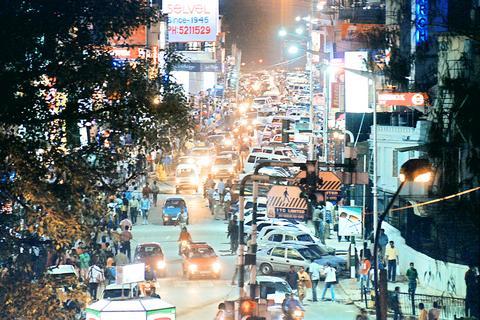
Without a functioning public transportation system, Bangalore's citizens rely on motor scooters and unbalanced, three-wheeled motorized rickshaws. They are also buying more cars, adding to the 1.8 million vehicles that already jam roads.
Baindur, of the Civic group, said the city's newly built highway bridges and circular roads -- meant to bypass traffic congestion points -- were badly planned and ended up creating jams at crossroads. Wider routes lead to narrow ones, where traffic gets choked.
Meanwhile, digging by telephone companies and battering by rains create potholes that don't get patched. Widening roads and creating additional parking spaces narrow sidewalks, where overflowing garbage cans and drainage pipes already reduce space for pedestrians.
Despite the city's high-tech reputation, technological infrastructure can also be lacking.
Visitors to conventions and exhibitions find breakdowns in Internet service, scarcity of telephones and power outages at the media centers.
At the national air show this February -- held at Bangalore's small airport -- 300 journalists were accredited, but officials provided only four computers. On the day French Prime Minister Jean-Pierre Raffarin was the chief guest, Internet facilities at the media center failed.
With a population of 53 million, Karnataka state has only about 6,000 megawatts of power generation capacity, or 1,200 megawatts less than what it needs. Karnataka depends on hydroelectric power stations, which don't have enough water in the summer.
California has 10 times the electric capacity for its 35 million people, leading to questions about whether Bangalore can justify its claims to be the ``Silicon Valley of India.''
``From the infrastructure viewpoint,'' Baindur said, ``you can't.''
On the Net:
Bangalore's IT department: http://www.bangaloreit.com

In late October of 1873 the government of Japan decided against sending a military expedition to Korea to force that nation to open trade relations. Across the government supporters of the expedition resigned immediately. The spectacle of revolt by disaffected samurai began to loom over Japanese politics. In January of 1874 disaffected samurai attacked a senior minister in Tokyo. A month later, a group of pro-Korea expedition and anti-foreign elements from Saga prefecture in Kyushu revolted, driven in part by high food prices stemming from poor harvests. Their leader, according to Edward Drea’s classic Japan’s Imperial Army, was a samurai

Located down a sideroad in old Wanhua District (萬華區), Waley Art (水谷藝術) has an established reputation for curating some of the more provocative indie art exhibitions in Taipei. And this month is no exception. Beyond the innocuous facade of a shophouse, the full three stories of the gallery space (including the basement) have been taken over by photographs, installation videos and abstract images courtesy of two creatives who hail from the opposite ends of the earth, Taiwan’s Hsu Yi-ting (許懿婷) and Germany’s Benjamin Janzen. “In 2019, I had an art residency in Europe,” Hsu says. “I met Benjamin in the lobby

April 22 to April 28 The true identity of the mastermind behind the Demon Gang (魔鬼黨) was undoubtedly on the minds of countless schoolchildren in late 1958. In the days leading up to the big reveal, more than 10,000 guesses were sent to Ta Hwa Publishing Co (大華文化社) for a chance to win prizes. The smash success of the comic series Great Battle Against the Demon Gang (大戰魔鬼黨) came as a surprise to author Yeh Hung-chia (葉宏甲), who had long given up on his dream after being jailed for 10 months in 1947 over political cartoons. Protagonist

Peter Brighton was amazed when he found the giant jackfruit. He had been watching it grow on his farm in far north Queensland, and when it came time to pick it from the tree, it was so heavy it needed two people to do the job. “I was surprised when we cut it off and felt how heavy it was,” he says. “I grabbed it and my wife cut it — couldn’t do it by myself, it took two of us.” Weighing in at 45 kilograms, it is the heaviest jackfruit that Brighton has ever grown on his tropical fruit farm, located


 RSS
RSS