


The National Museum of History is offering up a frustrating and fascinating exhibit of old maps of Taiwan. Frustrating because, for English-reading visitors, there is scant information provided regarding the various materials on display. Fascinating because Taiwan's history of colonization has seen it redrawn in a different light countless times.
First a warning; if you must rely on the few English-language signs provided in the exhibit, your understanding of the materials will be hobbled by the fact that the signage is insufficient, contains glaring grammatical errors and tells you little of value about what you'll see.
From the moment you read the first sentence upon entering the exhibit -- "A map is a sign language the [sic] makes a record of one's environment" -- it becomes apparent that the museum's decision to provide English-language information was an afterthought at best ... and poorly executed at that.
But the incompetence isn't found only in the exhibition, it also scars an otherwise enjoyable book that the museum staff has compiled to accompany the exhibit. Again the English-language material provided is insufficient, impenetrable given the amount of errors it contains and mind-numbingly uninformative.
"Among myriads of the examples in Taiwan, [coal] is typical example of Taiwanese local product. After viewing these maps, it seems apparent that Taiwan truly is a `BAU-DAU,' this is the Standard Ping Ying that is a treasure island."
This is only one poor passage among myriads of examples.

COURTESY OF NATIONAL MUSEUM OF HISTORY
If you don't need to rely on the English-language signage provided, you'll instead find a fascinating exhibit divided into three parts; history, culture and resources. The history section is interesting insofar as it has few to no maps of Taiwan drawn by native Taiwanese.
Instead, it offers a panorama of perspectives of the island's many colonizers, from the Portuguese, Dutch, Japanese and the KMT.
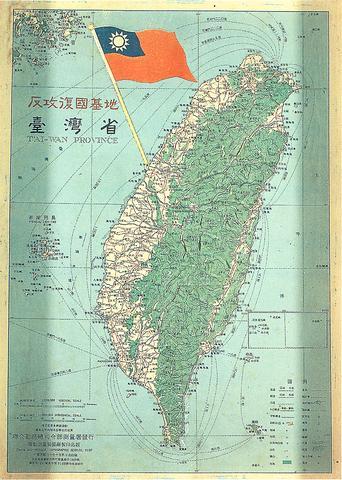
While all the earlier maps show Taiwan faded various shades of sepia, a more colorful latter map hangs in the corner. It's not a map of Taiwan per se, but the KMT's map of it's territory in 1951.
The top border of the document asks: "How much of our land have Russian pirates stolen?" while the bottom border rallies people to "Oppose
communism, oppose Russia! Take back our country!"
Taiwan, relegated to the bottom corner of the map, has a giant Republic of China flag stuck in it and bears the label "ROC base for opposing communism and Russia."
Of the various perspectives of what Taiwan is, this map piqued people the most. One visitor's comment raised the eyebrows of all those around him and seemed to sum up the exhibition: "All these maps and we still don't know where we are."
Beautiful Island -- An Exhibition of Old Taiwanese Maps and Life is on display at the National Museum of History, located at 49, Nanhai Rd, Taipei (
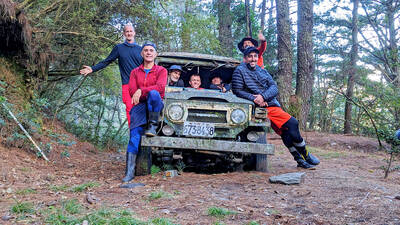
The year was 1991. A Toyota Land Cruiser set out on a 67km journey up the Junda Forest Road (郡大林道) toward an old loggers’ camp, at which point the hikers inside would get out and begin their ascent of Jade Mountain (玉山). Little did they know, they would be the last group of hikers to ever enjoy this shortcut into the mountains. An approaching typhoon soon wiped out the road behind them, trapping the vehicle on the mountain and forever changing the approach to Jade Mountain. THE CONTEMPORARY ROUTE Nowadays, the approach to Jade Mountain from the north side takes an

Last week Joseph Nye, the well-known China scholar, wrote on the Australian Strategic Policy Institute’s website about how war over Taiwan might be averted. He noted that years ago he was on a team that met with then-president Chen Shui-bian (陳水扁), “whose previous ‘unofficial’ visit to the US had caused a crisis in which China fired missiles into the sea and the US deployed carriers off the coast of Taiwan.” Yes, that’s right, mighty Chen caused that crisis all by himself. Neither the US nor the People’s Republic of China (PRC) exercised any agency. Nye then nostalgically invoked the comical specter

Relations between Taiwan and the Czech Republic have flourished in recent years. However, not everyone is pleased about the growing friendship between the two countries. Last month, an incident involving a Chinese diplomat tailing the car of vice president-elect Hsiao Bi-khim (蕭美琴) in Prague, drew public attention to the People’s Republic of China’s (PRC) operations to undermine Taiwan overseas. The trip was not Hsiao’s first visit to the Central European country. It was meant to be low-key, a chance to meet with local academics and politicians, until her police escort noticed a car was tailing her through the Czech capital. The
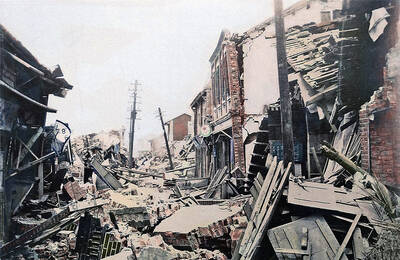
April 15 to April 21 Yang Kui (楊逵) was horrified as he drove past trucks, oxcarts and trolleys loaded with coffins on his way to Tuntzechiao (屯子腳), which he heard had been completely destroyed. The friend he came to check on was safe, but most residents were suffering in the town hit the hardest by the 7.1-magnitude Hsinchu-Taichung Earthquake on April 21, 1935. It remains the deadliest in Taiwan’s recorded history, claiming around 3,300 lives and injuring nearly 12,000. The disaster completely flattened roughly 18,000 houses and damaged countless more. The social activist and


 RSS
RSS